
Ford's 4.4 Million Vehicle Recall Reveals Industry's Hidden Crisis
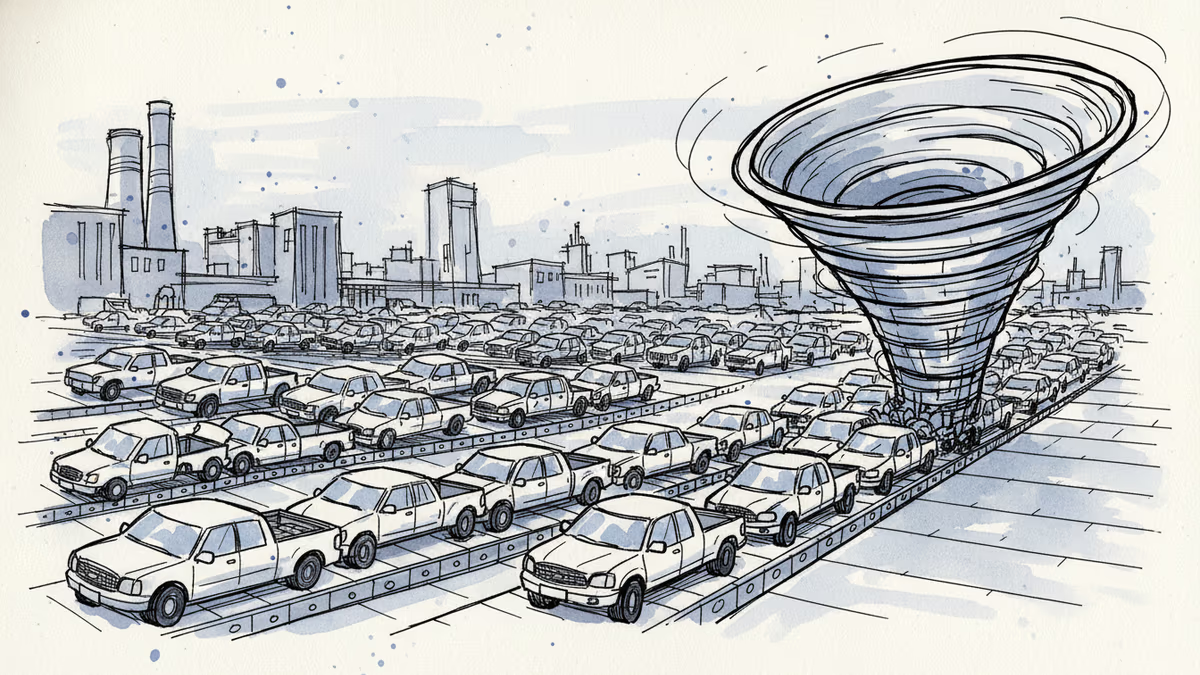
Ford set a record with 152 recalls last year. The latest 4.4 million vehicle recall exposes deeper issues plaguing the modern automotive industry.
152 recalls in a single year. That's Ford's new industry record for 2025—nearly double GM's previous high from 2014. During the same period, Tesla issued just 11. The numbers tell a story that goes far beyond quality control.
More than 24 million vehicles were recalled in the US last year, with 13 million of them wearing Ford or Lincoln badges. Now Ford's latest recall affects 4.4 million trucks, vans, and SUVs, including 2.3 million F-150s alone.
When Software Meets Steel
This isn't your grandfather's automotive industry. Today's vehicles contain over 100 electronic control units and more than 100 million lines of code—making them more complex than smartphones, yet expected to operate flawlessly for decades on public roads.
The affected models span Ford's entire lineup: Maverick (2022-2026), Ranger (2024-2026), Expedition (2022-2026), E-Transit (2026), F-150 (2021-2026), F-250 SD (2022-2026), and Lincoln Navigator (2022-2026). The breadth suggests this isn't an isolated manufacturing defect but something more systemic.
The Recall Paradox
Here's where it gets interesting: Ford's recall surge might actually indicate better safety practices, not worse ones. While competitors like Tesla issued fewer recalls, that doesn't necessarily mean their vehicles are safer—it might mean they're less transparent about problems.
Consumer advocates argue that frequent recalls erode trust. "Why should I buy a truck that'll spend half its life at the dealership?" they ask.
Ford executives counter that proactive recalls demonstrate responsibility. They'd rather over-communicate than hide problems and face lawsuits later.

Industry analysts see a deeper trend: as vehicles become software-defined, traditional quality metrics break down. A single over-the-air update can fix millions of vehicles instantly—or brick them just as quickly.
The Regulatory Tightrope
The National Highway Traffic Safety Administration faces an impossible choice. Penalize companies for transparency, and they'll hide problems. Ignore the recall surge, and public safety suffers. Meanwhile, automakers are caught between innovation pressure and liability concerns.
European regulators are watching closely. The EU's upcoming software liability framework could make American-style recall practices mandatory globally, forcing even reluctant manufacturers to be more transparent.
What This Means for Car Buyers
For consumers, Ford's recall record creates a dilemma. The F-150 remains America's best-selling truck, but its 2.3 million units in this latest recall represent nearly a year's worth of production. Should buyers avoid Ford entirely, or view frequent recalls as evidence of a company that takes safety seriously?
The financial implications are staggering. Each recall costs Ford an estimated $500-1,000 per vehicle in direct costs, not counting brand damage. That's potentially $2.2 billion for this recall alone.
The Bigger Picture
Ford's situation reflects the entire industry's struggle with complexity. As vehicles evolve from mechanical machines to rolling computers, the definition of "defect" expands exponentially. A software bug that affects lane-keeping assistance isn't just an inconvenience—it's a potential safety hazard requiring immediate action.
This shift challenges everything from manufacturing processes to customer expectations. In the smartphone world, users expect regular updates and occasional bugs. In automotive, the stakes are literally life and death.
Authors
Related Articles

Ford's new generative AI tool for commercial fleets turns vehicle data into plain-English recommendations. It's convenient—but who's really in control?
Ford pulls plug on F-150 Lightning after massive EV losses, pivoting to hybrids and smaller EVs. What this means for the auto industry's electric future.

Ford reveals its ambitious AI personalization strategy at CES 2026. Chief Officer Doug Field details a seamless intelligence layer that understands driver context.

Ford announces its roadmap for Level 3 autonomous driving by 2028, powered by the new UEV platform and in-house AI voice assistants.
Ford's new generative AI tool for commercial fleets turns vehicle data into plain-English recommendations. It's convenient—but who's really in control?
Ford pulls plug on F-150 Lightning after massive EV losses, pivoting to hybrids and smaller EVs. What this means for the auto industry's electric future.
Ford reveals its ambitious AI personalization strategy at CES 2026. Chief Officer Doug Field details a seamless intelligence layer that understands driver context.
Ford announces its roadmap for Level 3 autonomous driving by 2028, powered by the new UEV platform and in-house AI voice assistants.
Thoughts
Share your thoughts on this article
Sign in to join the conversation