
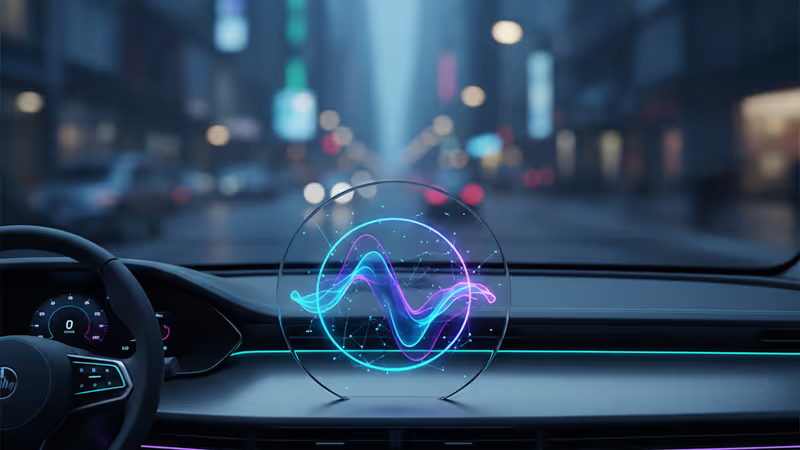
Ford to Debut Level 3 Autonomous Driving in 2028 via New UEV Platform
Ford announces its roadmap for Level 3 autonomous driving by 2028, powered by the new UEV platform and in-house AI voice assistants.
Ford's taking its eyes off the road—literally. By 2028, you won't just be hands-free; you'll be eyes-off. At CES 2026, Ford's top software executive revealed that the automaker is gearing up for a major shift toward Level 3 autonomous driving. According to reports from The Verge, this move is part of a broader strategy to integrate AI and in-house software to redefine the driving experience.
The Roadmap for Ford Level 3 Autonomous Driving 2028
The centerpiece of this vision is the Universal Electric Vehicle (UEV) platform, set to launch in 2027. This platform isn't just about going electric; it's designed to be more affordable and profitable. By 2028, Ford plans to introduce Level 3 autonomy on this platform, allowing drivers to legally take their eyes off the road under specific conditions. It's a massive leap from current driver-assist systems that require constant supervision.

AI Integration and In-House Tech
Before the self-driving revolution arrives, Ford is rolling out a new AI-powered voice assistant later this year. The company's doubling down on in-house development for its core technology. While Ford isn't building its own large language models or silicon chips, it's focusing on owning the software stack to reduce costs and maintain tighter control over the user ecosystem. This vertical integration is seen as vital for competing with tech-heavy rivals.
Authors
Related Articles
Auto China 2026 set records with 1,451 vehicles and 181 world premieres. But the real story isn't the size—it's how Chinese automakers stopped competing on price and started competing on brains.
Elon Musk confirmed on Tesla's Q1 2026 earnings call that Hardware 3 vehicles will never receive unsupervised Full Self-Driving — locking out millions who paid for the feature.
The Netherlands became the first European country to officially approve Tesla's FSD Supervised. With EU's type-approval framework, this could ripple across 27 member states fast.
Ford's new generative AI tool for commercial fleets turns vehicle data into plain-English recommendations. It's convenient—but who's really in control?
Auto China 2026 set records with 1,451 vehicles and 181 world premieres. But the real story isn't the size—it's how Chinese automakers stopped competing on price and started competing on brains.
Elon Musk confirmed on Tesla's Q1 2026 earnings call that Hardware 3 vehicles will never receive unsupervised Full Self-Driving — locking out millions who paid for the feature.
The Netherlands became the first European country to officially approve Tesla's FSD Supervised. With EU's type-approval framework, this could ripple across 27 member states fast.
Ford's new generative AI tool for commercial fleets turns vehicle data into plain-English recommendations. It's convenient—but who's really in control?
Thoughts
Share your thoughts on this article
Sign in to join the conversation