
Nuclear's Big Comeback Has a Dirty Secret
Nuclear power is winning fans across the political spectrum—and Big Tech is pouring billions in. But America still has no permanent home for the 2,000 metric tons of high-level waste its reactors produce every single year.
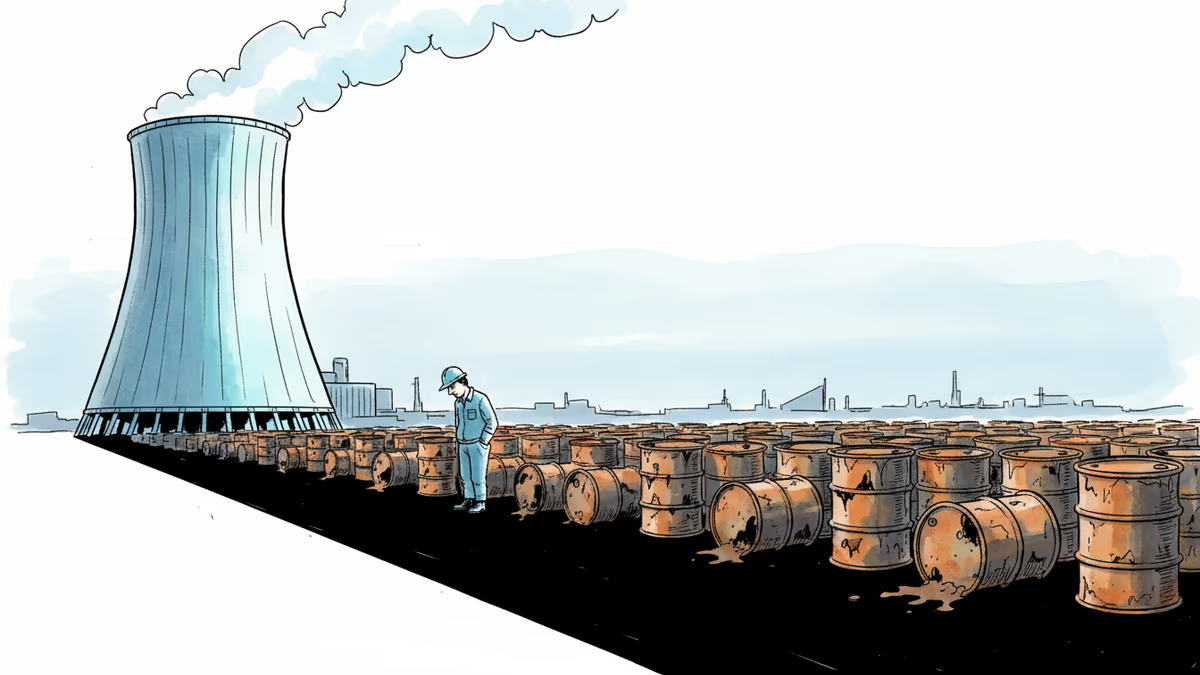
Somewhere on the grounds of a US nuclear plant, inside a steel-and-concrete dry cask that was never meant to last forever, sits waste that will remain radioactive for tens of thousands of years. There are more than 70 sites like this across the country. And every year, America's reactors add another 2,000 metric tons of high-level nuclear waste to the pile—with nowhere permanent to send it.
Nuclear energy is having a moment. The question is whether that moment is being built on an unresolved foundation.
The Comeback Nobody Expected
Five years ago, nuclear power looked like a sunset industry in the US—too expensive, too slow, too politically toxic. Then the AI boom happened. Microsoft, Google, and Amazon are now spending billions to secure round-the-clock, low-carbon electricity for data centers that consume power at a scale previously unimagined. Nuclear, which can run continuously regardless of weather, suddenly became the only realistic answer.
Public opinion has shifted with it. Nuclear approval ratings have climbed steadily, reaching a point of rare bipartisan consensus. The shuttered Three Mile Island reactor came back online. Plants scheduled for decommissioning got reprieves. Small modular reactor startups attracted a flood of venture capital.
But the more reactors run—and the more that get built—the more waste accumulates. And the US has not opened a single permanent high-level nuclear waste repository in its history.
Half a Century of 'Temporary'
This isn't a new problem. Congress designated Yucca Mountain in Nevada as the permanent disposal site back in 1987. After decades of legal battles and political resistance from Nevada, the Obama administration effectively killed the project in 2010. In the 15 years since, no alternative has been agreed upon.

The waste currently sits in dry casks at plant sites—engineered to be safe for decades, not millennia. It's a bit like storing a document you need to keep for 10,000 years in a filing cabinet rated for 50.
The contrast with other countries is instructive. Finland is already constructing Onkalo, the world's first permanent deep geological repository for high-level nuclear waste, carved 500 meters into bedrock. Sweden has approved a similar site. Both succeeded not just through engineering, but through decades of transparent, sustained engagement with local communities—something the US process conspicuously lacked.
Who Bears the Cost
The nuclear waste debate isn't only a technical one. Proposed disposal sites in the US have frequently been located near Indigenous communities or lower-income rural areas—raising questions about who absorbs the long-term burden of decisions made far away.
The industry's argument is straightforward: waste storage is a solvable engineering problem, and the climate math demands we solve it rather than abandon nuclear altogether. Some next-generation reactor designs claim to use existing waste as fuel, potentially reducing the stockpile. Proponents argue that paralysis on waste has become an excuse to block a technology the world urgently needs.
Environmental groups counter that expanding nuclear capacity before resolving waste disposal is precisely the wrong sequence—locking in a problem for future generations while the benefits flow to the present. The fact that Big Tech is now a primary driver of new nuclear demand adds a pointed edge to that argument: the companies whose AI products generate the electricity need are not the ones who will live next to a waste repository.
The Political Problem Technology Can't Solve
Every serious analysis of nuclear waste disposal eventually arrives at the same conclusion: the engineering is hard, but the politics is harder. Finding a geologically suitable site is a tractable scientific problem. Convincing a community to accept it is not.
The Biden administration made some moves toward restarting a consent-based siting process, and the current political environment—with nuclear enjoying support across the spectrum—may offer a window that hasn't existed in decades. But windows close.
The deeper irony is that the very enthusiasm driving nuclear's revival could make the waste problem worse before it gets better. More reactors, more waste, more urgency—and still no agreed destination.
This content is AI-generated based on source articles. While we strive for accuracy, errors may occur. We recommend verifying with the original source.
Related Articles

A U.S. nonprofit has petitioned the federal government to sanction China over shark finning. If upheld, it could trigger a ban on all Chinese seafood imports worth $1.5 billion annually.

Google's Gmail Live lets you ask your inbox questions out loud. Announced at I/O 2026, it's AI's pitch to skeptics — and a reminder of how much Google already knows about you.

OpenAI has reorganized for the second time in a month, merging ChatGPT and Codex into a single agentic platform under president Greg Brockman's unified product leadership.
AI sustainability researcher Sasha Luccioni is launching a new venture to push for energy transparency in AI. Here's why Big Tech keeps the numbers hidden—and what's starting to change.
A U.S. nonprofit has petitioned the federal government to sanction China over shark finning. If upheld, it could trigger a ban on all Chinese seafood imports worth $1.5 billion annually.
Google's Gmail Live lets you ask your inbox questions out loud. Announced at I/O 2026, it's AI's pitch to skeptics — and a reminder of how much Google already knows about you.
OpenAI has reorganized for the second time in a month, merging ChatGPT and Codex into a single agentic platform under president Greg Brockman's unified product leadership.
AI sustainability researcher Sasha Luccioni is launching a new venture to push for energy transparency in AI. Here's why Big Tech keeps the numbers hidden—and what's starting to change.
Thoughts
Share your thoughts on this article
Sign in to join the conversation