
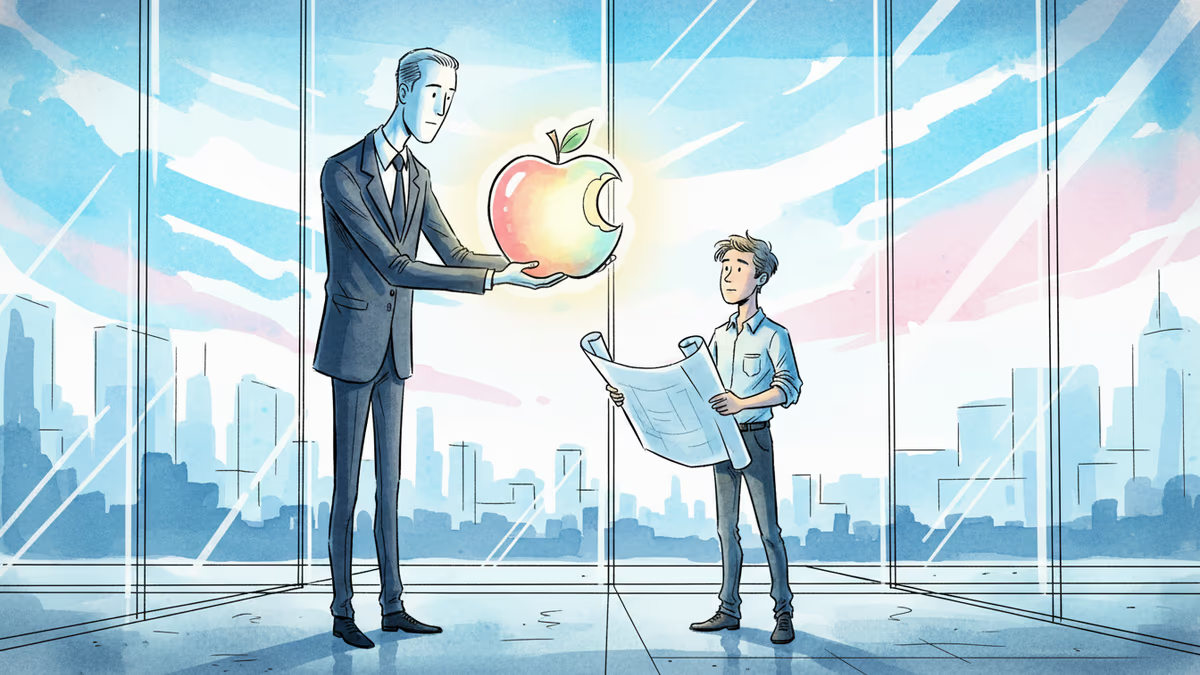
Tim Cook Is Out. What Apple Bets on Next.
After 14 years and a run that turned Apple into a $4 trillion company, Tim Cook steps down as CEO. Hardware chief John Ternus takes over September 1. Here's what changes—and what doesn't.
When Tim Cook took over Apple in 2011, the company was worth roughly $360 billion. He's leaving behind a $4 trillion one. That's not a typo—it's roughly the GDP of Germany.
And yet, the question the market is quietly asking right now isn't about the past. It's about whether the next chapter can be written by someone the world has barely heard of.
The Handoff
Apple announced Monday that Tim Cook will step down as CEO on September 1, handing the role to John Ternus, currently Senior Vice President of Hardware Engineering. Cook isn't disappearing—he moves to Executive Chairman, staying on the board. Arthur Levinson, who has served as non-executive chairman for 15 years, transitions to Lead Independent Director. Ternus joins the board simultaneously.
The transition has been expected for some time. But expected doesn't mean unremarkable. When Cook first got the title in August 2011, Steve Jobs died just six weeks later—before anyone had a real chance to see whether Apple without Jobs was even possible. The skeptics were loud. The assumption in Silicon Valley was almost universal: no one could follow a founder like Jobs, least of all a supply-chain operator from Alabama.
Cook spent the next 14 years making that assumption look foolish.
What Cook Actually Built
Here's the thing about Tim Cook: he was never hired to be a visionary. When he joined Apple in 1998, Jobs needed someone to fix a supply chain that was, by most accounts, a mess. Cook—who'd spent 12 years at IBM before stints at Compaq and Intelligent Electronics—closed warehouses, consolidated suppliers, and turned manufacturing from a liability into a competitive edge.
As CEO, he did something arguably harder than launching a revolutionary product: he built a business that doesn't depend on any single one. Apple Services now exceeds $100 billion annually. The Apple Watch held roughly 25% of global smartwatch sales last year. The company that once lived and died by the iPhone now has multiple revenue engines running in parallel.
There were stumbles. Apple Vision Pro—the mixed-reality headset Cook championed as the company's next great platform—landed with a thud. Consumers weren't lining up to pay several thousand dollars for a pound of glass and silicon strapped to their face. But one expensive miss doesn't rewrite a record that includes turning a struggling computer maker into the most valuable company on Earth.

Who Is John Ternus?
John Ternus is 51—almost exactly the age Cook was when he became CEO. He's a California native who studied mechanical engineering at Penn, competed on the varsity swim team, and graduated in 1997. After a brief stint designing VR headsets at a small firm called Virtual Research Systems, he joined Apple's product design team in 2001. He has spent virtually his entire career there.
His fingerprints are on most of what Apple ships. He was a key contributor to the original iPad and AirPods, has overseen countless generations of the iPhone, Mac, and Apple Watch, and led the team behind last fall's iPhone 17 lineup—including the new iPhone Air and the more affordable MacBook Neo. When AirPods evolved from headphones into an over-the-counter hearing health system, that was his team's work.
But the detail that may matter most going forward is this: Ternus has made durability and repairability a design priority. His team introduced new recycled aluminum compounds across multiple product lines and has pushed to extend device lifespans through advances in fixability. In an era when Right to Repair legislation is gaining ground across the US and Europe, that's not just an environmental talking point—it's a strategic position.
Why This Moment Is Complicated
The timing of this transition is genuinely tricky. Apple is navigating several pressure points at once.
On AI, the company has been conspicuously cautious. While OpenAI, Google, and Anthropic have been racing to ship, Apple Intelligence has rolled out slowly, with features delayed and expectations managed downward. Ternus is a hardware engineer by background—the question of whether he'll accelerate Apple's AI ambitions or approach them with the same methodical patience Cook applied to services is genuinely open.
On regulation, Apple faces antitrust scrutiny in the US and Europe over its App Store practices. The DOJ lawsuit over the iPhone's competitive moat isn't going away. Cook was a skilled Washington operator—his relationships with policymakers on multiple continents were a quiet but real asset. Ternus has no such track record yet.
On competition, Samsung and a resurgent wave of Chinese manufacturers are closing the hardware gap faster than many expected. The premium device market that Apple dominates is not guaranteed territory.
The Stakeholder Divide
For investors, the immediate read is cautious optimism. Cook's transition to Executive Chairman provides continuity, and Ternus is an insider who knows the product roadmap intimately. But markets generally don't love uncertainty at the top of a $4 trillion company, and the first earnings call under new leadership will be closely watched.
For developers and enterprise customers, the more relevant question is whether Apple's platform strategy—particularly around AI integration and App Store economics—will shift. Cook's Apple was famously consistent in its platform rules, for better and worse. Ternus hasn't signaled a direction here.
For consumers, the near-term impact is probably minimal. The products in the pipeline were designed under Cook's watch. What Ternus shapes will take years to reach store shelves. But his emphasis on repairability and longer device lifespans could, over time, change the calculus of when and why you upgrade your phone.
Authors
Related Articles
Google's Gmail Live lets you ask your inbox questions out loud. Announced at I/O 2026, it's AI's pitch to skeptics — and a reminder of how much Google already knows about you.
OpenAI has reorganized for the second time in a month, merging ChatGPT and Codex into a single agentic platform under president Greg Brockman's unified product leadership.
AI sustainability researcher Sasha Luccioni is launching a new venture to push for energy transparency in AI. Here's why Big Tech keeps the numbers hidden—and what's starting to change.
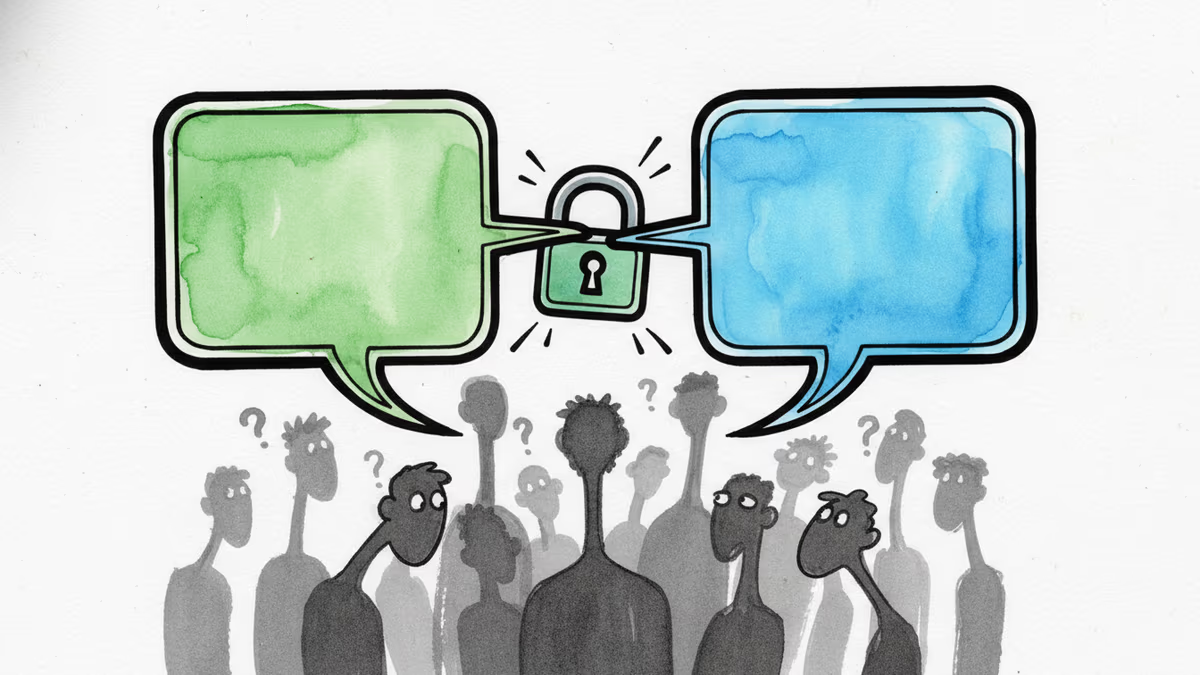
After 15 years of fragmented mobile messaging, Apple and Google are rolling out end-to-end encrypted RCS messaging between iPhones and Android devices. Here's what changed, why it took so long, and what it means for your privacy.
Google's Gmail Live lets you ask your inbox questions out loud. Announced at I/O 2026, it's AI's pitch to skeptics — and a reminder of how much Google already knows about you.
OpenAI has reorganized for the second time in a month, merging ChatGPT and Codex into a single agentic platform under president Greg Brockman's unified product leadership.
AI sustainability researcher Sasha Luccioni is launching a new venture to push for energy transparency in AI. Here's why Big Tech keeps the numbers hidden—and what's starting to change.
After 15 years of fragmented mobile messaging, Apple and Google are rolling out end-to-end encrypted RCS messaging between iPhones and Android devices. Here's what changed, why it took so long, and what it means for your privacy.
Thoughts
Share your thoughts on this article
Sign in to join the conversation