
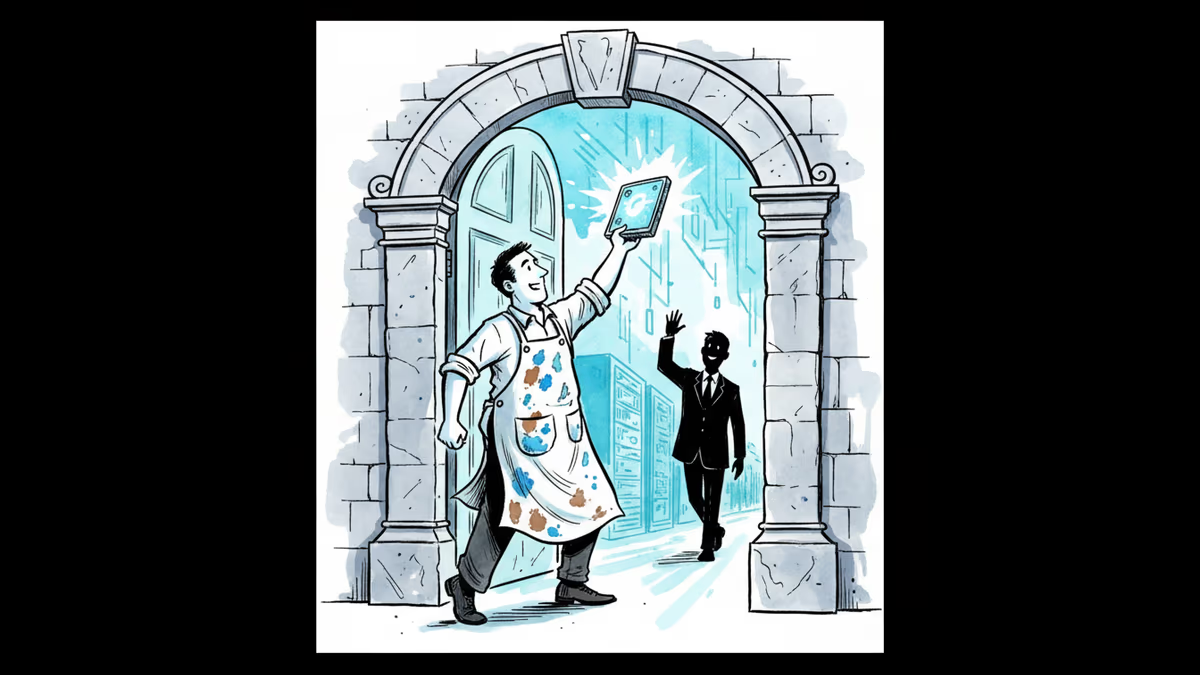
After Tim Cook, Apple Bets on a Builder
Apple names John Ternus, its hardware engineering chief, as the next CEO. The shift from operator to product person signals where Apple thinks its next decade of growth will come from — and raises real questions about what comes next.
The Engineer Gets the Keys
In November 2020, Apple stood on a stage and told the world it was ditching Intel — the chip supplier it had relied on for 15 years — in favor of silicon it designed itself. The person who walked out to make that case wasn't Tim Cook. It was John Ternus, then Apple's SVP of Hardware Engineering, calm and precise, explaining why this was the right call.
Five years later, Ternus introduced the iPhone Air — Apple's thinnest iPhone to date — to a packed auditorium. And now, Apple has handed him the biggest stage of all: the CEO chair.
The transition marks something more than a personnel change. It's a statement about what Apple believes will define its next era.
What Tim Cook Built — And What He Leaves Behind
It's worth pausing on what Cook actually accomplished, because the numbers are staggering. When he took over in 2011, Apple's market cap hovered around $350 billion. Today it sits north of $3 trillion. He didn't do that by inventing new products — he did it by turning Apple into one of the most efficient, disciplined supply chains on earth, and by quietly building a services business that now generates over $100 billion a year.
That services empire — App Store, Apple Music, iCloud, Apple TV+ — is Cook's most durable legacy. It transformed Apple from a hardware company that needed to keep selling you new devices into a subscription business that earns money whether or not you upgrade your phone.
Ternus inherits all of that. The question is what he adds to it.
A Product Person in a Platform World

The case for Ternus is intuitive: Apple's competitive moat has always started with hardware. The reason people pay $1,000+ for an iPhone isn't the software alone — it's the feeling that the thing in your hand was designed, top to bottom, by people who cared obsessively about every millimeter. Ternus is one of those people.
His fingerprints are on Apple Silicon, the transition that made Macs genuinely competitive again after years of being outpaced by PC rivals. He oversaw the industrial design decisions that produced the iPhone Air. He's spent his career thinking about how atoms become products.
But Apple in 2026 isn't just a hardware company. It's a platform, a content studio, a financial services provider, and increasingly an AI company — or at least it's trying to be. The Apple Intelligence rollout has drawn criticism for being slower and less capable than what Google, OpenAI, and Microsoft have put into market. Whether that's a hardware problem or a software strategy problem matters enormously for what Ternus prioritizes.
Three Stakeholders, Three Very Different Reactions
Investors will be watching the services growth line. Cook's genius was proving that Apple could generate recurring revenue. If Ternus pivots heavily toward hardware bets — say, doubling down on Vision Pro or an entirely new product category — Wall Street will want to know the path to monetization. Hardware cycles are lumpy; subscription revenue is smooth. That tension doesn't go away.
Developers have a more complicated relationship with whoever sits in that chair. Apple's App Store policies, its 30% commission, and its tight control over what runs on its devices have made it both essential and resented. A hardware-first CEO might be less focused on ecosystem politics — or might see tighter hardware-software integration as a reason to tighten the walls further.
Consumers — particularly the 1.4 billion active iPhone users worldwide — mostly won't care about the leadership change until they feel it in a product. The real test for Ternus is whether the next iPhone, the next Mac, or whatever comes after Vision Pro gives people a reason to feel that Apple still surprises them.
The Honest Case Against This Appointment
Not everyone is convinced that a hardware engineer is the right person to run a $3 trillion company in the AI era. The criticism isn't about Ternus's competence — it's about fit.
Apple's biggest competitive battles right now aren't being fought in chip fabs or industrial design studios. They're being fought in data centers, in AI model training, in regulatory courtrooms in Brussels and Washington, and in the quiet negotiations that determine whether Apple Maps or Google Maps is the default on the next billion devices. These are arenas where Cook's diplomatic and operational instincts were genuinely valuable.
Ternus has not been tested at that scale publicly. That's not a disqualifier — Cook himself was an untested CEO until he wasn't — but it's a real unknown.
Authors
Related Articles
Google's Gmail Live lets you ask your inbox questions out loud. Announced at I/O 2026, it's AI's pitch to skeptics — and a reminder of how much Google already knows about you.
OpenAI has reorganized for the second time in a month, merging ChatGPT and Codex into a single agentic platform under president Greg Brockman's unified product leadership.
AI sustainability researcher Sasha Luccioni is launching a new venture to push for energy transparency in AI. Here's why Big Tech keeps the numbers hidden—and what's starting to change.
After 15 years of fragmented mobile messaging, Apple and Google are rolling out end-to-end encrypted RCS messaging between iPhones and Android devices. Here's what changed, why it took so long, and what it means for your privacy.
Google's Gmail Live lets you ask your inbox questions out loud. Announced at I/O 2026, it's AI's pitch to skeptics — and a reminder of how much Google already knows about you.
OpenAI has reorganized for the second time in a month, merging ChatGPT and Codex into a single agentic platform under president Greg Brockman's unified product leadership.
AI sustainability researcher Sasha Luccioni is launching a new venture to push for energy transparency in AI. Here's why Big Tech keeps the numbers hidden—and what's starting to change.
After 15 years of fragmented mobile messaging, Apple and Google are rolling out end-to-end encrypted RCS messaging between iPhones and Android devices. Here's what changed, why it took so long, and what it means for your privacy.
Thoughts
Share your thoughts on this article
Sign in to join the conversation