
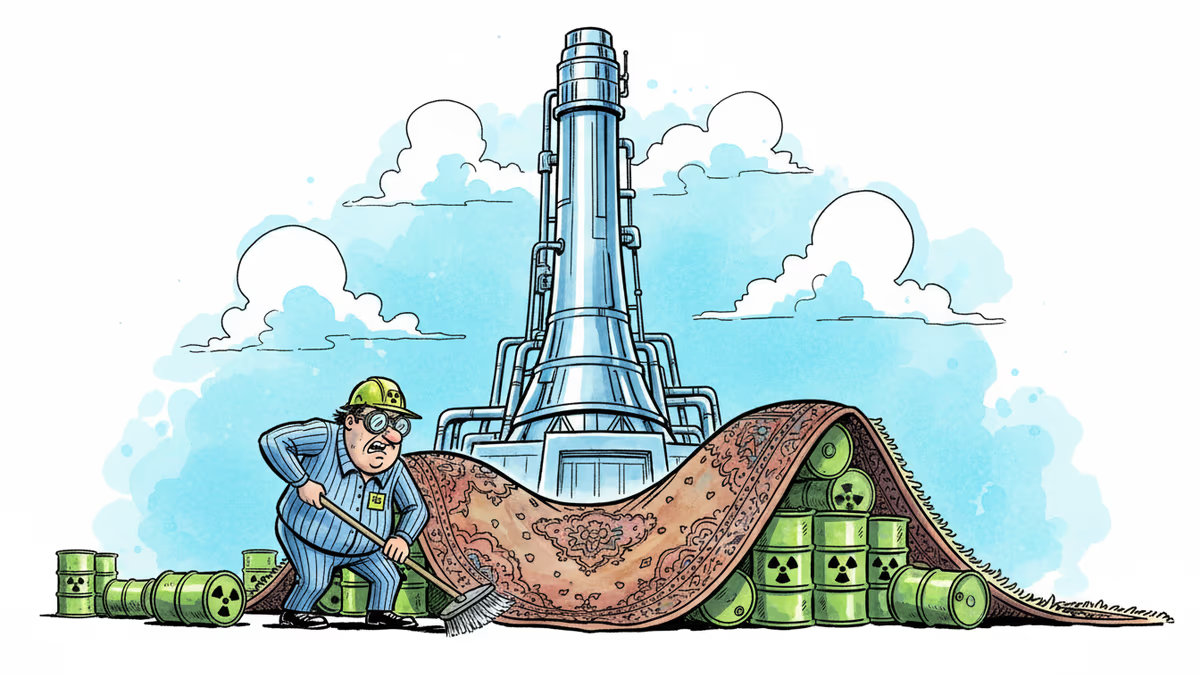
Nuclear Is Back. The Waste Never Left.
Nuclear energy is booming again, fueled by Big Tech's data center appetite. But 70 years of spent fuel still has nowhere permanent to go. Finland solved it. The US hasn't tried hard enough.
The Cleanest Energy Has the Dirtiest Secret
Every year, US nuclear reactors quietly produce 2,000 metric tons of high-level radioactive waste. Every year, that waste goes to the same place it's been going for seven decades: temporary storage at the reactor sites where it was created. Steel casks. Concrete pools. "Safe for now" solutions that were never meant to be permanent.
Nuclear power is having a moment. Google, Microsoft, and Amazon are racing to lock up reactor capacity for their AI data centers. Small modular reactors are clearing regulatory hurdles. Bipartisan support—a rarity in Washington—has coalesced around nuclear as a serious climate solution. The money is flowing, the enthusiasm is real, and the industry is expanding into new reactor designs that use different fuels, different coolants, different everything.
Which means it's also generating new kinds of waste that don't yet have anywhere to go, on top of the old waste that already doesn't.
What the Rest of the World Figured Out
The scientific consensus on what to do with high-level nuclear waste has been stable for decades: dig deep, bury it, seal it. A deep geological repository—hundreds of meters underground, engineered to remain intact for tens of thousands of years—is the agreed-upon endgame. The physics aren't in dispute. The geology isn't the hard part.
The hard part, it turns out, is everything else.
Finland started planning in the 1980s, selected its site in the early 2000s, and as of 2026 is running tests at its facility near Olkiluoto. Final approvals are expected soon. It took roughly 40 years from decision to near-completion—and Finland is the global leader.
France operates more than 50 reactors and draws more of its electricity from nuclear than any other country. It also runs the world's most advanced spent fuel reprocessing program at La Hague, separating out plutonium and uranium to create mixed oxide (MOX) fuel. But reprocessing isn't a closed loop—the leftover material still needs a permanent home. France is targeting pilot repository operations by 2035.

Sweden, Canada, and Switzerland are all in various stages of planning and approval. None of them have a finished repository yet. But all of them have a credible path forward.
America's $13 Billion Hole in the Ground That Isn't
The US has a designated site: Yucca Mountain, Nevada. Congress picked it in 1987. The federal government spent roughly $13 billion studying and developing it over the following two decades. Then Nevada's political opposition—amplified by Senate Majority Leader Harry Reid—proved insurmountable. In 2011, the Obama administration pulled funding. For the past 15 years, there has been essentially no progress.
In the meantime, spent fuel has accumulated at more than 70 sites across 35 states. The US hosts more reactors and more nuclear generating capacity than any other country on Earth. It has no plan for where the waste ultimately goes.
The irony is sharp: the nation that pioneered commercial nuclear power, that operates the world's largest fleet of reactors, that is now attracting billions in fresh investment from the most valuable companies in history—this nation cannot decide where to put its garbage.
The New Waste Problem Layered on the Old One
The current nuclear revival makes the unresolved waste question more urgent, not less. China is building reactors faster than any country in history. Bangladesh and Turkey are constructing their first. In the US, next-generation reactor designs—molten salt, gas-cooled, liquid metal—are moving from concept to regulatory review.
These aren't just new reactors. They're new waste streams. Some advanced reactor designs produce waste with different isotopic compositions and different half-lives than conventional light-water reactors. The regulatory and geological frameworks built around existing waste may not map cleanly onto what's coming.
Some experts are calling for a structural fix: pull nuclear waste management out of the Department of Energy entirely and create a dedicated independent organization, modeled on Finland's Posiva, Canada's NWMO, or France's Andra. The argument is straightforward—DOE's priorities shift with administrations, and a problem that requires 50-year planning horizons cannot be managed by an agency whose budget is renegotiated every two years.
For the tech companies now staking their AI infrastructure on nuclear power, there's a case to be made that waste policy is not someone else's problem. If Microsoft signs a 20-year power purchase agreement with a reactor operator, it has a stake in whether that operator's waste has a credible long-term home. Directing even a fraction of the capital flowing into new reactor development toward waste infrastructure advocacy would be a start.
This content is AI-generated based on source articles. While we strive for accuracy, errors may occur. We recommend verifying with the original source.
Related Articles
Google's Gmail Live lets you ask your inbox questions out loud. Announced at I/O 2026, it's AI's pitch to skeptics — and a reminder of how much Google already knows about you.

OpenAI has reorganized for the second time in a month, merging ChatGPT and Codex into a single agentic platform under president Greg Brockman's unified product leadership.
AI sustainability researcher Sasha Luccioni is launching a new venture to push for energy transparency in AI. Here's why Big Tech keeps the numbers hidden—and what's starting to change.
Emails revealed in the Musk v. Altman trial show Microsoft executives were deeply skeptical of OpenAI in 2017–2018. What actually changed their minds?
Google's Gmail Live lets you ask your inbox questions out loud. Announced at I/O 2026, it's AI's pitch to skeptics — and a reminder of how much Google already knows about you.
OpenAI has reorganized for the second time in a month, merging ChatGPT and Codex into a single agentic platform under president Greg Brockman's unified product leadership.
AI sustainability researcher Sasha Luccioni is launching a new venture to push for energy transparency in AI. Here's why Big Tech keeps the numbers hidden—and what's starting to change.
Emails revealed in the Musk v. Altman trial show Microsoft executives were deeply skeptical of OpenAI in 2017–2018. What actually changed their minds?
Thoughts
Share your thoughts on this article
Sign in to join the conversation