
The Most Powerful Laser in America Just Went Dark
The Texas Petawatt laser—capable of outpowering the entire US electrical grid for a trillionth of a second—has shut down due to funding cuts. What does this mean for fusion energy and America's scientific future?
For a trillionth of a second, it carried more power than every power plant in the United States combined. Then the funding ran out—and it went dark for good.
The Texas Petawatt laser is closed. Not because the science failed. Because the money stopped.
What Was Happening Two Floors Underground
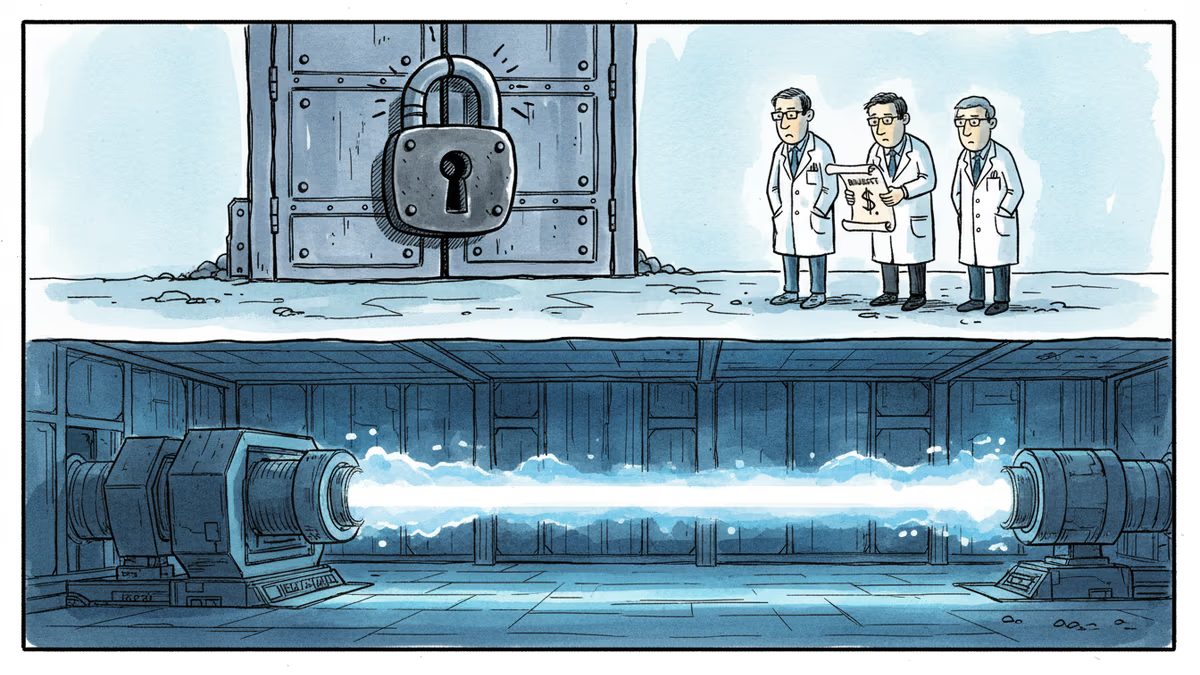
Walk across the open yard in front of the Physics, Math, and Astronomy building at the University of Texas at Austin. You'll see a 17-story tower. You'll see an L-shaped building. What you won't see is what sits two floors below your feet: one of the most powerful lasers ever built in the United States, sitting behind heavy double doors that most students never noticed.
The lead laser scientist who ran the Texas Petawatt (TPW) from 2020 to 2024 describes the machine's logic in terms that are almost hard to believe. Take a tiny pulse of light. Stretch it out so it doesn't vaporize the optics. Amplify it until—for a brief, almost unmeasurable instant—it carries more power than the entire US electrical grid. Then compress it back down to a trillionth of a second. The result: a star, created in a vacuum chamber, underground, in Texas.
This wasn't a private lab. TPW was part of LaserNetUS, a Department of Energy-funded network of high-power laser facilities where scientists from across the country could apply for time to run experiments. Think of it as a national library—but instead of books, it lent out extreme physics.
Why This Matters Right Now
The timing of this closure is uncomfortable. The global fusion energy industry is in the middle of a genuine boom. Private companies like Commonwealth Fusion Systems and TAE Technologies have collectively raised billions. The National Ignition Facility (NIF) made headlines in 2022 when it achieved fusion ignition—producing more energy from a fusion reaction than the laser energy delivered to the fuel. That result, celebrated as a milestone decades in the making, used exactly this kind of high-power laser technology.
And yet, as private fusion investment surges and the science moves faster than at any point in history, the US public infrastructure that supports the underlying research is contracting. TPW isn't the only casualty. The broader LaserNetUS network faces pressure, and the researchers who depended on these facilities are left looking for alternatives—often abroad.

Meanwhile, China's Shanghai Superintense Ultrafast Laser Facility (SULF) continues to expand. Europe's Extreme Light Infrastructure (ELI) network, spread across multiple countries, keeps its doors open through coordinated multinational funding. The US is not losing ground in fusion science dramatically or suddenly. It's losing it quietly, one closed door at a time.
Who Sees This Differently
For researchers, the loss is immediate and practical. TPW wasn't a local resource—it was a national one. Scientists from universities across the country applied for beam time to run experiments that simply couldn't be done anywhere else. With the facility closed, those experiments don't happen. Some researchers will find alternatives; others will shelve projects entirely.
For the private fusion industry, the picture is more complicated. Companies building commercial fusion reactors are increasingly developing their own laser systems or working with commercial vendors. From a pure business standpoint, a public research lab closing doesn't necessarily slow their roadmaps. But this misses something important: the private sector's knowledge base was built on decades of publicly funded basic science. The pipeline doesn't refill itself.
For policymakers and taxpayers, this is the hardest case to make. Basic science facilities produce results that are invisible for years, sometimes decades. The NIF's 2022 ignition milestone drew on physics insights developed over 50 years of laser research. The return on investment is real—but it's slow, and it doesn't show up in next quarter's numbers.
For investors watching the fusion space, the closure raises a quieter concern: if the US government is pulling back from the foundational infrastructure, who fills the gap? Private companies can fund applied research. They're much less likely to fund the kind of open, exploratory basic science that produces unexpected breakthroughs.
The Invisible Price of Turning Off the Lights
Budget cuts to basic science don't make headlines the way a rocket explosion does. There's no dramatic failure, no visible wreckage. A door closes. A laser goes cold. Researchers find other jobs or other countries.
But the cost accumulates. The scientists who trained on TPW and facilities like it are the ones who will design the next generation of fusion reactors, develop new medical imaging technologies, and push the boundaries of materials science. That pipeline is a lagging indicator—you don't notice it's thinning until years later, when you look around for the expertise and find it's gone.
The Texas Petawatt created stars in a basement. For a trillionth of a second, it was the most powerful thing in America. Now it's an empty room behind a locked door that most people never knew existed.
Authors
Related Articles
Nuclear power is winning fans across the political spectrum—and Big Tech is pouring billions in. But America still has no permanent home for the 2,000 metric tons of high-level waste its reactors produce every single year.
Nuclear energy is booming again, fueled by Big Tech's data center appetite. But 70 years of spent fuel still has nowhere permanent to go. Finland solved it. The US hasn't tried hard enough.
Inertia Enterprises just signed three agreements with Lawrence Livermore National Laboratory, licensing nearly 200 patents. Is this the moment laser fusion gets serious about the grid?
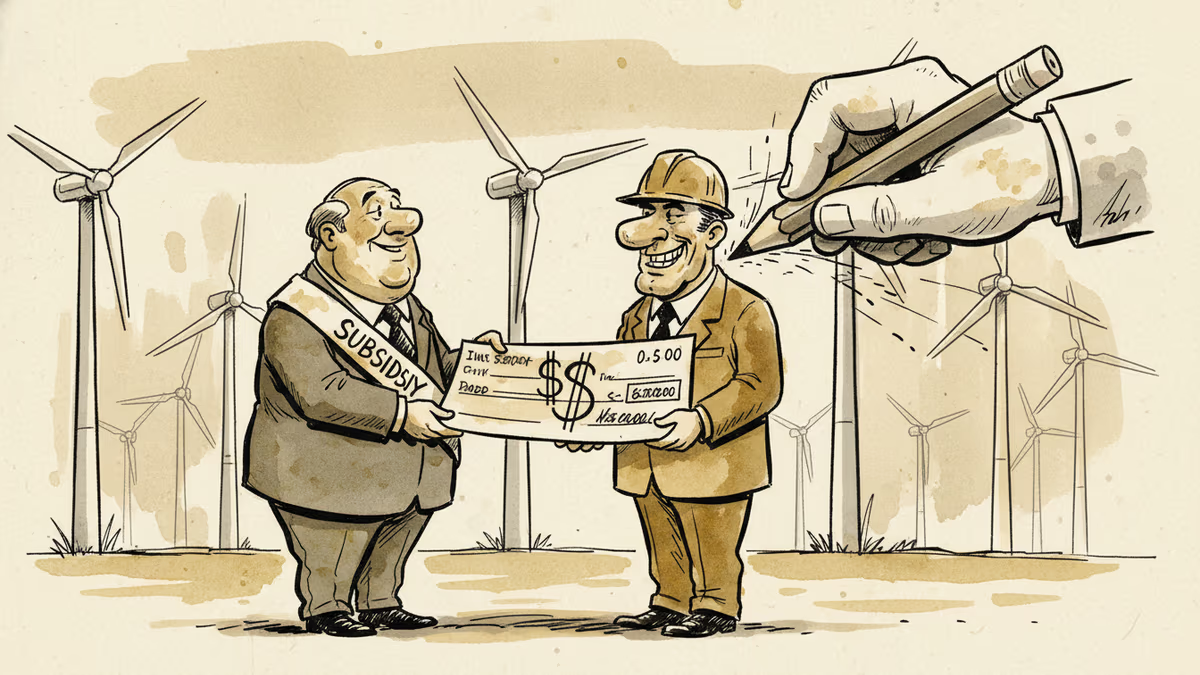
The Trump administration struck a deal to buy back offshore wind leases from TotalEnergies for $1 billion, redirecting that money into fossil fuel projects. What this means for energy markets, grid reliability, and the future of U.S. climate policy.
Nuclear power is winning fans across the political spectrum—and Big Tech is pouring billions in. But America still has no permanent home for the 2,000 metric tons of high-level waste its reactors produce every single year.
Nuclear energy is booming again, fueled by Big Tech's data center appetite. But 70 years of spent fuel still has nowhere permanent to go. Finland solved it. The US hasn't tried hard enough.
Inertia Enterprises just signed three agreements with Lawrence Livermore National Laboratory, licensing nearly 200 patents. Is this the moment laser fusion gets serious about the grid?
The Trump administration struck a deal to buy back offshore wind leases from TotalEnergies for $1 billion, redirecting that money into fossil fuel projects. What this means for energy markets, grid reliability, and the future of U.S. climate policy.
Thoughts
Share your thoughts on this article
Sign in to join the conversation