
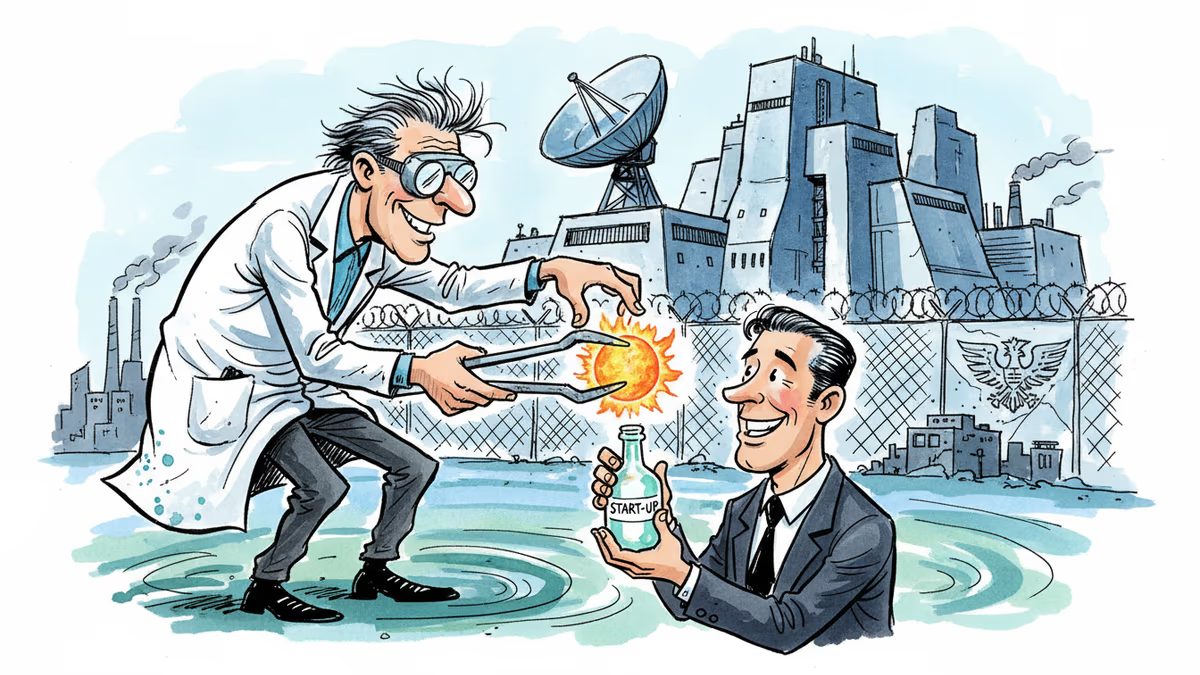
The Lab That Cracked Fusion Is Now Backing a Startup
Inertia Enterprises just signed three agreements with Lawrence Livermore National Laboratory, licensing nearly 200 patents. Is this the moment laser fusion gets serious about the grid?
It took 25 years and billions in public funding to prove that a fusion reaction could produce more energy than it consumes. Now, a startup founded two months ago wants to turn that proof into a power plant.
What Just Happened
Inertia Enterprises announced Tuesday it has signed three agreements with the Lawrence Livermore National Laboratory (LLNL) — two strategic partnerships and one cooperative R&D agreement. Together, they'll work on developing more advanced lasers and improving fuel targets. As part of the deal, Inertia is licensing nearly 200 patents from the lab.
The company only burst onto the scene in February, raising a $450 million Series A — one of the largest first rounds in fusion history. Its co-founder and chief scientist, Annie Kritcher, isn't just a fusion expert. She's the scientist who helped design the specific experiment at LLNL's National Ignition Facility (NIF) that achieved scientific breakeven in 2022: the first controlled fusion reaction in history to release more energy than was needed to ignite it. The 2022 CHIPS and Science Act created the legal pathway for her to found a company while keeping her position at the lab.
Why This Technology Is Harder Than It Sounds
The NIF's approach — called inertial confinement fusion — is genuinely exotic. 192 laser beams fire into a vacuum chamber, converging on a small gold cylinder called a hohlraum. Inside sits a BB-sized, diamond-coated pellet of deuterium-tritium fuel. The lasers vaporize the gold cylinder, which emits X-rays that blast the pellet. The diamond coating becomes plasma, which expands inward and compresses the fuel until atoms fuse.
The science works. The engineering challenge is staggering: for a commercial power plant, this sequence needs to happen several times per second, indefinitely. The NIF's lasers are built on technology from the 1980s, consuming far more electricity than any commercial operation could absorb. The entire bet of Inertia — and rivals like Xcimer, Focused Energy, and First Light — is that modern laser technology can close that efficiency gap dramatically.

Three Ways to Read This Deal
For investors, the LLNL partnership is a credibility signal that's hard to replicate. You can raise $450 million, but you can't manufacture the institutional knowledge of the team that actually made fusion work. Licensing 200 patents from that team's home lab is a meaningful moat — at least on paper.
For rival startups, the deal sharpens an already competitive field. Most fusion companies are pursuing magnetic confinement approaches — the tokamak design championed by Commonwealth Fusion Systems and the international ITER project. Inertial confinement is a smaller, more concentrated bet. The LLNL partnership gives Inertia a head start in the laser-driven lane, but it also raises the stakes for everyone else in that lane.
For policymakers and the public, the deal raises a structural question that rarely gets asked: the NIF was built with public money over 25 years, and the breakthrough it produced is now being commercialized by a private company. That's not inherently wrong — the CHIPS and Science Act was explicitly designed to enable this kind of public-private transfer. But as fusion inches toward commercial viability, the question of who benefits from decades of taxpayer-funded science will become harder to ignore.
The Gap Between Ignition and the Grid
It's worth being precise about where fusion actually stands. Scientific breakeven — the milestone NIF achieved — means the energy released by the fusion reaction exceeded the laser energy delivered to the target. It does not account for the vastly larger amount of electricity needed to power those lasers in the first place. True energy gain, from wall-plug electricity in to grid electricity out, remains unproven at any scale.
That's not a reason for dismissal. Every major energy technology looked economically absurd before it didn't — solar power cost $76 per watt in 1977 and costs roughly $0.20 today. The question is whether fusion's learning curve can compress fast enough to matter for the 2030s and 2040s energy transition, not just the 2050s.
Authors
Related Articles
The Texas Petawatt laser—capable of outpowering the entire US electrical grid for a trillionth of a second—has shut down due to funding cuts. What does this mean for fusion energy and America's scientific future?
Fusion startups have raised over $10 billion as energy demand from AI data centers surges. Here's what's actually being built, which approaches are closest, and why this time might—just might—be different.
Trump administration announces massive critical minerals reserve while publicly opposing clean energy. The contradiction reveals markets are stronger than political rhetoric in shaping America's energy future.

Europe pours billions into early-stage climate startups, only to watch them fail at Series B. New funds like Kembara are trying to bridge this 'valley of death.
The Texas Petawatt laser—capable of outpowering the entire US electrical grid for a trillionth of a second—has shut down due to funding cuts. What does this mean for fusion energy and America's scientific future?
Fusion startups have raised over $10 billion as energy demand from AI data centers surges. Here's what's actually being built, which approaches are closest, and why this time might—just might—be different.
Trump administration announces massive critical minerals reserve while publicly opposing clean energy. The contradiction reveals markets are stronger than political rhetoric in shaping America's energy future.
Europe pours billions into early-stage climate startups, only to watch them fail at Series B. New funds like Kembara are trying to bridge this 'valley of death.
Thoughts
Share your thoughts on this article
Sign in to join the conversation