
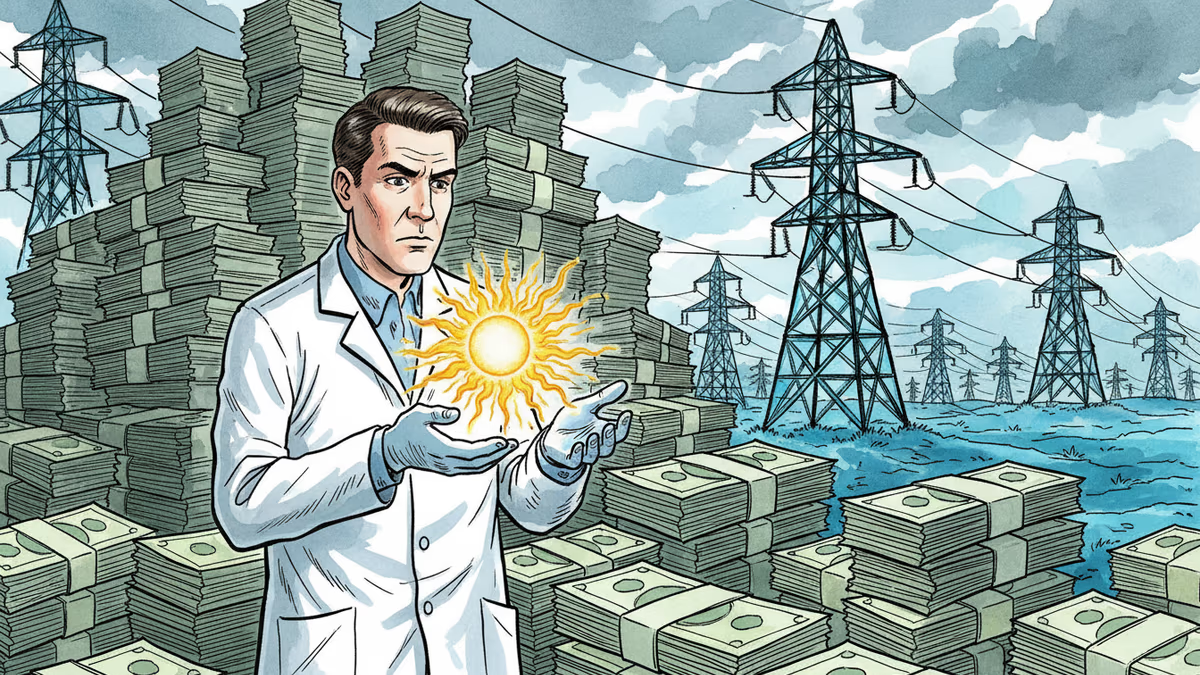
The $10 Billion Bet That the Sun's Power Can Light Your Home
Fusion startups have raised over $10 billion as energy demand from AI data centers surges. Here's what's actually being built, which approaches are closest, and why this time might—just might—be different.
For roughly 70 years, physicists have promised fusion power is a decade away. Investors are finally calling that bluff — with $10 billion.
The Setup: Why Now, Why This Much
Fusion startups have collectively raised more than $10 billion in private capital, with over a dozen companies each clearing the $100 million threshold. A significant chunk of that has landed in the last twelve months alone. The timing isn't accidental.
AI data centers are consuming electricity at a pace that's straining grids across the US and Europe. Utilities are struggling to keep up. Coal plants that were slated for retirement are getting second lives. In that context, investors are scanning the horizon for anything that could deliver large-scale, carbon-free baseload power — the kind that runs whether the sun is shining or the wind is blowing. Fusion, long the punchline of energy jokes, suddenly looks like a serious hedge.
The physics is elegant in theory. Fusion — the process that powers the sun — joins atomic nuclei together, releasing enormous amounts of energy. Unlike nuclear fission (conventional nuclear power), it doesn't produce long-lived radioactive waste, and its fuel sources, primarily isotopes of hydrogen, are abundant. The catch: to make atoms fuse, you need temperatures exceeding 100 million degrees Celsius — hotter than the core of the sun. Containing that heat long enough to extract useful energy is the engineering problem that has stumped humanity for generations.
We've managed uncontrolled fusion since the 1950s — that's what a hydrogen bomb is. Controlled fusion in a lab? Also achieved. The missing piece is generating a surplus large enough to run a power plant.
Two Paths to the Same Star
The startups racing toward commercialization are largely split between two technical approaches.
Magnetic confinement uses powerful magnetic fields to trap superheated plasma — the ionized gas where fusion reactions occur — inside a chamber. The leading private player here is Commonwealth Fusion Systems (CFS), a spinout from MIT. CFS is building magnets capable of generating 20 tesla magnetic fields, roughly 13 times stronger than a typical MRI machine. To achieve that, the magnets use high-temperature superconductors cooled to –253°C with liquid helium. The company is currently assembling a demonstration device called Sparc in Massachusetts, targeting a switch-on in late 2026. If Sparc performs as hoped, CFS plans to break ground on Arc, its commercial-scale power plant in Virginia, as early as 2027 or 2028.

Within magnetic confinement, there are two main reactor geometries. Tokamaks — the doughnut-shaped design first theorized by Soviet scientists in the 1950s — are the most studied. The international ITER project in France, a $22 billion tokamak backed by 35 countries, is expected to begin operations in the late 2030s. UK-based Tokamak Energy is developing a more compact spherical variant. Stellarators take a different approach: their twisted, irregular shape is designed to work with the plasma's natural behavior rather than forcing it into a symmetric geometry. Germany's Wendelstein 7-X has been operating since 2015; startups like Proxima Fusion, Thea Energy, and Type One Energy are pursuing commercial stellarator designs.
Inertial confinement takes a fundamentally different approach: instead of magnets, it uses pulses of laser light to compress tiny fuel pellets until the atoms inside fuse. This is the only approach that has achieved scientific breakeven — meaning the fusion reaction released more energy than the lasers delivered to the pellet. That milestone was hit at the National Ignition Facility (NIF) at Lawrence Livermore National Laboratory in California. A critical asterisk: that measurement doesn't count the electricity needed to power the lasers themselves or the facility. The total energy budget still runs deeply negative. Still, nearly a dozen startups see enough promise to build reactors around this approach. Focused Energy, Marvel Fusion, and Xcimer are among those using lasers. First Light Fusion is developing a piston-based compression system, while Pacific Fusion is pursuing electromagnetic pulses as its compression mechanism.
The Skeptic's Corner
Not everyone is convinced the finish line is as close as the fundraising numbers suggest.
The history of fusion is littered with milestones that turned out to be smaller than they appeared. ITER, originally targeting first plasma around 2020, is now looking at the late 2030s — a delay of nearly two decades on a project that has already consumed billions in public funding. The NIF's celebrated breakeven result, while real, was achieved with a single shot that required months of preparation and didn't come close to net energy when the full system is accounted for.
Meanwhile, the energy transition isn't waiting. Solar and battery storage costs have fallen so dramatically that in many markets, renewables are already the cheapest source of new electricity. By the time fusion plants are ready to connect to the grid — optimistically, the mid-2030s for demonstration plants, realistically the 2040s for commercial scale — the competitive landscape may look very different. A technology that arrives late to a market that has already solved the problem it was meant to solve is not a revolution; it's a footnote.
There's also the question of which approach wins. Experts genuinely disagree. Each technical path has different failure modes, different cost profiles, and different timelines. The $10 billion flowing into the sector is spread across competing bets, which means most of it will, statistically, be wrong.
What It Means for the Grid — and Your Bill
If even one of these approaches delivers a working commercial reactor in the 2030s, the implications ripple outward quickly. Fusion plants would offer something renewables fundamentally cannot: dispatchable, high-density power that doesn't depend on weather or geography. That changes the math for energy-intensive industries — aluminum smelting, green hydrogen production, semiconductor fabrication — that can't easily run on intermittent power.
For consumers, the direct impact would take years to materialize; power plants are long-lived infrastructure. But for policymakers trying to plan grid capacity decades out, a credible fusion timeline changes what investments make sense today. And for geopolitics, a world with abundant fusion power is one where the leverage held by fossil fuel exporters erodes significantly.
Investors are also watching the secondary market: the companies supplying high-temperature superconducting tape, precision laser systems, tritium handling equipment, and plasma diagnostics tools. These supply chains don't exist at scale yet. Building them is itself a multibillion-dollar opportunity — and a constraint on how fast the industry can actually move.
Authors
Related Articles
Lucra Sports CEO Dylan Robbins landed Cathie Wood's ARK Invest as a Series B lead without building AI. The story behind his unconventional fundraising playbook.

Indian venture capital has quietly displaced Silicon Valley in its own backyard. Only one American VC made India's top 10 investor list last year. Here's why that matters beyond India.

E-commerce fintech Parker filed for Chapter 7 bankruptcy on May 7, despite raising over $200M. The YC-backed startup's abrupt shutdown left small business customers scrambling—and exposed the fragility of vertical fintech models.
Nuclear power is winning fans across the political spectrum—and Big Tech is pouring billions in. But America still has no permanent home for the 2,000 metric tons of high-level waste its reactors produce every single year.
Lucra Sports CEO Dylan Robbins landed Cathie Wood's ARK Invest as a Series B lead without building AI. The story behind his unconventional fundraising playbook.
Indian venture capital has quietly displaced Silicon Valley in its own backyard. Only one American VC made India's top 10 investor list last year. Here's why that matters beyond India.
E-commerce fintech Parker filed for Chapter 7 bankruptcy on May 7, despite raising over $200M. The YC-backed startup's abrupt shutdown left small business customers scrambling—and exposed the fragility of vertical fintech models.
Nuclear power is winning fans across the political spectrum—and Big Tech is pouring billions in. But America still has no permanent home for the 2,000 metric tons of high-level waste its reactors produce every single year.
Thoughts
Share your thoughts on this article
Sign in to join the conversation