
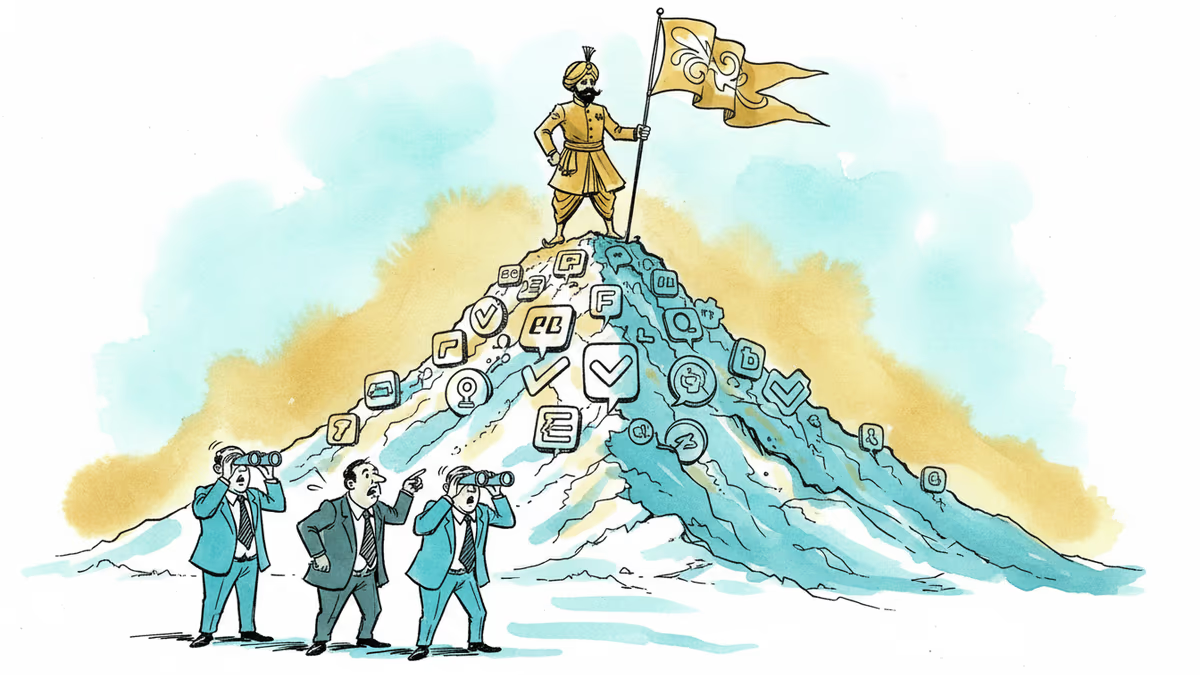
India's VCs Are Winning at Home — And Now Eyeing America
Indian venture capital has quietly displaced Silicon Valley in its own backyard. Only one American VC made India's top 10 investor list last year. Here's why that matters beyond India.
When Walmart bought Flipkart for $16 billion in 2018, the biggest winner wasn't the Indian founders. It was Tiger Global, a New York hedge fund that reportedly walked away with roughly $3.5 billion in profit from a single bet. For years, that was the template: American capital flies into India early, collects the returns, and flies home.
That template is breaking down.
The Numbers Tell the Story
Of the top 10 investors in Indian tech startups over the past year, only one was an American venture capital firm — Accel — according to data from startup intelligence platform Tracxn. The other nine were Indian. A decade ago, that list would have looked almost exactly the opposite.
To understand why, you have to go back to what India looked like in the early 2010s. There was no mature risk-capital culture. Wealthy families parked money in real estate, gold, and public equities. Writing million-dollar checks to young founders with no revenue and ambitious ideas felt alien. Silicon Valley stepped into that vacuum, and firms like Sequoia, SoftBank, and Tiger Global dominated the deal flow. Having an American name on your cap table wasn't just about money — it was a status signal, proof that your startup had global ambitions worth backing.
That psychology has shifted. Many Indian entrepreneurs no longer see Silicon Valley money as a prerequisite for credibility. They've watched a generation of homegrown investors build track records, and increasingly, they prefer them.
What Local Investors Actually Know
The edge isn't just sentiment. It's structural.
India is not a textbook market. Infrastructure is patchy. Consumers speak more than 20 languages. Purchasing power varies wildly between a Mumbai tech worker and a farmer in Bihar. The digital payments revolution — driven by UPI, which now processes over 10 billion transactions a month — happened fast and unevenly. Navigating that complexity requires more than a quarterly flight into Bengaluru.

Indian VCs lived through all of it. They have an instinct for what works in Tier 2 cities versus metros, which business models collapse under India's logistics realities, and which consumer behaviors are durable versus hype. They also move faster at the early stage, writing smaller checks without the months-long due diligence cycles that slow down larger global funds.
Then came the macro shift. Rising U.S. interest rates after 2022 made global LPs more cautious about emerging market exposure. Many crossover investors who aggressively chased Indian deals during the boom years quietly pulled back. Local capital filled the gap — and didn't let go.
The Direction of Capital Is Reversing
Here's where the story gets more interesting. Indian capital isn't just winning at home. It's going abroad.
At the 2026 SelectUSA Investment Summit last week, Indian companies announced a record $20.5 billion in planned investments into the United States — spanning AI infrastructure, pharmaceuticals, advanced manufacturing, and technology. That's not aid or diplomacy. That's Indian capital looking for returns in American markets.
The directionality that defined the last two decades — Western money flowing into emerging markets to capture growth — is no longer the only story. Mature ecosystems are producing their own capital exporters.
This pattern isn't unique to India. Across Southeast Asia, Latin America, and parts of Africa, local VC ecosystems have matured enough to compete with foreign entrants on their home turf. The first-mover advantage that Silicon Valley enjoyed in these markets — showing up before local alternatives existed — is eroding market by market.
What This Means for Global Investors
For American VCs, the implications are uncomfortable. The playbook of flying into a developing market, leading a Series A, and riding the growth wave is harder to execute when local investors already have the relationships, the market intuition, and the check-writing speed.
The deals that remain accessible to foreign capital tend to be later-stage rounds — larger checks, lower risk, lower upside. The early-stage alpha, where venture returns are actually made, is increasingly captured domestically.
Some American funds are adapting by partnering with local firms rather than competing with them. Others are doubling down on proprietary networks and sector expertise that local generalists can't replicate. A few have simply reduced their India exposure. None of these is obviously the right answer.
For Indian founders, the shift offers genuine optionality — but also a new set of questions. Local investors understand the domestic market better, but do they have the global networks to help a startup expand internationally? The best outcome might be a cap table that blends both, rather than treating it as an either/or.
This content is AI-generated based on source articles. While we strive for accuracy, errors may occur. We recommend verifying with the original source.
Related Articles

Lucra Sports CEO Dylan Robbins landed Cathie Wood's ARK Invest as a Series B lead without building AI. The story behind his unconventional fundraising playbook.
SolarSquare is raising $55-60M at a $450-500M valuation, more than doubling its worth in 18 months. Here's what's driving investor conviction in India's residential solar market.

Cerebras Systems IPO yields a $5.3 billion return for Benchmark. Explore the 8.5-year journey from a reluctant first meeting to challenging Nvidia's AI dominance.
After two weeks of witnesses calling him a liar, OpenAI CEO Sam Altman testified in his own defense, claiming Elon Musk tried to kill the company twice.
Lucra Sports CEO Dylan Robbins landed Cathie Wood's ARK Invest as a Series B lead without building AI. The story behind his unconventional fundraising playbook.
SolarSquare is raising $55-60M at a $450-500M valuation, more than doubling its worth in 18 months. Here's what's driving investor conviction in India's residential solar market.
Cerebras Systems IPO yields a $5.3 billion return for Benchmark. Explore the 8.5-year journey from a reluctant first meeting to challenging Nvidia's AI dominance.
After two weeks of witnesses calling him a liar, OpenAI CEO Sam Altman testified in his own defense, claiming Elon Musk tried to kill the company twice.
Thoughts
Share your thoughts on this article
Sign in to join the conversation