
Sam Altman Takes the Stand — And Doesn't Flinch
After two weeks of witnesses calling him a liar, OpenAI CEO Sam Altman testified in his own defense, claiming Elon Musk tried to kill the company twice.
For two weeks, the jury heard witnesses describe Sam Altman as a lying snake. Then the lying snake spoke for himself.
The Bewildered Boy from St. Louis
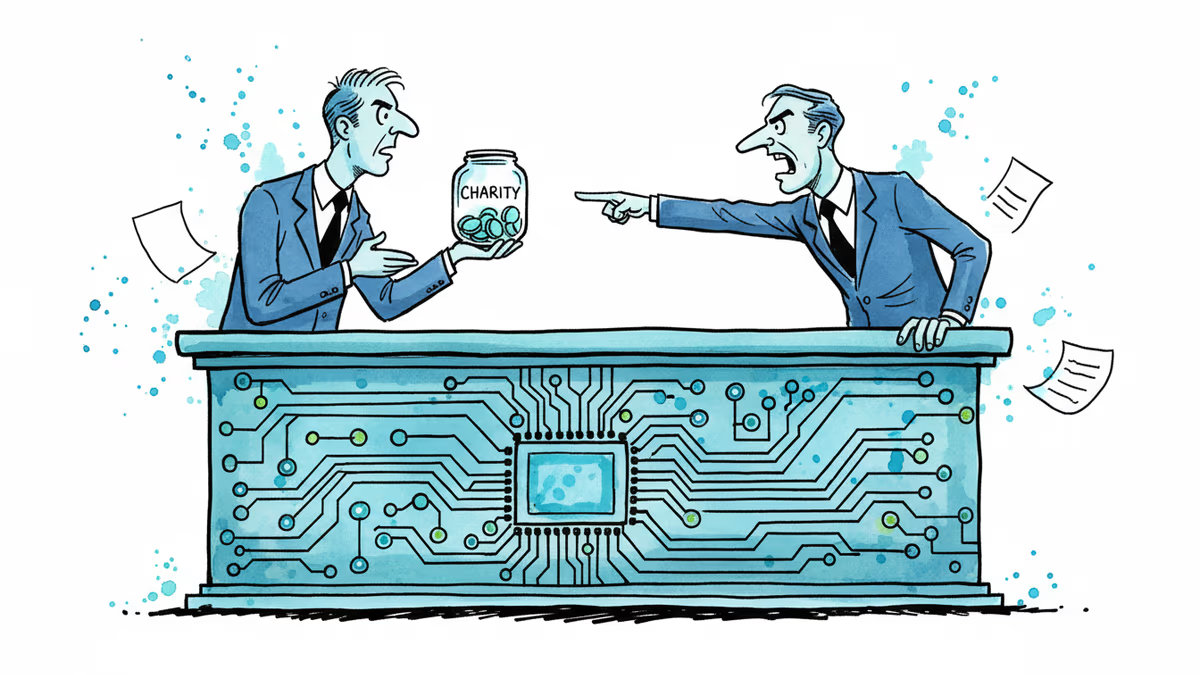
Altman arrived in court playing a character reporters on the scene quickly recognized: the mild-mannered Midwesterner who simply cannot believe any of this is happening to him. His attorney, William Savitt, closed his examination with the kind of question designed to land on the front page: how does it feel to be accused of stealing a charity?
"We created, through a ton of hard work, this extremely large charity, and I agree you can't steal it," Altman said. "Mr. Musk did try to kill it, I guess. Twice."
It was a composed, almost understated delivery — which, given the stakes, may have been the point. When he stepped down from the stand carrying a stack of evidence binders, the image was almost deliberately ordinary. Not a villain. Just a guy with a lot of paperwork.
What This Case Is Actually About
Strip away the personal drama between two of the most prominent figures in tech, and the lawsuit raises a question the AI industry has been quietly dreading: can a nonprofit's founding mission be legally enforceable once the money gets big enough?
OpenAI was incorporated in 2015 as a nonprofit research lab, with the explicit goal of developing artificial general intelligence for the benefit of humanity — not shareholders. Elon Musk was a co-founder and early backer. He departed the board in 2018, citing conflicts of interest with his work at Tesla.

What followed was a $13 billion investment from Microsoft, the release of ChatGPT, and a valuation that has since ballooned past $300 billion. OpenAI began restructuring toward a for-profit model. Musk sued, arguing the transformation betrayed the original charter — and that Altman personally orchestrated the betrayal.
Altman's counter-narrative: Musk wanted control, didn't get it, and has been trying to destabilize the company ever since — first from the inside, then through litigation, and now through xAI, his own competing AI venture.
The Conflict-of-Interest Problem Nobody Wants to Name
That last point is where things get genuinely complicated. Musk is not a disinterested party defending charitable principles. He is the founder and CEO of xAI, which competes directly with OpenAI in the large language model market. His Grok assistant runs on X (formerly Twitter), a platform he owns. A court ruling that hamstrings OpenAI's commercial expansion would, not incidentally, benefit his own business.
Musk's legal team would argue that personal motivation doesn't invalidate a legitimate legal claim. They're not wrong. The nonprofit conversion question is real, and California's attorney general is separately reviewing whether OpenAI's restructuring complies with state law governing charitable assets. The legal issue exists independent of Musk's competitive interests.
But the optics matter in a trial that is, at its core, a battle over whose story the jury believes.
Three Groups Watching Very Closely
OpenAI employees are living inside the uncertainty. The company's ability to attract and retain top AI researchers depends partly on its mission narrative — the idea that working there means something beyond a paycheck. A ruling that forces the company back into nonprofit constraints, or alternatively validates the for-profit pivot, reshapes that story either way.
Institutional investors, led by Microsoft, have structured deals worth billions around the assumption that the for-profit transition succeeds. Any legal obstacle to that transition isn't an abstract governance question — it's a balance sheet problem.
And for the broader AI industry, the outcome sets a precedent. Several other AI safety organizations — Anthropic, DeepMind in its early form — were founded with explicit public-benefit language. If courts establish that such language carries binding legal weight, the entire sector's fundraising and governance architecture may need rethinking.
This content is AI-generated based on source articles. While we strive for accuracy, errors may occur. We recommend verifying with the original source.
Related Articles
SpaceX's IPO filing puts AI at the center, claiming a $26.5 trillion market opportunity. But can Grok compete with OpenAI and Anthropic for enterprise customers?
SpaceX filed a nearly 400-page S-1 with the SEC, targeting an IPO as early as June 12. Here's what the filing reveals—and what it doesn't.
SpaceX has filed its S-1 with the SEC, targeting the Nasdaq under ticker SPCX. With $18.67B in revenue but a $4.9B loss, the IPO forces investors to answer one hard question.
Indian venture capital has quietly displaced Silicon Valley in its own backyard. Only one American VC made India's top 10 investor list last year. Here's why that matters beyond India.
SpaceX's IPO filing puts AI at the center, claiming a $26.5 trillion market opportunity. But can Grok compete with OpenAI and Anthropic for enterprise customers?
SpaceX filed a nearly 400-page S-1 with the SEC, targeting an IPO as early as June 12. Here's what the filing reveals—and what it doesn't.
SpaceX has filed its S-1 with the SEC, targeting the Nasdaq under ticker SPCX. With $18.67B in revenue but a $4.9B loss, the IPO forces investors to answer one hard question.
Indian venture capital has quietly displaced Silicon Valley in its own backyard. Only one American VC made India's top 10 investor list last year. Here's why that matters beyond India.
Thoughts
Share your thoughts on this article
Sign in to join the conversation