
Microsoft Nearly Walked Away From OpenAI
Emails revealed in the Musk v. Altman trial show Microsoft executives were deeply skeptical of OpenAI in 2017–2018. What actually changed their minds?
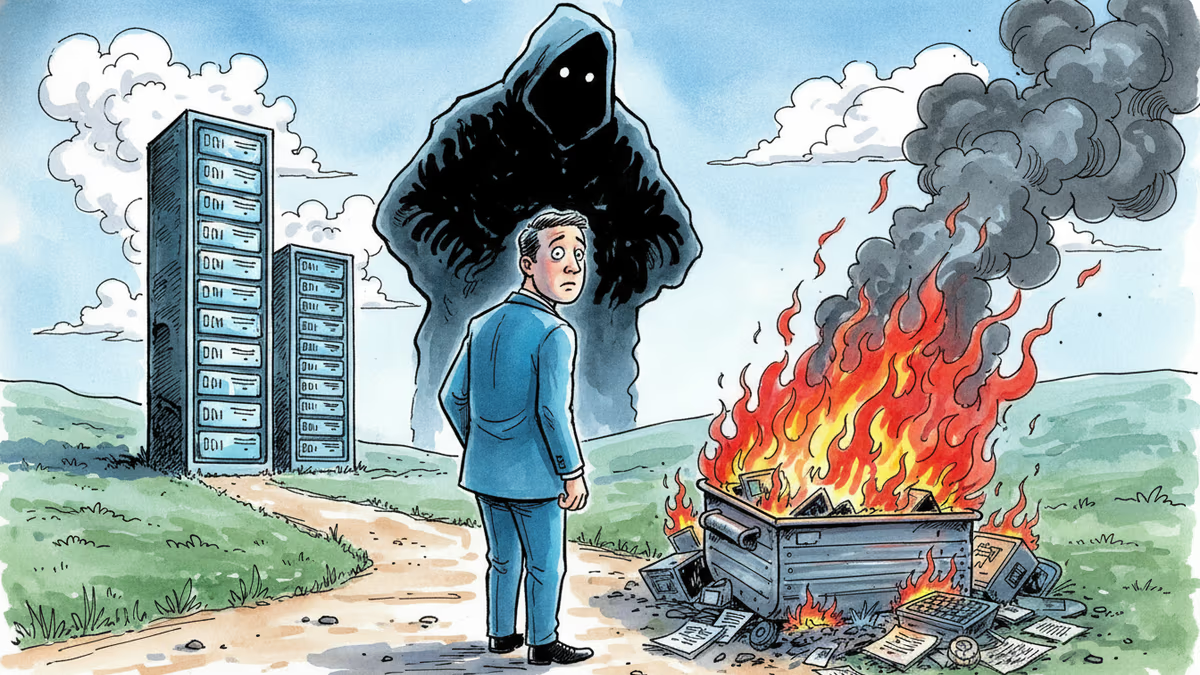
The most consequential bet in AI history almost didn't happen — because Microsoft's own executives couldn't figure out what they'd get out of it.
Emails shown in federal court on Thursday, as part of the Elon Musk v. Sam Altman trial, reveal that in 2017 and 2018, senior Microsoft leaders — including CEO Satya Nadella — were openly skeptical of OpenAI, dismissive of its research, and reluctant to send more money to what was then a small nonprofit playing around with video game AI.
What changed their minds wasn't a breakthrough. It was the fear of losing to Amazon.
The Ask That Almost Got Ignored
The email chain begins on August 11, 2017. Nadella congratulated Altman after OpenAI's AI beat human players in a video game competition. Ten days later, Altman wrote back — not to chat, but to ask for $300 million worth of Microsoft Azure cloud computing services.
"We could figure how to do some of it but not that much," Altman wrote. "I think it will be the most impressive thing yet in the history of AI."
Nadella circulated the request to four lieutenants. The responses were blunt. Jason Zander, executive vice president overseeing Azure, relayed that the AI team saw "no value in engaging." Microsoft's own research team believed its work was "more advanced." The PR team didn't want to be associated with a group promoting the idea of "machines beating humans."
One internal analysis estimated that granting Altman's request would cost Microsoft roughly $150 million in losses over several years. "Unless he can help us draw a more direct networking effect with OpenAI → Microsoft business value, we will wind up having to pass," Zander wrote.
For several months, the thread went quiet.
"I'm Highly Skeptical of an Imminent AGI Breakthrough"

The conversation revived in January 2018, when a director on the Azure team told Nadella that Altman was now offering to license OpenAI's gaming AI to Microsoft's Xbox division in exchange for $35–50 million in Azure credits. Xbox couldn't commit. Microsoft was preparing to tell Altman the discounts were ending.
Nadella forwarded the email to 15 executives, asking for their read.
CTO Kevin Scott responded with a line that now reads as either prescient or ironic, depending on your perspective: "I'm highly skeptical of an imminent breakthrough in AGI. IMO, they're treating us like a bucket of undifferentiated GPUs, which isn't interesting for us at all."
But Scott also noted the downside of cutting OpenAI off — specifically, the risk of them "storming off to Amazon in a huff and shit-talking us and Azure on the way out."
Zander echoed the concern more formally: "My worst case scenario is having them ditch Azure for AWS, as Kevin says bad-mouth us on the way over, and then land with some big new innovation that is shared with our competitors."
Chief Scientific Officer Eric Horvitz offered a more measured take: he'd prefer Microsoft Research to collaborate with OpenAI without handing over millions of dollars — unless there were clear ecosystem benefits that justified the spend.
In the end, no team inside Microsoft volunteered to sponsor OpenAI. Altman was told there would be no more discounts.
Fear as Strategy
Roughly 18 months later, Microsoft announced a landmark $1 billion investment in OpenAI — after the lab restructured into a "capped-profit" entity that gave Microsoft a potential $20 billion return. Between 2019 and 2023, Microsoft committed a total of $13 billion in cash and cloud credits.
The emails are now being used by Musk's legal team to trace how Microsoft became entangled in what Musk alleges was OpenAI's drift away from its nonprofit mission. Musk contends that Microsoft helped OpenAI build a profit-generating machine that betrayed its founding principles. Nadella is set to take the witness stand Monday.
The deeper irony: the nightmare scenario Zander described in 2018 has, in a different form, come true anyway. OpenAI recently committed to spending $138 billion on Amazon Web Services, and Amazon agreed to invest between $15 billion and $50 billion in OpenAI. The partnership with Microsoft remains, but OpenAI is no longer a captive partner.
The executives who worried about OpenAI bad-mouthing Azure on the way to AWS are now watching OpenAI do business with AWS — while still cashing Microsoft's checks.
This content is AI-generated based on source articles. While we strive for accuracy, errors may occur. We recommend verifying with the original source.
Related Articles
GitHub confirmed hackers stole data from 3,800 internal repositories via a poisoned VS Code extension. Here's why developer tools are now the most dangerous attack surface in tech.
Google's Gmail Live lets you ask your inbox questions out loud. Announced at I/O 2026, it's AI's pitch to skeptics — and a reminder of how much Google already knows about you.

OpenAI has reorganized for the second time in a month, merging ChatGPT and Codex into a single agentic platform under president Greg Brockman's unified product leadership.
AI sustainability researcher Sasha Luccioni is launching a new venture to push for energy transparency in AI. Here's why Big Tech keeps the numbers hidden—and what's starting to change.
GitHub confirmed hackers stole data from 3,800 internal repositories via a poisoned VS Code extension. Here's why developer tools are now the most dangerous attack surface in tech.
Google's Gmail Live lets you ask your inbox questions out loud. Announced at I/O 2026, it's AI's pitch to skeptics — and a reminder of how much Google already knows about you.
OpenAI has reorganized for the second time in a month, merging ChatGPT and Codex into a single agentic platform under president Greg Brockman's unified product leadership.
AI sustainability researcher Sasha Luccioni is launching a new venture to push for energy transparency in AI. Here's why Big Tech keeps the numbers hidden—and what's starting to change.
Thoughts
Share your thoughts on this article
Sign in to join the conversation