
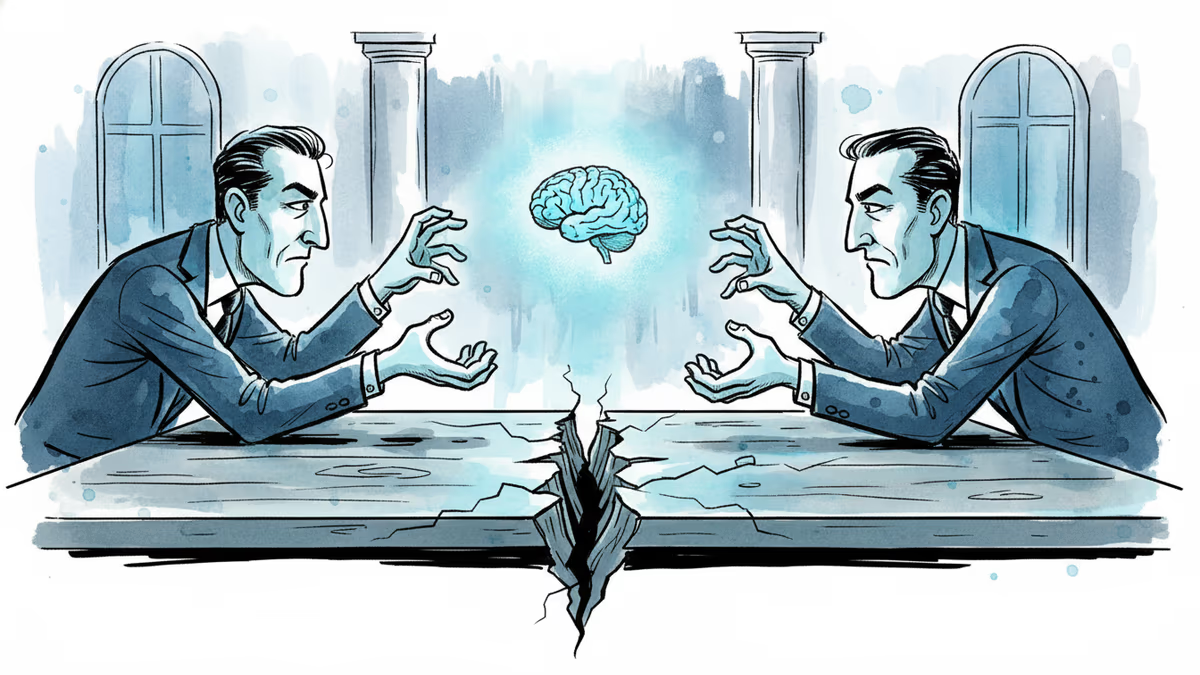
OpenAI's Founding Myth Is Being Dismantled in Court
Week two of Musk v. Altman revealed a 2017 power struggle over AGI control, a stormed-out Tesla painting, and a diary entry asking 'what will take me to $1B?
"By the end of this week, you and Sam will be the most hated men in America."
That text from Elon Musk to Greg Brockman—sent two days before the trial began—is either a threat, a prediction, or a window into how Musk operates. Possibly all three. It also tells you everything about why this trial is so hard to look away from.
Week two of Musk v. Altman didn't just add testimony. It added texture—a Tesla painting grabbed in fury, a private journal entry about becoming a billionaire, and a former OpenAI board member who was secretly having Musk's children while sitting on the board. The story of OpenAI's founding is being rewritten in real time, under oath.
The Painting, the Silence, and the Storm-Out
Greg Brockman took the stand Monday in a blue suit, calm at first, visibly agitated by cross-examination. His account of OpenAI's early days is the most detailed public reconstruction of the company's founding yet—and it directly contradicts Musk's version.
The pivot point, according to Brockman, came in the summer of 2017. OpenAI's AI model had just beaten the world's top players at the video game Dota 2. Musk hosted a celebration at his "Haunted Mansion" near San Francisco—confetti, cups, Amber Heard serving whiskey. And a decisive email from Musk: "Time to make the next step for OpenAI. This is the triggering event." Weeks earlier, he'd told the team that a major public achievement would be "time to create a for-profit."
Over the next six weeks, the cofounders negotiated what that for-profit would look like. Musk wanted majority equity, the right to appoint a majority of board members, and the CEO title. Then came August 2017: Brockman and Ilya Sutskever proposed equal equity splits. Sutskever had brought a Tesla painting as a goodwill gesture—Musk had recently given them all actual Teslas. "It felt a little bit like he was buttering us up," Brockman told the jury.
When the equal-split proposal landed, Musk went silent. Then: "I decline." He stood up, walked around the table—"I actually thought he was going to hit me," Brockman said—grabbed the painting, and walked out.
"The one thing we could not accept," Brockman told the jury, "was to hand him unilateral, absolute control, potentially, over the AGI."
Musk's lawyer, Steven Molo, offered a different frame: Brockman wasn't protecting humanity. He was protecting his own stake—now worth close to $30 billion—in a company he never invested a dollar in.
What the Diary Said
Molo's sharpest move was pulling up Brockman's personal journal on the courtroom screen. In 2017, while negotiating OpenAI's future with Musk, Brockman wrote: "Financially what will take me to $1B?"

"Why didn't you take the $29 billion and donate it to the nonprofit," Molo asked, voice rising, "for the good of humanity?"
"Solving for the mission has always been my primary motivation," Brockman replied.
A second journal entry, from November 2017, complicated things further. Torn over whether to convert OpenAI to a for-profit without Musk, Brockman wrote: "it'd be wrong to steal the nonprofit from him. to convert to a b-corp without him. that'd be pretty morally bankrupt." His explanation in court: he meant it would be hard to look at himself in the mirror, not that the conversion itself was wrong.
The jury also learned that Brockman holds stakes in Cerebras, CoreWeave, and Helion Energy—all companies with business ties to OpenAI. Sam Altman has faced similar conflict-of-interest scrutiny for steering OpenAI toward deals with companies he personally invests in.
Video depositions from former CTO Mira Murati and former board member Helen Toner added another layer: both said the OpenAI board couldn't trust Altman in 2023 due to what they described as a pattern of dishonesty—the backdrop to his brief, chaotic firing that year.
The Rival Lab Musk Was Building All Along
Shivon Zilis—former OpenAI board member, Neuralink executive, and mother of four of Musk's children—took the stand Thursday. Her testimony was the week's most structurally significant.
OpenAI's lawyer Sarah Eddy argued that Musk's lawsuit isn't about saving a nonprofit mission. It's about kneecapping a competitor. The evidence: by late 2017, while still on OpenAI's board, Musk had already concluded the company was unlikely to build AGI and pivoted to building his own AI lab inside Tesla.
A draft FAQ document Zilis emailed a Tesla colleague in 2017 about a NeurIPS event described its purpose as sharing "that Tesla is building a world leading AI lab which will rival the likes of Google/DeepMind and Facebook AI Research." Musk asked researcher Andrej Karpathy to compile "a list of top OpenAI people to poach." He even tried to recruit Sam Altman to lead the Tesla lab.
"There is little chance of OpenAI being a serious force if I focus on TeslaAI," Musk texted Zilis in 2018, just before leaving the company.
The Tesla AI lab never materialized. But xAI did—founded in 2023, now merged with SpaceX, targeting a public listing as early as June at a valuation of $1.75 trillion.
Zilis, for her part, told the jury she didn't disclose her personal relationship with Musk to OpenAI's board until Business Insider reported it in 2022—two years after she joined the board. Asked about her loyalties, she said: "I had an allegiance to the best outcome for AI for humanity."
What's Actually at Stake
Musk is asking the court to remove Altman and Brockman from their roles and unwind OpenAI's restructuring—the conversion of its for-profit subsidiary into a public benefit corporation. Damages sought: up to $134 billion from OpenAI and Microsoft combined.
The trial's outcome could directly affect OpenAI's path to an IPO at a valuation approaching $1 trillion. Next week: Ilya Sutskever testifies, as does Microsoft CEO Satya Nadella. Closing arguments follow. The jury delivers an advisory verdict; the judge makes the final call.
This content is AI-generated based on source articles. While we strive for accuracy, errors may occur. We recommend verifying with the original source.
Related Articles
SpaceX's IPO filing puts AI at the center, claiming a $26.5 trillion market opportunity. But can Grok compete with OpenAI and Anthropic for enterprise customers?
SpaceX filed a nearly 400-page S-1 with the SEC, targeting an IPO as early as June 12. Here's what the filing reveals—and what it doesn't.
SpaceX has filed its S-1 with the SEC, targeting the Nasdaq under ticker SPCX. With $18.67B in revenue but a $4.9B loss, the IPO forces investors to answer one hard question.
OpenAI has reorganized for the second time in a month, merging ChatGPT and Codex into a single agentic platform under president Greg Brockman's unified product leadership.
SpaceX's IPO filing puts AI at the center, claiming a $26.5 trillion market opportunity. But can Grok compete with OpenAI and Anthropic for enterprise customers?
SpaceX filed a nearly 400-page S-1 with the SEC, targeting an IPO as early as June 12. Here's what the filing reveals—and what it doesn't.
SpaceX has filed its S-1 with the SEC, targeting the Nasdaq under ticker SPCX. With $18.67B in revenue but a $4.9B loss, the IPO forces investors to answer one hard question.
OpenAI has reorganized for the second time in a month, merging ChatGPT and Codex into a single agentic platform under president Greg Brockman's unified product leadership.
Thoughts
Share your thoughts on this article
Sign in to join the conversation