
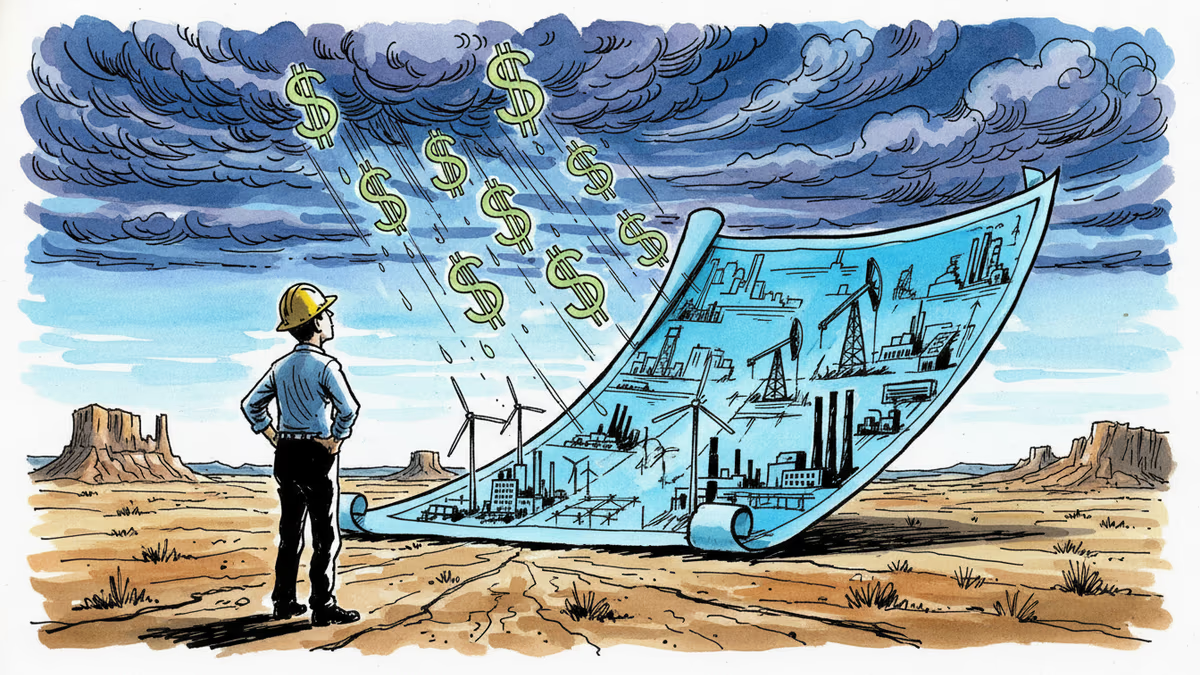
Musk's $119B Chip Bet: Ambition or Bluff?
SpaceX plans to invest at least $55 billion in a Texas AI chip factory called Terafab, with total costs potentially reaching $119 billion. We break down what's real, what's at stake, and who wins or loses.
$119 billion. That's not a typo — and it's not a government budget. It's what one private company says it might spend on a single chip factory in Texas.
SpaceX filed a public hearing notice in Grimes County, Texas, seeking tax breaks for a planned AI semiconductor facility it's calling Terafab. The filing puts the minimum investment at $55 billion, with a maximum figure of $119 billion if additional construction phases proceed. When Elon Musk first announced the project in March, he framed it with a single headline number: enough chips to support 200 gigawatts of AI computing per year. For context, that's roughly the entire current electricity consumption of the United Kingdom — applied to AI inference alone.
Why Build Your Own Chips at All?
The logic starts with a problem Musk knows intimately. Running xAI's Colossus supercomputer cluster in Memphis has made one thing painfully clear: in the AI race, the real constraint isn't talent or ideas — it's silicon. Nvidia's H100 and B200 GPUs are rationed like wartime supplies, with OpenAI, Google, Meta, and Microsoft all competing for the same limited pool.
Building Terafab is a bet that vertical integration solves this. Control your own chip supply, and you control your own destiny. It's the same logic Apple used when it ditched Intel for its own M-series processors — except Apple outsources fabrication to TSMC. SpaceX's ambition, apparently, is to own the manufacturing too.
There's also a financial argument. Every dollar spent on Nvidia GPUs is a dollar that doesn't compound inside Musk's own ecosystem. If xAI and future ventures can run on proprietary chips at lower marginal cost, the long-term economics look very different.
The Reality Check

The skeptics have a case. $119 billion isn't just a large number — it's larger than TSMC's entire Arizona investment ($65 billion) and Intel's Ohio fab ($20 billion) combined. Semiconductor fabrication is one of the most technically demanding manufacturing processes humans have ever attempted. TSMC spent decades accumulating the process knowledge, yield optimization, and supply chain depth that makes it the world's dominant chipmaker. The idea that a rocket company can replicate that in a compressed timeline — while simultaneously running an AI lab, a car company, a social media platform, and a satellite network — is not obviously true.
There's also the question of what these numbers actually mean. Tax incentive filings routinely cite maximum possible investment figures to maximize negotiating leverage with local governments. The $55 billion floor is significant; the $119 billion ceiling may be aspirational arithmetic.
That said, SpaceX has a habit of doing things aerospace veterans said were impossible. Reusable orbital rockets were considered economically unviable until they weren't. Tesla was written off as a toy until it restructured the global auto industry's cost assumptions. Dismissing Musk's manufacturing ambitions purely on precedent carries its own risks.
Who Wins, Who Worries
Texas is an obvious short-term winner regardless of outcome. The filing alone signals jobs, infrastructure spending, and political capital for a state that has been aggressively courting tech investment. Governor Greg Abbott has made semiconductor attraction a centerpiece of economic policy.
Nvidia has more to think about. Musk is currently one of its largest customers — xAI reportedly placed orders worth billions in GPU hardware. If Terafab eventually reduces that dependency, Nvidia loses a major revenue stream. But that transition, if it happens at all, is years away. In the near term, Nvidia still supplies the chips that will train whatever models Terafab eventually runs.
Smaller AI companies are watching with mixed feelings. A SpaceX-controlled chip supply chain primarily serves Musk's own ventures. It doesn't democratize access to compute — it concentrates it further. If Terafab succeeds, it widens the gap between companies that control their own infrastructure and those that don't.
Memory chipmakers — SK Hynix, Samsung, Micron — could see demand tailwinds. Any large-scale AI chip operation requires substantial HBM (high-bandwidth memory), which these companies supply. Terafab's growth, if real, means more memory orders.
This content is AI-generated based on source articles. While we strive for accuracy, errors may occur. We recommend verifying with the original source.
Related Articles
Nvidia shipped roughly a billion RISC-V cores in 2024, then announced it would run CUDA on the open standard. We break down how royalty-free instruction sets and open software stacks are trying to route around CUDA's lock-in. Part 2 of the Semiconductor Sovereignty series.
AMD's MI325X matches or beats Nvidia on memory and bandwidth — yet Nvidia's 86-92% share holds. The real moat is CUDA, 20 years in the making. Part 1 of 4.
American Airlines just signed Starlink for 500+ aircraft. It's not just about faster inflight internet — it's a calculated move in the run-up to what could be the largest IPO in history.
SpaceX's upgraded Starship V3 completed its first test flight, deploying 20 Starlink simulators but losing the Super Heavy booster. With an IPO weeks away, the stakes just got higher.
Nvidia shipped roughly a billion RISC-V cores in 2024, then announced it would run CUDA on the open standard. We break down how royalty-free instruction sets and open software stacks are trying to route around CUDA's lock-in. Part 2 of the Semiconductor Sovereignty series.
AMD's MI325X matches or beats Nvidia on memory and bandwidth — yet Nvidia's 86-92% share holds. The real moat is CUDA, 20 years in the making. Part 1 of 4.
American Airlines just signed Starlink for 500+ aircraft. It's not just about faster inflight internet — it's a calculated move in the run-up to what could be the largest IPO in history.
SpaceX's upgraded Starship V3 completed its first test flight, deploying 20 Starlink simulators but losing the Super Heavy booster. With an IPO weeks away, the stakes just got higher.
Thoughts
Share your thoughts on this article
Sign in to join the conversation