
$200M Raised, Then Gone: What Parker's Collapse Reveals
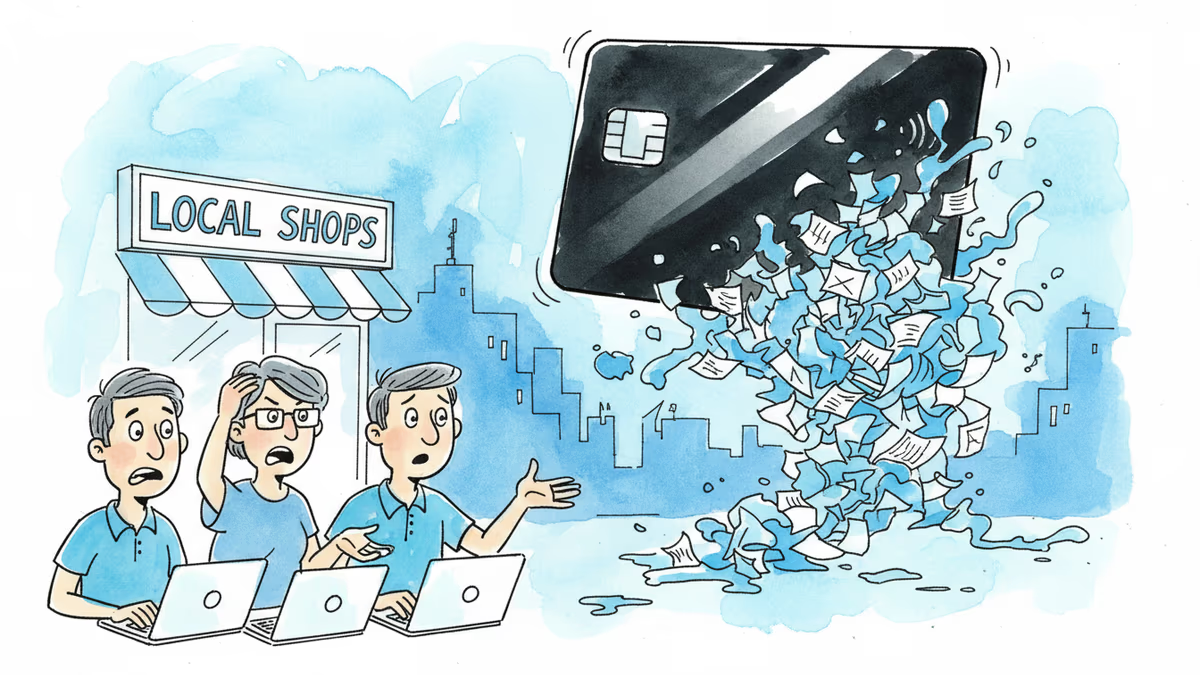
E-commerce fintech Parker filed for Chapter 7 bankruptcy on May 7, despite raising over $200M. The YC-backed startup's abrupt shutdown left small business customers scrambling—and exposed the fragility of vertical fintech models.
The Banner Is Still Up. The Company Is Gone.
Parker's website still boasts a funding milestone: over $200 million raised, including a $125 million lending arrangement. What it doesn't mention is the Chapter 7 bankruptcy filing the company made on May 7th. Not a restructuring. A liquidation.
Founded in 2019 as part of Y Combinator's winter cohort, Parker positioned itself as the financial stack built specifically for e-commerce businesses. Its Series A was led by Valar Ventures, the firm co-founded by Peter Thiel. When the startup emerged from stealth in 2023, co-founder and CEO Yacine Sibous described its edge plainly: an underwriting process that could actually read e-commerce cash flows — the kind of irregular, platform-dependent revenue cycles that traditional lenders routinely misread.
The pitch made sense. The execution, evidently, didn't hold.
What the Filing Says — and Doesn't
The May 7 bankruptcy filing lists assets between $50 million and $100 million, liabilities in the same range, and between 100 and 199 creditors. The company has not issued a public statement. Sibous has not acknowledged the shutdown or bankruptcy on LinkedIn. His most recent post references $65 million in revenue and offers a reflective note on what he'd do differently: "Avoid over-hiring, reactive decisions, and doomsayers."
The actual shutdown became public not through any official announcement, but through customers. Parker's card-issuing partner, Patriot Bank, sent a message to users confirming the closure. Those users — largely small e-commerce business owners — posted the notification online. Competitors moved quickly, publishing posts aimed at capturing Parker's displaced customer base.
Fintech consultant Jason Mikula reported that Parker had been in acquisition talks, and that the collapse of those negotiations triggered the abrupt shutdown. He noted the situation "has left small business customers in a tough spot" and raised questions about the oversight responsibilities of banking partners Piermont and Patriot.

The Structural Problem No One Talks About
Parker wasn't a bank. It operated on a BaaS (Banking as a Service) model — partnering with licensed banks and layering its own software and underwriting logic on top. This structure is now the default architecture for vertical fintech startups. It lowers the barrier to entry dramatically. It also creates a specific failure mode: when the startup collapses, the banking infrastructure doesn't go with it — but the customers do.
Small business owners who relied on Parker for their corporate cards and banking services had no transition period. No advance notice. Their financial operations simply stopped.
This isn't unique to Parker. Plastiq, Settle, and several other B2B fintech startups with similar positioning have quietly wound down over the past two years. Each time, the same pattern: a compelling niche thesis, significant early funding, and then a gap between revenue scale and operating costs that couldn't be closed.
Parker reaching $65 million in revenue while still arriving at bankruptcy suggests the problem wasn't product-market fit — it was unit economics and burn rate. "Over-hiring" is rarely a standalone cause of failure; it's usually a symptom of growth assumptions that stopped being true.
Three Stakeholders, Three Very Different Problems
For small business customers, the immediate question is operational: where do their transactions go, and how fast can they migrate to another provider? The lack of a wind-down notice period is the most concrete harm here.
For investors, Parker represents a familiar post-2021 story. Valar Ventures and other backers funded a company built for a high-growth, low-rate environment. When e-commerce growth normalized post-pandemic and interest rates climbed, the assumptions underpinning vertical fintech credit models became harder to defend.
For banking regulators, Mikula's question about Piermont's and Patriot's oversight is the one that may have the longest tail. As BaaS-dependent fintechs continue to fail, pressure is building on regulators — particularly the OCC and FDIC — to clarify what chartered banks owe customers when their fintech partners disappear. The current framework was not designed with abrupt shutdowns in mind.
This content is AI-generated based on source articles. While we strive for accuracy, errors may occur. We recommend verifying with the original source.
Related Articles
Lucra Sports CEO Dylan Robbins landed Cathie Wood's ARK Invest as a Series B lead without building AI. The story behind his unconventional fundraising playbook.

Indian venture capital has quietly displaced Silicon Valley in its own backyard. Only one American VC made India's top 10 investor list last year. Here's why that matters beyond India.
Venmo's biggest redesign since 2021 adds social features, personalized offers, and a revamped feed. But the timing — amid PayPal's restructuring and Stripe's reported interest — raises a harder question about who this update is really for.
Factory just raised $150M at a $1.5B valuation to build AI coding agents for enterprises. In a market already crowded with Cursor, Claude Code, and Cognition, investors say there's still room. Here's why that bet might make sense — and why it might not.
Lucra Sports CEO Dylan Robbins landed Cathie Wood's ARK Invest as a Series B lead without building AI. The story behind his unconventional fundraising playbook.
Indian venture capital has quietly displaced Silicon Valley in its own backyard. Only one American VC made India's top 10 investor list last year. Here's why that matters beyond India.
Venmo's biggest redesign since 2021 adds social features, personalized offers, and a revamped feed. But the timing — amid PayPal's restructuring and Stripe's reported interest — raises a harder question about who this update is really for.
Factory just raised $150M at a $1.5B valuation to build AI coding agents for enterprises. In a market already crowded with Cursor, Claude Code, and Cognition, investors say there's still room. Here's why that bet might make sense — and why it might not.
Thoughts
Share your thoughts on this article
Sign in to join the conversation