
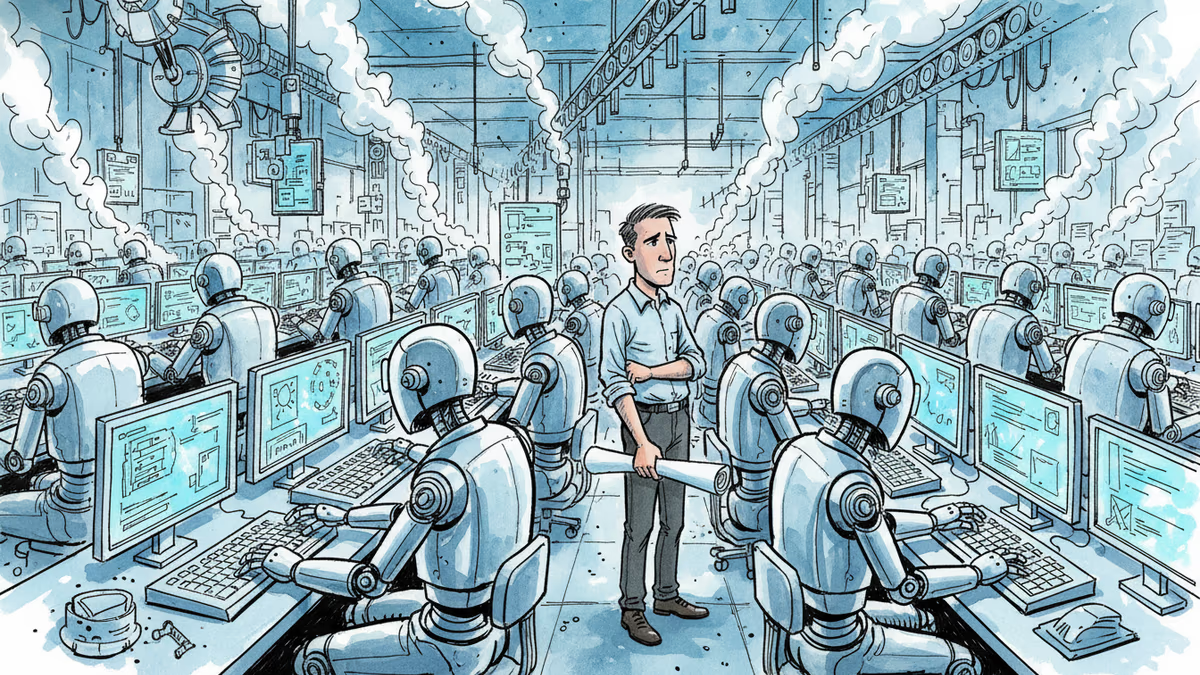
Another AI Coding Unicorn — But Does the Market Need One?
Factory just raised $150M at a $1.5B valuation to build AI coding agents for enterprises. In a market already crowded with Cursor, Claude Code, and Cognition, investors say there's still room. Here's why that bet might make sense — and why it might not.
A Crowded Room Just Got One More Chair
Three years into the generative AI era, the AI coding tools market looks, from the outside, like it should be full. GitHub Copilot has Microsoft's muscle. Cursor has developer mindshare. Claude Code has Anthropic's model advantage. Cognition is chasing fully autonomous software engineering. So why did Khosla Ventures, Sequoia Capital, Insight Partners, and Blackstone just write checks totaling $150 million into yet another player?
The answer says something important — not just about Factory, but about where the real money in AI coding is actually hiding.
What Factory Is, and What It's Claiming
Factory was founded in 2023 by Matan Grinberg, then a physics PhD student at UC Berkeley. His path to startup founder began with a cold email to Sequoia partner Shaun Maguire — a connection that clicked because both men share an academic background in the same corner of physics. Maguire convinced Grinberg to drop out. Sequoia backed the company at seed. Three years later, it's worth $1.5 billion.
The company builds AI agents for enterprise engineering teams. Current customers include Morgan Stanley, Ernst & Young, and Palo Alto Networks — organizations where engineering decisions move slowly, procurement cycles stretch across quarters, and security requirements are non-negotiable.
Grinberg's stated differentiator is model flexibility: Factory's agents can switch between foundation models — Anthropic's Claude, DeepSeek, or others — depending on the task. The idea is that enterprises shouldn't be locked into a single AI provider's performance ceiling.

It's a reasonable pitch. But it's worth noting that Cursor also runs on multiple models. Model-switching isn't a moat by itself.
The Real Market Nobody's Winning Yet
Here's the distinction that matters. The consumer and prosumer AI coding market — individual developers, small teams, indie hackers — is genuinely competitive. Cursor dominates mindshare. GitHub Copilot has distribution. Margins are thin, switching costs are low, and users churn fast.
The enterprise market is a different animal entirely. Think: a 500-person engineering organization at a global bank. They need audit trails. They need on-premise or private cloud options. They need integration with internal CI/CD pipelines built five years ago. They need someone to hold their hand through deployment. And they'll pay for all of it.
This is the gap Factory is targeting — and it's a gap that, despite all the noise in AI coding, still doesn't have a clear winner. The $1.5 billion valuation is essentially a bet that enterprise AI coding will be won by a dedicated vertical player, not by a general-purpose model provider or a developer-first tool that scales up.
Three Ways to Read This Round
From an investor's perspective, this is a high-conviction bet on enterprise software's next platform shift. If AI agents become the standard interface for engineering work at large organizations, the company that owns that relationship owns a very sticky, very recurring revenue stream. The presence of Blackstone — a private equity giant not typically associated with early-stage AI bets — signals that this round is being structured with an eye toward a clear exit path.
From a competitor's perspective, this is a validation and a threat. Anthropic is already pushing Claude Code aggressively into enterprise. OpenAI just expanded Codex with deeper desktop integration. Every dollar Factory raises is a signal that the enterprise segment is worth fighting for — which means the incumbents will fight harder for it too.
From a developer's perspective, the picture is more complicated. Tools that make senior engineers more productive are welcome. But tools that automate the work junior developers use to build their skills raise harder questions about how the next generation of engineers actually learns the craft. AI coding agents don't just change workflows — they may be quietly reshaping the career ladder.
Authors
Related Articles

Lucra Sports CEO Dylan Robbins landed Cathie Wood's ARK Invest as a Series B lead without building AI. The story behind his unconventional fundraising playbook.
Indian venture capital has quietly displaced Silicon Valley in its own backyard. Only one American VC made India's top 10 investor list last year. Here's why that matters beyond India.

E-commerce fintech Parker filed for Chapter 7 bankruptcy on May 7, despite raising over $200M. The YC-backed startup's abrupt shutdown left small business customers scrambling—and exposed the fragility of vertical fintech models.
SAP acquires German AI startup Prior Labs and commits €1 billion over four years to build a structured data AI lab. The deal signals a broader fight over who controls the enterprise AI stack — and which agents get through the gate.
Lucra Sports CEO Dylan Robbins landed Cathie Wood's ARK Invest as a Series B lead without building AI. The story behind his unconventional fundraising playbook.
Indian venture capital has quietly displaced Silicon Valley in its own backyard. Only one American VC made India's top 10 investor list last year. Here's why that matters beyond India.
E-commerce fintech Parker filed for Chapter 7 bankruptcy on May 7, despite raising over $200M. The YC-backed startup's abrupt shutdown left small business customers scrambling—and exposed the fragility of vertical fintech models.
SAP acquires German AI startup Prior Labs and commits €1 billion over four years to build a structured data AI lab. The deal signals a broader fight over who controls the enterprise AI stack — and which agents get through the gate.
Thoughts
Share your thoughts on this article
Sign in to join the conversation