
SAP's €1B Bet Reveals the Real Battleground in Enterprise AI
SAP acquires German AI startup Prior Labs and commits €1 billion over four years to build a structured data AI lab. The deal signals a broader fight over who controls the enterprise AI stack — and which agents get through the gate.
Three years into the enterprise AI boom, OpenAI's own COO admitted the obvious last February: "We have not yet really seen AI penetrate enterprise business processes." The gap between AI hype and actual enterprise adoption is real — and it's exactly where SAP just placed a €1 billion bet.
The Acquisition: €1B for an 18-Month-Old Startup
On Monday, SAP announced its intention to acquire Prior Labs, a German AI startup founded just 18 months ago by Frank Hutter, Noah Hollmann, and Sauraj Gambhir. The acquisition price wasn't disclosed, but sources told Pathfounders the deal was "almost all cash" — with well over $500 million paid upfront to the founders. Beyond the acquisition, SAP plans to invest €1 billion over the next four years to build Prior Labs into a dedicated AI research lab focused on structured data.
For context: Prior Labs had raised just $9.3 million in a pre-seed round led by Balderton Capital before this deal. Balderton partner James Wise called it "one of Germany's biggest ever venture outcomes."
So what exactly did SAP buy? Prior Labs' core technology is the Tabular Foundation Model (TFM) — AI models trained specifically to make predictions from data that lives in tables and databases, rather than natural language. Their open-source TabPFN model series has been downloaded over 3 million times by developers. SAP CTO Philipp Herzig put it plainly: "The greatest untapped opportunity in enterprise AI wasn't large language models; it was AI built for the structured data that runs the world's businesses."
This is a meaningful distinction. The vast majority of enterprise data — accounting records, HR files, procurement histories — doesn't live in documents or emails. It lives in rows and columns. LLMs are optimized for language. TFMs are optimized for exactly the kind of data SAP's entire product portfolio runs on.
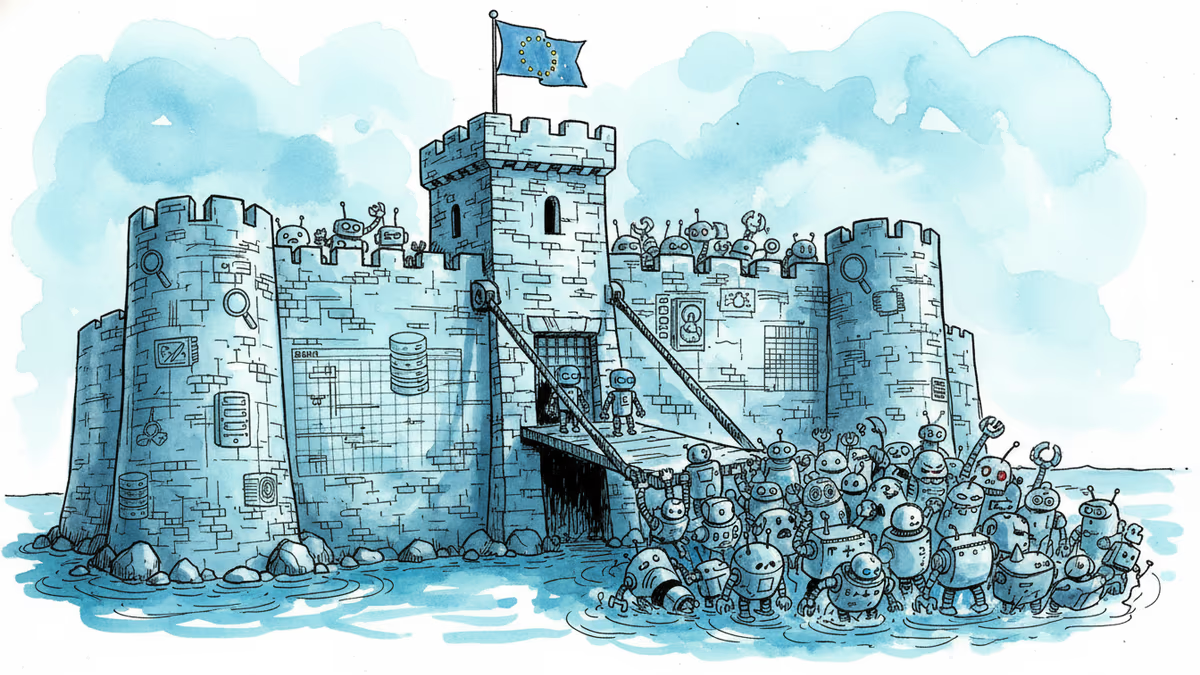
The Harder Story: SAP Is Locking Its Gates
The Prior Labs deal is the headline. The subtext is more consequential for SAP's customers.

As the enterprise software industry races toward agentic AI — systems where AI agents autonomously navigate software to complete tasks — SAP has quietly taken a hard line. The company has blocked OpenClaw and any other AI agent it hasn't explicitly authorized from accessing its products via API. SAP's official API policy states that only "SAP-endorsed architectures" are permitted. That list currently includes SAP's own Joule Agents (still in beta) and NemoClaw, Nvidia's enterprise-focused agent toolkit, which SAP integrated after Nvidia announced Joule support in March.
This puts SAP in direct contrast with Salesforce, which is navigating the same existential pressure — the so-called SaaSpocalypse, the threat that AI-native tools will displace traditional SaaS platforms — with the opposite strategy. Salesforce's new Headless 360 architecture lets enterprise customers bring whatever agent they want, including OpenClaw.
| SAP | Salesforce | |
|---|---|---|
| Agent access policy | Approved agents only | Customer's choice |
| Native agent product | Joule Agents (beta) | Einstein Agents |
| Third-party partners | NemoClaw (Nvidia) | OpenClaw + others |
| AI data strategy | Structured data / TFM | General-purpose LLM |
| Open-source stance | Committed to maintaining | Not applicable |
SAP's rationale isn't without logic. Enterprise data is sensitive. An unvetted agent roaming through payroll databases or financial records is a genuine liability risk, not just a competitive threat. The controlled ecosystem argument is also an enterprise sales argument: SAP customers can point to a curated, security-reviewed stack.
But the counterargument is equally clear. Restricting agent choice is a form of vendor lock-in — one that could frustrate enterprise buyers who are increasingly sophisticated about AI procurement. If Joule Agents doesn't outperform the competition in capability, SAP's gatekeeping becomes a liability rather than a feature.
Why This Matters Beyond SAP
SAP's moves this week are a preview of a broader industry dynamic. Every major enterprise software incumbent — Oracle, Workday, ServiceNow, Microsoft — faces the same question: do you control the AI layer that sits on top of your data, or do you let the market decide?
SAP is choosing control, and betting that TFMs give it a technical moat to justify that control. The company has been building toward this: it previously invested in Anthropic, Aleph Alpha, and Cohere (which is now merging with Aleph Alpha), and developed its own SAP-RPT-1 relational pretrained transformer. Prior Labs is the most direct move yet — acquiring the team and technology closest to SAP's actual data architecture.
The open-source commitment is notable too. SAP has promised that Prior Labs will maintain its open-source models while commercializing enterprise versions through SAP AI Core and SAP Business Data Cloud. It's a dual-track strategy: build goodwill with the developer community, monetize through the enterprise channel. Whether that balance holds under commercial pressure is worth watching.
For SAP's 300 million+ users across industries, the near-term implication is straightforward: the AI agents that will work inside their SAP environment will be chosen by SAP, not by them.
This content is AI-generated based on source articles. While we strive for accuracy, errors may occur. We recommend verifying with the original source.
Related Articles

Factory just raised $150M at a $1.5B valuation to build AI coding agents for enterprises. In a market already crowded with Cursor, Claude Code, and Cognition, investors say there's still room. Here's why that bet might make sense — and why it might not.

Nvidia unveiled NemoClaw at GTC 2026 — an enterprise-grade platform built on viral open-source agent framework OpenClaw. Is this the infrastructure play that defines the agentic AI era?
While Microsoft and Google battle with AI assistants, Glean is quietly building the intelligence layer between models and enterprise systems. Seven years of mapping enterprise data becomes their secret weapon.

Intel spin-off Articul8 hits a $500M valuation in its latest Series B funding round. The company is scaling its specialized AI agents for regulated industries globally.
Factory just raised $150M at a $1.5B valuation to build AI coding agents for enterprises. In a market already crowded with Cursor, Claude Code, and Cognition, investors say there's still room. Here's why that bet might make sense — and why it might not.
Nvidia unveiled NemoClaw at GTC 2026 — an enterprise-grade platform built on viral open-source agent framework OpenClaw. Is this the infrastructure play that defines the agentic AI era?
While Microsoft and Google battle with AI assistants, Glean is quietly building the intelligence layer between models and enterprise systems. Seven years of mapping enterprise data becomes their secret weapon.
Intel spin-off Articul8 hits a $500M valuation in its latest Series B funding round. The company is scaling its specialized AI agents for regulated industries globally.
Thoughts
Share your thoughts on this article
Sign in to join the conversation