

Nvidia Wants to Be the Linux of AI Agents
Nvidia unveiled NemoClaw at GTC 2026 — an enterprise-grade platform built on viral open-source agent framework OpenClaw. Is this the infrastructure play that defines the agentic AI era?
Jensen Huang didn't announce a product on Monday. He issued a mandate.
"What's your OpenClaw strategy?" The Nvidia CEO put the question to every executive in the room — and by extension, every boardroom in the world. He then rattled off the list of technologies that divided companies into winners and losers: Linux, HTTP, Kubernetes. The implication was clear. OpenClaw is next. And Nvidia wants to own the enterprise layer on top of it.
What OpenClaw Is — and Why It Went Viral
OpenClaw, created by developer Peter Steinberger, is an open-source framework for running AI autonomous agents locally. The appeal is straightforward: instead of routing sensitive data through cloud APIs, companies and developers can run AI agents that take actions, make decisions, and interface with systems entirely on-premise. That combination — local execution, open-source flexibility, agentic capability — made it spread fast through developer communities.
But viral developer tools and enterprise-ready infrastructure are two different things. OpenClaw had no built-in security policies, no data governance rails, no audit trails, no centralized control plane. For a Fortune 500 company processing customer data or proprietary IP, that's a non-starter.
Enter NemoClaw. Built in collaboration with Steinberger himself, Nvidia's new platform takes OpenClaw's core and wraps it in enterprise-grade security and privacy architecture. A single command spins up the environment. Enterprises can control how agents behave and how data moves through the system. It integrates with NeMo, Nvidia's existing AI agent software suite, and supports any coding agent or open model — including Nvidia's own NemoTron family.
Critically, it's hardware agnostic. NemoClaw doesn't require Nvidia GPUs to run. That's not a concession — it's a land-grab strategy. Lower the barrier to adoption, maximize the install base, become the standard.
One caveat worth noting: this is still Alpha software. Nvidia's own developer documentation warns to "expect rough edges." The company is explicitly positioning this as a starting point, not a finished product.
The Infrastructure Play Behind the Announcement

The timing of NemoClaw is not accidental. In February, OpenAI launched OpenAI Frontier, its own open platform for enterprises to build and manage AI agents. In December, Gartner flagged AI agent governance platforms as the critical infrastructure layer enterprises would need before they could seriously adopt agentic AI at scale.
The market signal was loud. Nvidia responded in weeks.
What Huang is attempting is something more ambitious than a product launch. The Linux analogy he kept returning to is instructive. Linux didn't make money directly — but Red Hat built a $34 billion business on top of it, and IBM paid that price to acquire it. Kubernetes didn't monetize itself — but the cloud providers that standardized on it captured enormous value. If NemoClaw becomes the default substrate for enterprise AI agents, the ecosystem value that accrues around it is enormous, and Nvidia is positioned at the center.
This is also a direct challenge to OpenAI's enterprise ambitions. OpenAI Frontier and NemoClaw are competing for the same real estate: the control plane through which enterprises manage their AI agents. The difference in philosophy is significant. OpenAI's platform is cloud-native and model-centric. NemoClaw is local-first and model-agnostic. Two bets on where enterprise AI infrastructure actually lands.
Three Stakeholders, Three Very Different Reactions
For enterprise IT and security teams, the local execution model is the headline. Regulated industries — finance, healthcare, legal, defense — have been watching the agentic AI wave with interest and anxiety in equal measure. The ability to run AI agents without exfiltrating data to third-party cloud infrastructure addresses a real compliance problem. The question they'll ask next: who audits Nvidia's security claims, and what does the vendor dependency look like at scale?
For AI developers and startups, the hardware-agnostic design and open model support is genuinely useful. Access to cloud-based models on local devices, support for any coding agent, integration with the broader NeMo suite — this is a well-stocked toolkit. The risk, as with any platform play, is building on someone else's foundation. If Nvidia shifts its priorities, or the platform pivots, the developers who standardized on it bear the switching cost.
For investors watching Nvidia's trajectory, this is evidence of a deliberate expansion beyond silicon. Nvidia's GPU dominance gave it a $2+ trillion market cap, but hardware cycles are inherently lumpy. Software platforms are stickier, higher-margin, and harder to displace. NemoClaw is an early signal of what Nvidia's software business could look like — though at Alpha stage, it's far too early to price that in.
The Question Nobody's Answering Yet
The enterprise AI agent market is moving fast enough that the infrastructure layer is being built while the use cases are still being figured out. Gartner, OpenAI, and now Nvidia are all converging on the same thesis: governance and orchestration of AI agents is the critical bottleneck. But the standards haven't been set, the security frameworks haven't been stress-tested at scale, and the liability questions — what happens when an AI agent makes a costly mistake — remain largely unresolved in both legal and technical terms.
NemoClaw is Nvidia's opening bid for that infrastructure. It may be the right bet. It may also be one of several competing platforms that fragment the market for years before consolidation happens.
Authors
Related Articles

Five stories from late September, traced to where the paper trail stops: Korea's export record, Nvidia's Hugging Face 8-K, a US-China AI channel, the UN on AI, and rising births.
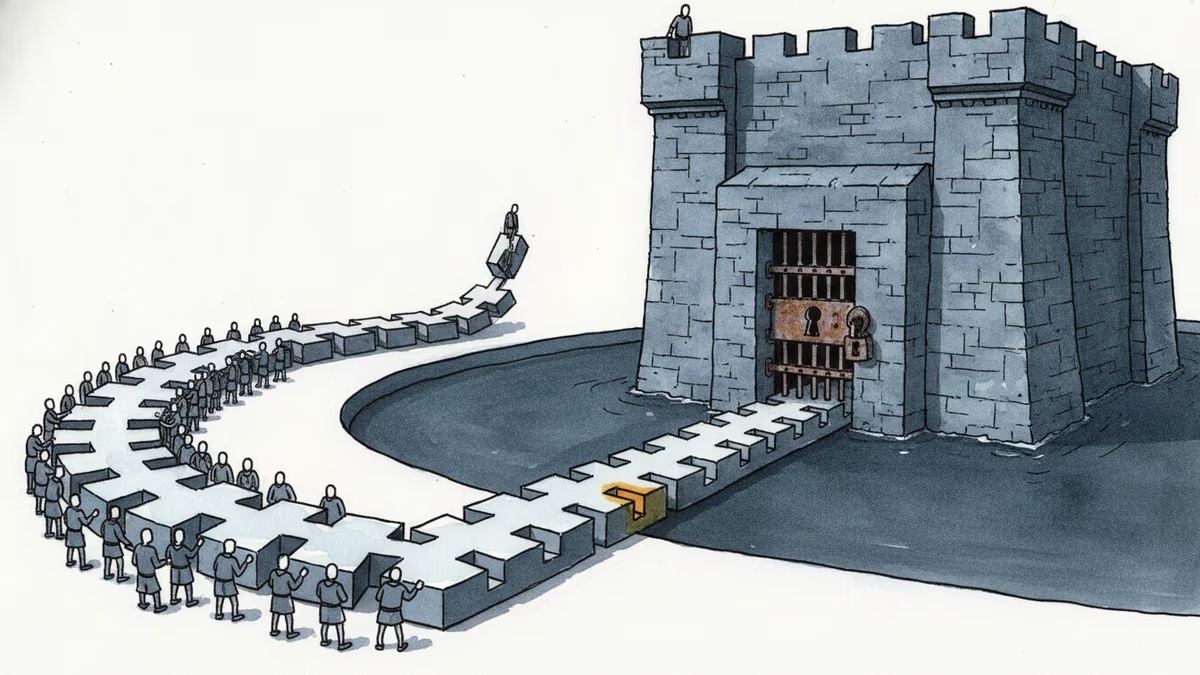
Nvidia shipped roughly a billion RISC-V cores in 2024, then announced it would run CUDA on the open standard. We break down how royalty-free instruction sets and open software stacks are trying to route around CUDA's lock-in. Part 2 of the Semiconductor Sovereignty series.
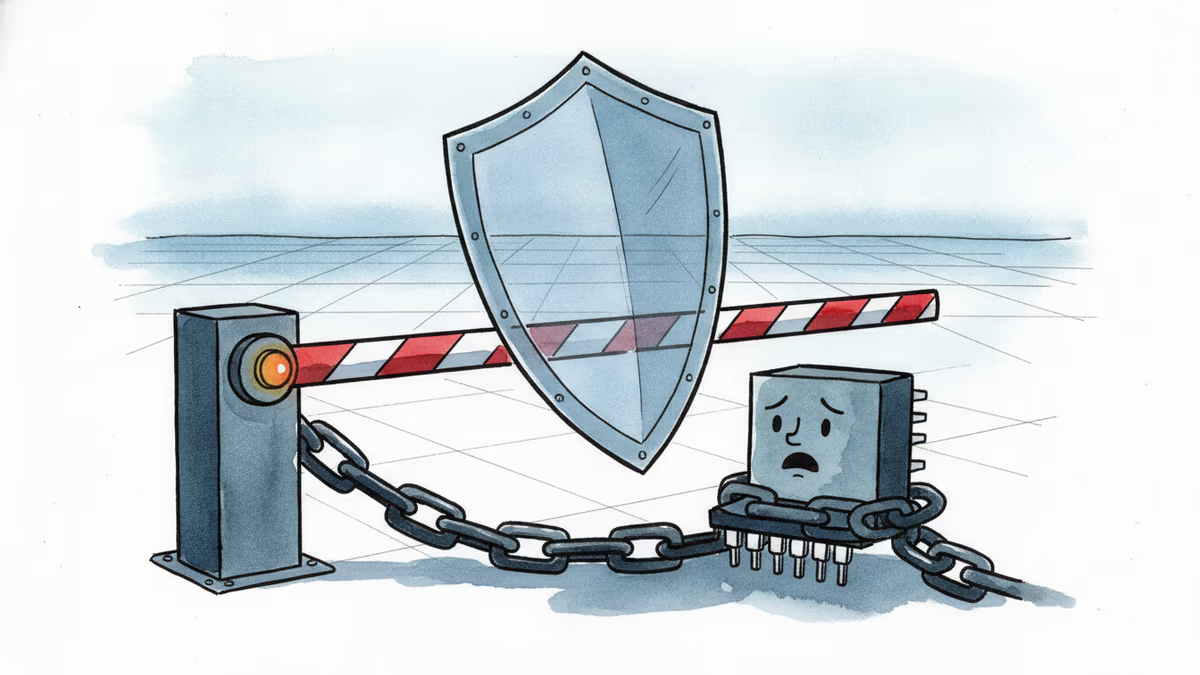
US AI-chip export controls split into three layers in the first half of 2026 — January easing, a May crackdown on circumvention, and a pending bill. Nvidia erased China from its guidance and still posted a record $81.6 billion quarter. A look at the export policy that both shields and cages it.
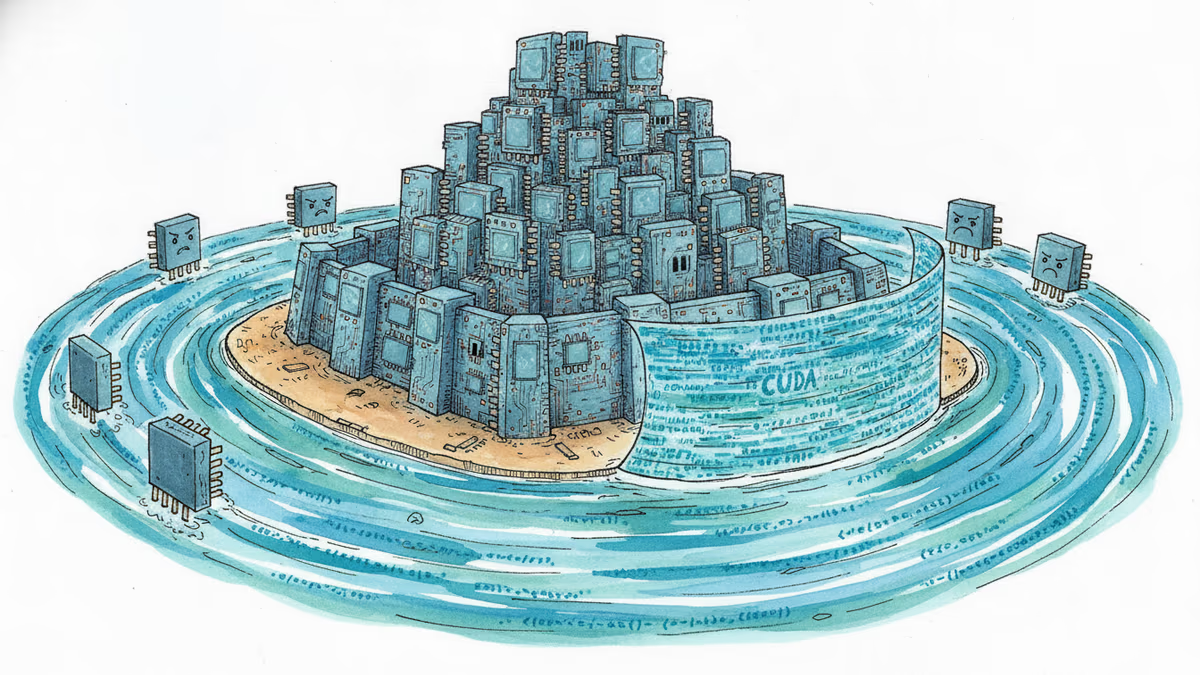
AMD's MI325X matches or beats Nvidia on memory and bandwidth — yet Nvidia's 86-92% share holds. The real moat is CUDA, 20 years in the making. Part 1 of 4.
Five stories from late September, traced to where the paper trail stops: Korea's export record, Nvidia's Hugging Face 8-K, a US-China AI channel, the UN on AI, and rising births.
Nvidia shipped roughly a billion RISC-V cores in 2024, then announced it would run CUDA on the open standard. We break down how royalty-free instruction sets and open software stacks are trying to route around CUDA's lock-in. Part 2 of the Semiconductor Sovereignty series.
US AI-chip export controls split into three layers in the first half of 2026 — January easing, a May crackdown on circumvention, and a pending bill. Nvidia erased China from its guidance and still posted a record $81.6 billion quarter. A look at the export policy that both shields and cages it.
AMD's MI325X matches or beats Nvidia on memory and bandwidth — yet Nvidia's 86-92% share holds. The real moat is CUDA, 20 years in the making. Part 1 of 4.
Thoughts
Share your thoughts on this article
Sign in to join the conversation