
He Pitched AI Without Building AI — And It Worked
Lucra Sports CEO Dylan Robbins landed Cathie Wood's ARK Invest as a Series B lead without building AI. The story behind his unconventional fundraising playbook.
What happens when the hottest investor in AI bets on a company that has nothing to do with AI?
Last month, Lucra Sports closed a $20 million Series B round led by Cathie Wood's ARK Invest Venture Fund. That's notable for two reasons. First, ARK previously took a painful loss on Skillz, a skill-based gaming platform with a similar profile — and still came back to the same sector. Second, and more striking: in a funding environment where VCs are practically refusing to take meetings with non-AI companies, Lucra doesn't build AI models, agents, or anything close.
So how did Dylan Robbins pull it off?
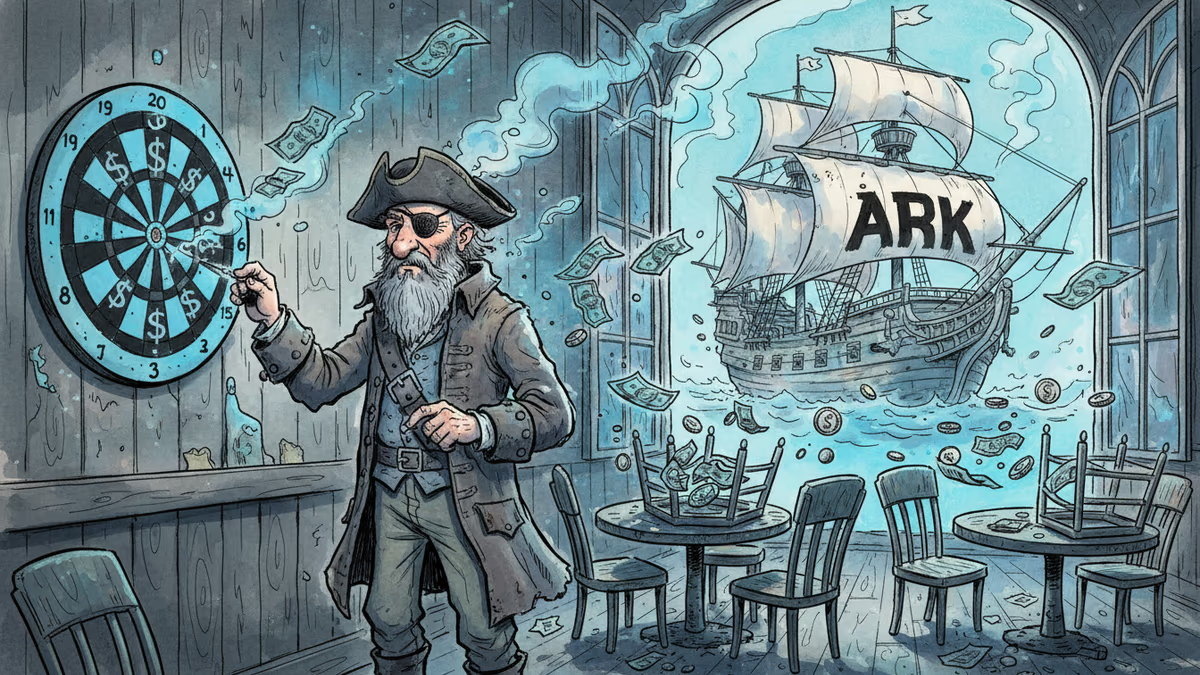
The Dartboard That Started It All
The origin story is almost implausibly casual. Robbins was playing darts at a bar in New York. He played a few games with a stranger, didn't think much of it. Six months later, they ran into each other at the same bar. This time, they actually talked about what they did for work. The stranger worked at ARK.
"You never know who you're talking to. Just go around, be nice, meet people, have fun," Robbins said. That chance encounter led to a small ARK check in his Series A — and eventually, the lead position in his Series B.
Lucra's product sits at the intersection of loyalty programs and competitive gaming. Instead of earning points toward a discount, customers of Lucra's clients — Five Iron Golf, Dave & Buster's, Chess King — can enter online tournaments or place friendly wagers. It's a white-label platform: Lucra builds the infrastructure, the brands put their name on it.

The AI Wall — and How He Climbed It
By Q4 2025, Robbins was ready to raise his Series B. The timing was rough. "One out of every three calls, the first line, they would stop the meeting and say, 'We're only investing in AI now,'" he recalled. "To the point where they wouldn't even let me pitch."
So he rewrote the deck. The new opening argument: if AI succeeds, people gain more free time — more time to play games with friends, online or at the bar. Lucra wins. If AI disappoints, a non-AI bet starts to look like smart portfolio diversification. Either way, it's a hedge.
It was a logical construction, not a product pivot. The company didn't change. The framing did. "It was a small cohort of people that would really take it seriously," Robbins admitted. ARK was one of them. Once ARK committed as lead, they made introductions to other VCs to help fill the round — a reminder that in venture, a credible lead doesn't just write a check, they open doors.
The Rejection Letter on the Wall
Underpinning the fundraise were solid fundamentals: consistent year-over-year growth, not a single spike. But Robbins learned that for a non-AI company, VCs need to believe in a very large dream. His TAM pitch covered everyone who plays any kind of game — pickleball, chess, Wordle — essentially every American between 18 and 70.
Still, one VC sent a rejection that read simply: "TAM's too small."
Robbins printed it out and pinned it to his wall. Not as a grievance — as a reminder. "I have to put myself in that mindset and really swing for the fences if I want to raise venture capital money," he said.
The round also included a strategic move: Lucra invested in a mini-game development partner to expand its product offering, signaling to investors that growth wasn't just about replicating what already worked.
This content is AI-generated based on source articles. While we strive for accuracy, errors may occur. We recommend verifying with the original source.
Related Articles

SolarSquare is raising $55-60M at a $450-500M valuation, more than doubling its worth in 18 months. Here's what's driving investor conviction in India's residential solar market.

Indian venture capital has quietly displaced Silicon Valley in its own backyard. Only one American VC made India's top 10 investor list last year. Here's why that matters beyond India.
Cerebras Systems IPO yields a $5.3 billion return for Benchmark. Explore the 8.5-year journey from a reluctant first meeting to challenging Nvidia's AI dominance.

E-commerce fintech Parker filed for Chapter 7 bankruptcy on May 7, despite raising over $200M. The YC-backed startup's abrupt shutdown left small business customers scrambling—and exposed the fragility of vertical fintech models.
SolarSquare is raising $55-60M at a $450-500M valuation, more than doubling its worth in 18 months. Here's what's driving investor conviction in India's residential solar market.
Indian venture capital has quietly displaced Silicon Valley in its own backyard. Only one American VC made India's top 10 investor list last year. Here's why that matters beyond India.
Cerebras Systems IPO yields a $5.3 billion return for Benchmark. Explore the 8.5-year journey from a reluctant first meeting to challenging Nvidia's AI dominance.
E-commerce fintech Parker filed for Chapter 7 bankruptcy on May 7, despite raising over $200M. The YC-backed startup's abrupt shutdown left small business customers scrambling—and exposed the fragility of vertical fintech models.
Thoughts
Share your thoughts on this article
Sign in to join the conversation