
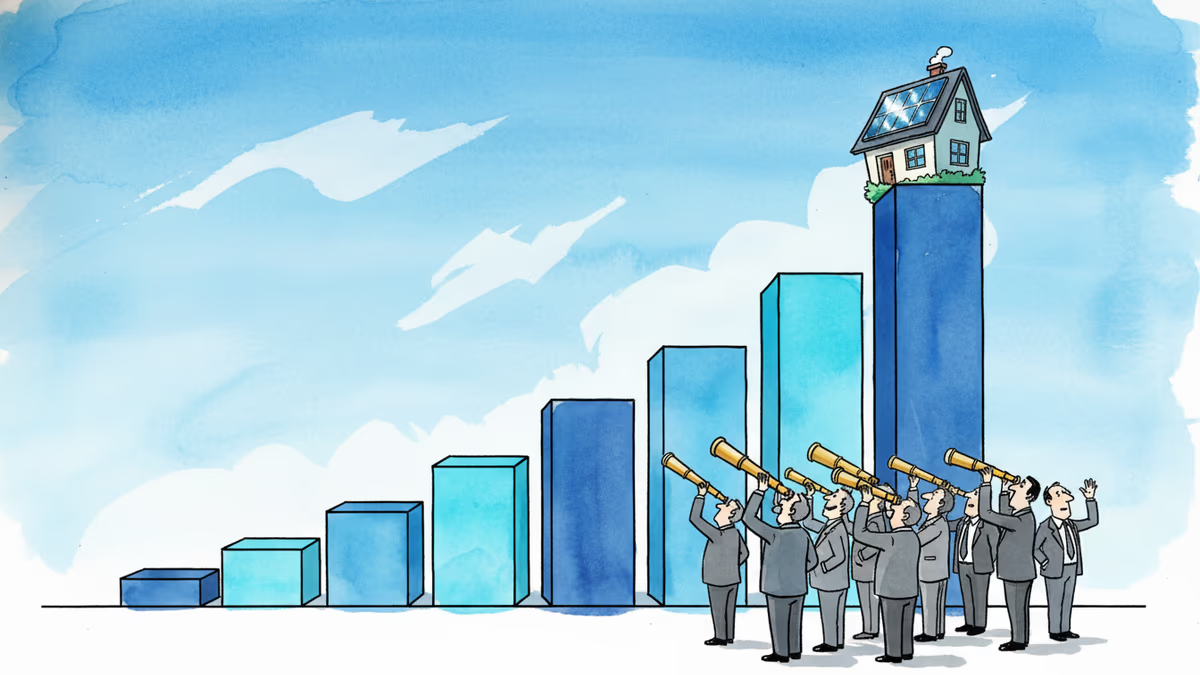
India's Rooftop Solar Bet Is Doubling Down — Fast
SolarSquare is raising $55-60M at a $450-500M valuation, more than doubling its worth in 18 months. Here's what's driving investor conviction in India's residential solar market.
From 3 gigawatts to 150 gigawatts in twelve years. India's solar buildout isn't a trend — it's a structural shift. And one startup is betting it can own the residential slice of it.
SolarSquare, an Indian rooftop solar company, is in advanced talks to close a $55–60 million Series C round co-led by B Capital and Lightspeed Venture Partners, TechCrunch has learned. The deal would value the Mumbai-based startup at $450–500 million — more than double its ~$200 million post-money valuation from just 18 months ago, when Lightspeed led its Series B in December 2024. Existing backer Elevation Capital is also expected to participate. The round is expected to close next month, though terms could still change.
The financing would bring SolarSquare's total equity raised to roughly $116 million.
The Market Nobody Has Figured Out Yet
India became the world's third-largest solar power producer in 2025, behind only China and the U.S. Its government has set a target of 500 GW of renewable energy by 2030, with solar expected to account for more than half. The policy tailwinds — subsidies, net metering schemes, grid connectivity mandates — are real.
But residential rooftop solar remains stubbornly fragmented. Walk into any Indian city and the solar installation market looks like the pre-consolidation taxi industry: hundreds of small local operators, inconsistent quality, no dominant brand, and dealer networks tied to component manufacturers like Tata Power, Waaree Energies, and Luminous Power Technologies. Nobody has built the equivalent of a national, full-service residential energy platform.
That's the gap SolarSquare is targeting. Founded in 2015, the company handles design, installation, and maintenance of rooftop solar systems for individual homes, housing societies (India's ubiquitous apartment complexes and gated communities), and enterprises. It now operates across 29 cities in 9 states, has installed more than 150 MW of solar capacity, and has powered nearly 50,000 homes and around 400 housing societies. Enterprise clients include Swiggy, Zepto, and iD Fresh Food — though the company has been deliberately pulling back from lower-margin industrial projects in favor of residential.

The Housing Society Playbook
Here's the part that makes the unit economics interesting. India's housing societies — think gated residential complexes housing anywhere from dozens to thousands of families — are a structurally efficient customer acquisition channel. Convince one managing committee, and you install for hundreds of households simultaneously. Customer acquisition cost drops. Installation density rises. Post-sale service becomes logistically manageable.
It's a distribution insight that's easy to underestimate from the outside. SolarSquare has leaned into it hard: residential customers and housing societies now account for the majority of its business. The result is an annualized revenue run rate that has crossed ₹10 billion (roughly $104 million) across homes and housing societies combined, according to a source familiar with the matter. The company is targeting 200 MW in its residential solar portfolio by end of this year.
What the Investor Signal Means
Notably, Lightspeed is investing this time through its growth fund — the same vehicle that backed Razorpay, India's dominant digital payments platform, and Zepto, the quick-commerce darling. That's not a seed-stage bet on a hypothesis. It's a growth-stage bet on a business that has already demonstrated scale.
B Capital, co-founded by Facebook co-founder Eduardo Saverin, has been building a meaningful emerging markets portfolio. Its co-lead here signals that global institutional capital is increasingly treating India's climate tech sector as a serious asset class, not an impact investing footnote.
Still, the bull case deserves scrutiny. Grid interconnection approvals in India remain inconsistent across states. Net metering policy — the mechanism that lets solar homeowners sell excess power back to the grid — varies by utility and has been subject to rollbacks in some regions. Scaling installation quality across 29 cities while maintaining margins is operationally hard. And larger energy conglomerates haven't fully entered the residential rooftop space yet. When they do, the competitive dynamics will change.
This content is AI-generated based on source articles. While we strive for accuracy, errors may occur. We recommend verifying with the original source.
Related Articles

Lucra Sports CEO Dylan Robbins landed Cathie Wood's ARK Invest as a Series B lead without building AI. The story behind his unconventional fundraising playbook.
Indian venture capital has quietly displaced Silicon Valley in its own backyard. Only one American VC made India's top 10 investor list last year. Here's why that matters beyond India.
Cerebras Systems IPO yields a $5.3 billion return for Benchmark. Explore the 8.5-year journey from a reluctant first meeting to challenging Nvidia's AI dominance.

Moonshot AI raised $2B at a $20B valuation. Its Kimi models rank second on OpenRouter. What China's open-weight AI surge means for the global LLM market.
Lucra Sports CEO Dylan Robbins landed Cathie Wood's ARK Invest as a Series B lead without building AI. The story behind his unconventional fundraising playbook.
Indian venture capital has quietly displaced Silicon Valley in its own backyard. Only one American VC made India's top 10 investor list last year. Here's why that matters beyond India.
Cerebras Systems IPO yields a $5.3 billion return for Benchmark. Explore the 8.5-year journey from a reluctant first meeting to challenging Nvidia's AI dominance.
Moonshot AI raised $2B at a $20B valuation. Its Kimi models rank second on OpenRouter. What China's open-weight AI surge means for the global LLM market.
Thoughts
Share your thoughts on this article
Sign in to join the conversation