
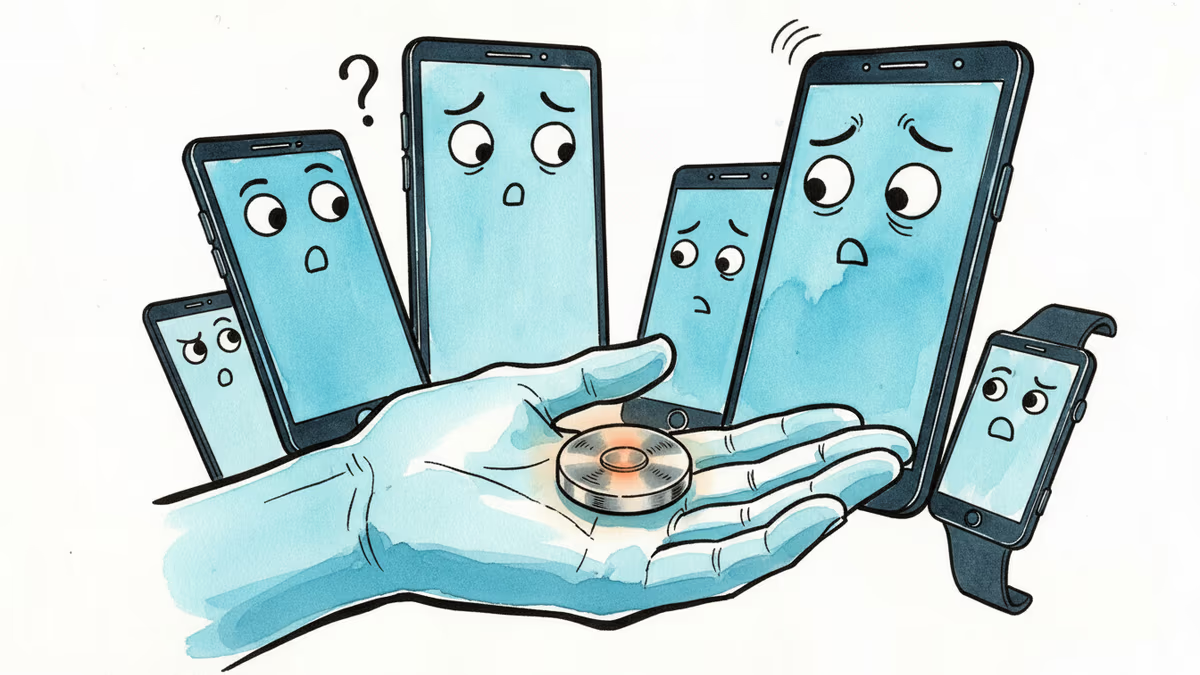
A Button That Answers Back: AI's Smallest Bet Yet
Two ex-Apple engineers built an AI puck that only listens when you press it. At $179, Button is a deliberate bet that dedicated AI hardware beats the Swiss Army knife approach of smartphones.
The Humane Ai Pin lasted exactly one year before it was shut down. Before that, there was the Rabbit R1. Before that, a necklace that mostly became a meme. The AI hardware graveyard fills up fast. So why does anyone think a button — literally, a button — is going to be different?
What It Is, and What It Isn't
Two former Apple engineers, Chris Nolet and Ryan Burgoyne, have built something they're calling Button. It's a small brushed-aluminum puck — they'll tell you it looks like an iPod Shuffle, because that's exactly what they were going for — with a generative AI chatbot inside. Press the button, ask your question, get an answer. Out loud, or through earbuds and smart glasses via Bluetooth. Available for preorder at $179, shipping in December.
Nolet and Burgoyne worked on the Apple Vision Pro before leaving to found the company, which is backed by Y Combinator. Their pitch is built on two words: privacy and speed.
On privacy: the device only activates when you physically press the button. No passive listening. No always-on microphone. Nolet says the decision wasn't just a product feature — it was personal. He once discovered, after the fact, that someone he'd been having a conversation with had been recording the entire thing on a wearable device. "It really freaked me out," he says. "It's one thing if I make a conscious decision to share something. But if people are just wearing around these pendants recording all of our conversations — that feels a little icky."
On speed: in a live demo, a local restaurant query came back in under a second. That's a direct shot at the Humane Ai Pin, which became infamous for response times that made users visibly impatient. Button also lets you cut off a response mid-sentence by pressing again — a small feature that turns out to matter a lot when you've already heard enough.
Standing on the Shoulders of Giants
Nolet's core argument draws on media analyst Ben Thompson's writing about cyclical hardware-software development. The smartphone didn't invent the internet — it just turned out to be a far better vessel for it than the PC. Button's thesis is that generative AI is the new internet, and smartphones, built in a pre-voice-AI era, aren't its natural home.
"You can use AI on your PC, you can use it on your phone," Nolet says. "But our pitch is that it's better on the Button."

He's careful to avoid the trap that swallowed Humane. "We are not trying to replace the phone," he says. "It's a complementary device." The framing is modest by design — a second screen rather than a first one, a dedicated tool rather than a universal one.
The Vision Pro experience also informs what Button is not. Nolet argues that VR headsets struggled partly because the industry had to build hardware and software ecosystems simultaneously, from scratch, with no proven user behavior to anchor to. Button has the opposite problem — almost too much existing AI infrastructure to plug into. "It's much, much easier to stand on the shoulders of giants," he says.
A Crowded Graveyard, A Crowded Market
The honest question is whether Button has a real lane to occupy, or whether it's about to get squeezed from both sides.
From below: smartphones are already doing this. Siri, Google Assistant, and ChatGPT's mobile app all respond to voice queries. For most people, the friction of pulling out a phone isn't the barrier — it's muscle memory. Convincing someone to carry a second device requires a compelling reason that "it's faster" may not fully provide.
From above: OpenAI is reportedly developing its own AI hardware. Meta has already shipped AI-integrated Ray-Ban smart glasses, which have found a surprisingly receptive audience. Apple itself could deepen AI integration into AirPods or Apple Watch with a software update. Any of these moves narrows the gap Button is trying to occupy.
For privacy advocates, though, the button-to-activate model is genuinely differentiated. In a world where Amazon Echo and Google Nest have normalized always-on listening, a device that is architecturally incapable of passive surveillance is a meaningful design choice, not just a marketing line.
Who's Actually Buying This?
The $179 price point is accessible enough to be an impulse buy for early adopters, but the use case has to be clear before checkout. Product images lean heavily into the wearable angle — clipped to a shirt, worn like a badge — but Nolet acknowledges it works just as well in a pocket or a glove box. That flexibility is smart: it doesn't force a lifestyle commitment the way a wearable does.
For investors watching the AI hardware space, the Y Combinator pedigree and the Apple engineering background are credibility signals. But the same traits that make Button appealing — simplicity, focus, restraint — also make it easy to replicate. If the form factor works, nothing stops a larger player from shipping something nearly identical at a lower price.
The iPod Shuffle comparison cuts both ways. It was cool, it was simple, and Apple eventually killed it when the iPhone made it redundant.
Authors
Related Articles
The FTC fined Cox Media and two ad firms $930,000 — not for actually eavesdropping on users, but for falsely claiming they could. The case raises uncomfortable questions about surveillance capitalism.

Lucra Sports CEO Dylan Robbins landed Cathie Wood's ARK Invest as a Series B lead without building AI. The story behind his unconventional fundraising playbook.
Xreal's Project Aura debuted at Google I/O with OLED displays, hand tracking, and an IPO on the horizon. The industry has burned billions for a decade. So why does it feel like something has actually shifted?

Google's Gmail Live lets you ask your inbox questions out loud. Announced at I/O 2026, it's AI's pitch to skeptics — and a reminder of how much Google already knows about you.
The FTC fined Cox Media and two ad firms $930,000 — not for actually eavesdropping on users, but for falsely claiming they could. The case raises uncomfortable questions about surveillance capitalism.
Lucra Sports CEO Dylan Robbins landed Cathie Wood's ARK Invest as a Series B lead without building AI. The story behind his unconventional fundraising playbook.
Xreal's Project Aura debuted at Google I/O with OLED displays, hand tracking, and an IPO on the horizon. The industry has burned billions for a decade. So why does it feel like something has actually shifted?
Google's Gmail Live lets you ask your inbox questions out loud. Announced at I/O 2026, it's AI's pitch to skeptics — and a reminder of how much Google already knows about you.
Thoughts
Share your thoughts on this article
Sign in to join the conversation