
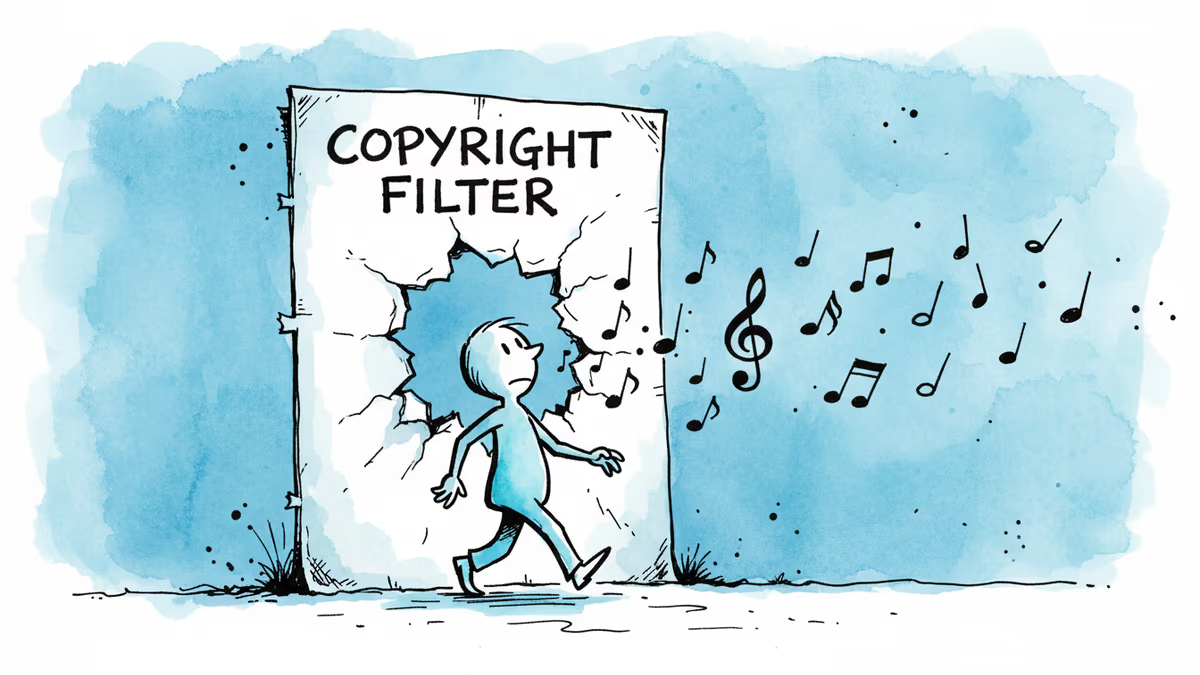
Suno's Copyright Filter Crumbles Under Free Software
Suno's AI music platform claims to block copyrighted content, but researchers found its filters can be bypassed with minimal effort and free tools, generating near-identical imitations of Beyoncé, Black Sabbath, and more.
If a copyright filter can be defeated with free software and a few minutes of effort, does it actually exist?
That's the uncomfortable question now facing Suno, one of the most prominent AI music generation platforms on the market — and the answer, based on recent reporting by The Verge, appears to be: not really.
What Suno Promised, and What Actually Happened
Suno's pitch to the world has always included a reassurance: the platform won't let you steal other people's music. Users can upload their own tracks for remixing, set original lyrics to AI-generated compositions, and explore a wide range of creative tools. But copyrighted songs and lyrics from other artists? Blocked, filtered, stopped.
Except they aren't. With nothing more than free, readily available software and minimal technical know-how, Suno can be coaxed into generating AI imitations of Beyoncé's "Freedom," Black Sabbath's "Paranoid," and Aqua's "Barbie Girl" — versions close enough to the originals that most listeners would recognize them immediately. No specialized hacking skills required. No paid tools. Just a workaround that, once you know it, takes almost no effort to execute.
This isn't a minor edge case. It's a direct contradiction of what Suno has publicly committed to.
The Timing Could Not Be Worse

This revelation lands while Suno is already in the middle of a significant legal battle. The Recording Industry Association of America (RIAA), alongside major labels including Sony Music, Universal Music Group, and Warner Music, filed a copyright infringement lawsuit against Suno last year. The case centers partly on whether copyrighted recordings were used without authorization to train Suno's AI models.
Suno has maintained that it respects copyright. But a filter that collapses under light pressure doesn't exactly reinforce that argument in court — or in public. The gap between policy and practice has rarely been this visible.
For the broader AI music industry, the implications stretch further. Udio, Stability AI, and others operating in the same space now face an implicit question: if Suno's safeguards don't hold, what about theirs?
Who's Watching, and What They See
For musicians and rights holders, this is less a technical story than an existential one. The creative economy has spent decades building legal frameworks to protect original work. The idea that an AI platform can reconstruct a recognizable version of your song — and that the platform's own safeguards won't stop it — feels like those frameworks being quietly dismantled from the inside.
For platform investors and the tech industry, the episode raises a harder question about liability. Under U.S. copyright law, platforms can claim safe harbor protections if they take reasonable steps to prevent infringement. Whether a filter this easily bypassed qualifies as "reasonable" is precisely the kind of argument that could define Suno's legal exposure going forward.
For regulators, particularly in the EU where the AI Act is beginning to take shape, this is a data point. Voluntary compliance measures and self-policing by AI companies have always been viewed skeptically by Brussels. Cases like this tend to accelerate calls for binding technical standards.
For everyday users, the picture is more complicated. Many people who might stumble onto this workaround won't understand they're crossing a legal line. The platform's apparent permissiveness could create inadvertent infringers — users who believed the system would stop them if they went too far.
Authors
Related Articles
Google's Gmail Live lets you ask your inbox questions out loud. Announced at I/O 2026, it's AI's pitch to skeptics — and a reminder of how much Google already knows about you.
Five major publishers and author Scott Turow have filed a class action lawsuit against Meta, alleging the company used illegal pirate sites like LibGen to train its Llama AI models without permission.
Two ex-Apple engineers built an AI puck that only listens when you press it. At $179, Button is a deliberate bet that dedicated AI hardware beats the Swiss Army knife approach of smartphones.
OpenAI killed Sora six months after launch — not because of a data scandal, but because it was hemorrhaging money while users walked away. A WSJ investigation reveals what really happened, and what it means for the AI industry.
Google's Gmail Live lets you ask your inbox questions out loud. Announced at I/O 2026, it's AI's pitch to skeptics — and a reminder of how much Google already knows about you.
Five major publishers and author Scott Turow have filed a class action lawsuit against Meta, alleging the company used illegal pirate sites like LibGen to train its Llama AI models without permission.
Two ex-Apple engineers built an AI puck that only listens when you press it. At $179, Button is a deliberate bet that dedicated AI hardware beats the Swiss Army knife approach of smartphones.
OpenAI killed Sora six months after launch — not because of a data scandal, but because it was hemorrhaging money while users walked away. A WSJ investigation reveals what really happened, and what it means for the AI industry.
Thoughts
Share your thoughts on this article
Sign in to join the conversation