
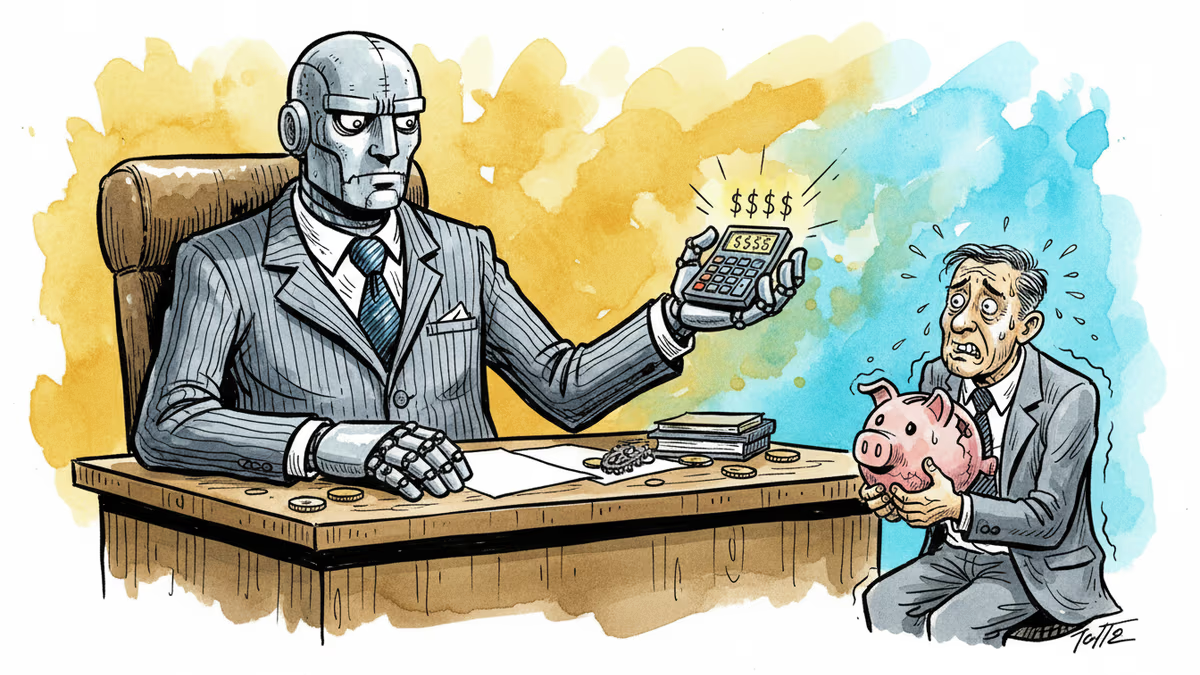
OpenAI Just Bought a Personal Finance App. Now What?
OpenAI acquired Hiro Finance, an AI-powered personal finance startup. Is this just a talent grab, or is the ChatGPT maker quietly building a financial services empire?
Your Next Financial Advisor Might Already Know Your Passwords
OpenAI just bought a personal finance startup. The deal is small — roughly 10 employees, no disclosed price tag, and the product shuts down April 20. But the pattern it fits into is anything but small.
On Monday, Hiro Finance founder Ethan Bloch announced the acquisition. OpenAI confirmed it to TechCrunch. All user data will be wiped from servers by May 13. Classic acquihire.
What Hiro Actually Built
Founded in 2023 and live for just five months, Hiro Finance offered AI-powered financial planning for consumers. Users fed it their salary, debts, and monthly expenses. The app then ran what-if scenarios — what if I refinance? what if I cut subscriptions? what if I invest an extra $500 a month? — to help people make real financial decisions.
The distinguishing feature wasn't the interface. It was the math. Bloch specifically trained Hiro to be accurate at financial calculations and built in a verification layer so users could check the AI's work. That's not a trivial problem. For years, large language models have been notoriously unreliable at complex arithmetic. Hiro was purpose-built to fix that, at least in the personal finance domain.
The startup had serious backing: Ribbit Capital, the A-list fintech VC, alongside General Catalyst and Restive. Total funding was never disclosed.
Why This Founder Matters
Bloch isn't a first-time founder chasing an exit. Hiro was his 15th project. He started as a tech entrepreneur at 13. The first 13 ventures failed. Number 14 — Flowtown, a social media SaaS tool — sold for $4.5 million in 2009. Number 14 was Digit, an automated savings app that he sold to Oportun in 2021 for roughly $230 million.

He also built RoboBuffett — his own automated stock-trading agent running on OpenClaw, a popular robo-trading platform. That detail matters more than it might seem.
The Bigger Play
This isn't OpenAI's first move into financial apps. The company already markets ChatGPT as a tool for business finance teams. Now it's adding a founder who has spent his career at the intersection of consumer finance and automation — and who has hands-on experience building trading agents.
Three things make this acquisition worth watching closely.
First, the math problem is getting solved. Two years ago, asking GPT-4 to model amortization schedules or tax-loss harvesting scenarios was a gamble. The models have improved dramatically, and Hiro's team was specifically focused on making AI financial math reliable. That expertise is now inside OpenAI.
Second, the product roadmap question. Will OpenAI fold this capability into ChatGPT as a feature, or build a standalone financial planning app? A specialized vertical app would put it in direct competition with Mint successors, YNAB, and the financial planning tools embedded in apps like Robinhood and SoFi.
Third, the automation angle. Bloch's RoboBuffett wasn't just a chatbot — it was an agent that executed trades. OpenAI has been heavily investing in agentic AI that doesn't just advise but acts. Combining personal finance data with autonomous execution capability is a qualitatively different product than a budgeting app.
Who's Nervous, Who's Excited
For independent financial advisors and CFPs, this is another data point in an uncomfortable trend. OpenAI isn't the first to try AI-powered financial planning, but it has 300 million weekly ChatGPT users and the distribution to make a financial feature mainstream overnight.
For regulators, the questions are harder. Financial advice in the US is governed by fiduciary standards, SEC oversight, and state-level licensing requirements. An AI that tells you to rebalance your portfolio — or worse, does it automatically — sits in murky legal territory. The Hiro acquihire brings talent that has navigated this landscape before.
For consumers, the pitch is genuinely appealing: personalized financial modeling, available 24/7, at no incremental cost inside a subscription you already pay for. The tradeoff is feeding your salary, debt load, and spending habits into a system operated by one of the world's most powerful AI companies.
Authors
Related Articles

OpenAI has reorganized for the second time in a month, merging ChatGPT and Codex into a single agentic platform under president Greg Brockman's unified product leadership.
After two weeks of witnesses calling him a liar, OpenAI CEO Sam Altman testified in his own defense, claiming Elon Musk tried to kill the company twice.

Sam Nelson, 19, died after following ChatGPT's advice to mix Kratom and Xanax. His parents are suing OpenAI for wrongful death, raising urgent questions about AI trust, liability, and design.

OpenAI's new Daybreak initiative uses the Codex AI agent to find and patch security vulnerabilities before attackers do—putting it in direct competition with Anthropic's secretive Claude Mythos.
OpenAI has reorganized for the second time in a month, merging ChatGPT and Codex into a single agentic platform under president Greg Brockman's unified product leadership.
After two weeks of witnesses calling him a liar, OpenAI CEO Sam Altman testified in his own defense, claiming Elon Musk tried to kill the company twice.
Sam Nelson, 19, died after following ChatGPT's advice to mix Kratom and Xanax. His parents are suing OpenAI for wrongful death, raising urgent questions about AI trust, liability, and design.
OpenAI's new Daybreak initiative uses the Codex AI agent to find and patch security vulnerabilities before attackers do—putting it in direct competition with Anthropic's secretive Claude Mythos.
Thoughts
Share your thoughts on this article
Sign in to join the conversation