
Europe's Deep Tech Startups Are Dying Despite Billions in Funding
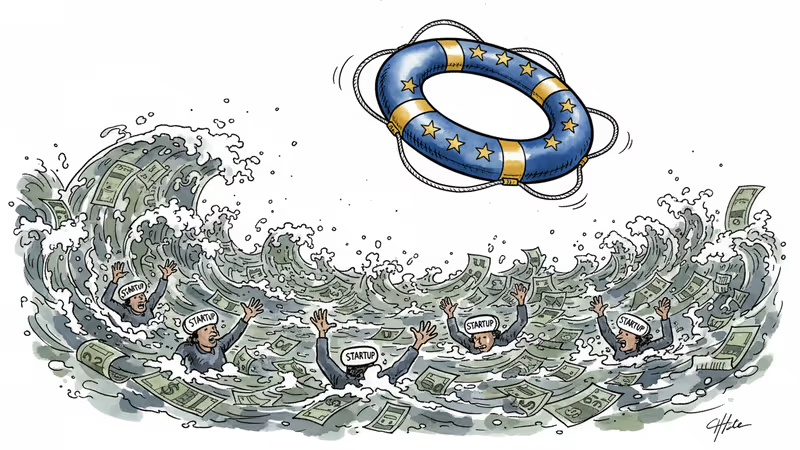
Europe pours billions into early-stage climate startups, only to watch them fail at Series B. New funds like Kembara are trying to bridge this 'valley of death.
A $1 billion fundraise couldn't save German electric aircraft startup Lilium from bankruptcy in 2024. This spectacular failure exposes a fundamental flaw in Europe's deep tech ecosystem: plenty of early-stage capital, but a deadly shortage of growth funding when startups need it most.
Enter Kembara Fund I, which just closed its first €750 million round and could reach €1.25 billion at final close. The fund, managed by Spain-based Mundi Ventures, is designed specifically to fill Europe's Series B funding gap—what many call the "valley of death" for deep tech startups.
The Scale-Up Problem
Yann de Vries, Kembara's co-founder, knows this pain intimately. As a former executive at Lilium, he watched the company collapse despite raising over $1 billion and going public via SPAC. "Europe doesn't have an innovation problem. It doesn't have a startup problem. The problem it has is a scale-up problem," he said.
The numbers tell the story. Europe excels at spinning out university research into startups, but too many die when they need €15-40 million checks to scale manufacturing and expand globally. Unlike the US or China, Europe lacks the deep pools of growth capital needed for capital-intensive deep tech companies.
Kembara plans to write initial checks of €15-40 million into about 20 companies, with follow-on investments potentially reaching €100 million per company. That's larger than many entire European funds, though the landscape is changing—Plural is reportedly raising up to €1 billion, while LEC (Lazard Elaia Capital) targets €20-60 million initial investments.
Beyond Equity: A New Playbook

Lilium's collapse taught de Vries that equity-only funding creates a dangerous trap. Companies burn through capital building hardware, then struggle to raise follow-on rounds when they're still pre-revenue. Kembara is developing what de Vries calls "productized non-dilutive financing"—combining venture debt, co-investments, and strategic partnerships to minimize dilution.
This approach reflects broader geopolitical shifts. European governments and sovereign wealth funds increasingly want to prevent their champions from being acquired too early by foreign buyers. The $500 million Google acquisition of DeepMind in 2014—now worth billions—serves as a cautionary tale.
The Geopolitical Dimension
Kembara's focus includes dual-use and defense tech to "protect European sovereignty." This isn't just rhetoric—it reflects genuine concern about technological dependence. As trade tensions rise, countries are examining their exposure to US and Chinese supply chains, creating opportunities for European alternatives in quantum computing, semiconductors, and space tech.
The fund's name—"kembara" means "to wander" in Malaysian—hints at global ambitions despite European roots. Co-founder Javier Santiso previously led Malaysian sovereign wealth fund Khazanah's European operations, and the team plans to court global investors in their second close.
The Innovation Paradox
Europe's struggle reveals a deeper paradox: having world-class research doesn't guarantee commercial success. Universities produce cutting-edge technology, but translating lab breakthroughs into scalable businesses requires patient capital, manufacturing expertise, and global market access—areas where Europe still lags.
Yet this creates opportunities. De Vries argues that "lots of gems are under the radar in Europe" that could become global champions with proper funding. The question is whether funds like Kembara can scale fast enough to capture them before they're acquired or relocate.
Authors
Related Articles

Lucra Sports CEO Dylan Robbins landed Cathie Wood's ARK Invest as a Series B lead without building AI. The story behind his unconventional fundraising playbook.

SolarSquare is raising $55-60M at a $450-500M valuation, more than doubling its worth in 18 months. Here's what's driving investor conviction in India's residential solar market.

Indian venture capital has quietly displaced Silicon Valley in its own backyard. Only one American VC made India's top 10 investor list last year. Here's why that matters beyond India.
Cerebras Systems IPO yields a $5.3 billion return for Benchmark. Explore the 8.5-year journey from a reluctant first meeting to challenging Nvidia's AI dominance.
Lucra Sports CEO Dylan Robbins landed Cathie Wood's ARK Invest as a Series B lead without building AI. The story behind his unconventional fundraising playbook.
SolarSquare is raising $55-60M at a $450-500M valuation, more than doubling its worth in 18 months. Here's what's driving investor conviction in India's residential solar market.
Indian venture capital has quietly displaced Silicon Valley in its own backyard. Only one American VC made India's top 10 investor list last year. Here's why that matters beyond India.
Cerebras Systems IPO yields a $5.3 billion return for Benchmark. Explore the 8.5-year journey from a reluctant first meeting to challenging Nvidia's AI dominance.
Thoughts
Share your thoughts on this article
Sign in to join the conversation