
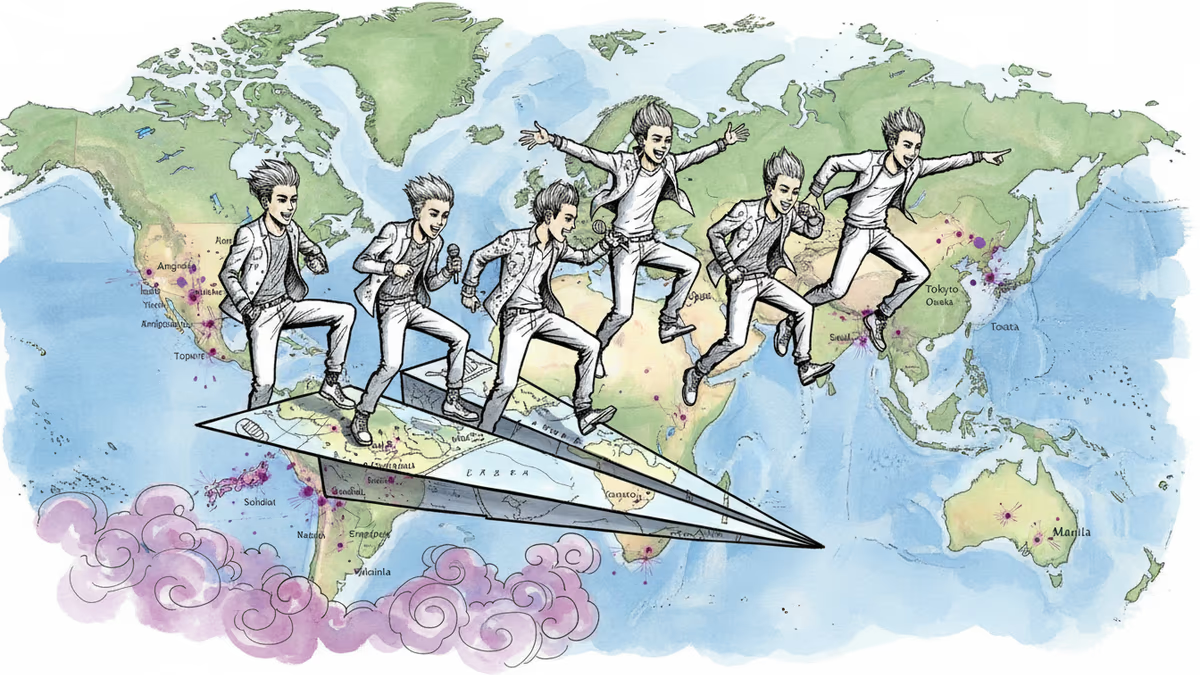
BOYNEXTDOOR's World Tour Reveals K-Pop's New Geography
BOYNEXTDOOR's 2026-27 'KNOCK ON Vol.2' tour spans 8 North American cities, 6 Japanese stops, and Southeast Asia — a roadmap that tells us more about K-pop's shifting fanbase than any chart position.
Three years into their career, BOYNEXTDOOR is playing Dallas. That one detail tells you almost everything about where K-pop's center of gravity is moving.
On May 13, the HYBE Labels group announced their 2026-27 world tour, 'KNOCK ON Vol.2.' Starting in Seoul and Busan, the tour sweeps through 6 Japanese cities — Kanagawa, Saga, Osaka, Miyagi, Nagano, Chiba — then crosses into 8 North American stops: Dallas, Pompano, Chicago, New York, Toronto, Vancouver, Seattle, San Francisco, and Los Angeles. Mexico City, Jakarta, and Kuala Lumpur round out the run.
For a group that debuted in 2023, this is a statement of intent, not just a schedule.
Why 'Vol.2' Is a Data Decision
The 'Vol.2' label isn't nostalgia for the first tour — it's a signal that the first one worked as a market survey. K-pop agencies have become increasingly methodical about this: tour stop #1 measures ticket sell-out speed, local fanbase density, and social media lift. Tour stop #2 doubles down on what the data confirmed.
Dallas and Mexico City are the most telling additions. Neither is on the traditional K-pop North American circuit (New York, LA, Chicago). But Latin American and Latinx K-pop fandom has grown fast enough that Stray Kids and Seventeen already blazed this trail. BOYNEXTDOOR following it suggests their management sees real, measurable demand there — not aspirational market-building, but confirmed audience.
The Japan leg deserves its own read. Six cities, including second-tier markets like Saga and Nagano, points to a strategy of fan density management rather than prestige venue chasing. Japan remains K-pop's most reliable overseas revenue market, and spreading across regional cities reduces ticket competition while deepening the connection with fans who'd otherwise travel hours to a Tokyo arena.

Where BOYNEXTDOOR Sits in the HYBE Ecosystem
BOYNEXTDOOR, signed to KOZ Entertainment under HYBE Labels, occupies a specific slot in a carefully tiered roster. BTS anchors the top. Seventeen and Tomorrow X Together hold the established mid-tier. BOYNEXTDOOR is being positioned as the next wave — the group that's supposed to grow into global headliner status over the next three to five years.
A world tour at this scale, this early, is part of that construction. For HYBE, a tour isn't just a revenue stream — though it is that. It's a compounding asset: merchandise sales, streaming spikes tied to tour announcements, local press coverage in each city, and the fan loyalty that live shows build in ways that album releases simply can't replicate. The tour is simultaneously marketing, revenue, and fanbase infrastructure.
There's a tension worth acknowledging, though. HYBE Labels now runs multiple groups on overlapping global schedules. When BOYNEXTDOOR, ENHYPEN, and TXT are all touring within the same calendar window, they're competing for the same pool of fan spending — tickets, travel, merchandise. Whether BOYNEXTDOOR's fanbase is genuinely distinct from its labelmates', or significantly overlapping, will shape what the actual box office looks like.
The Infrastructure Gap That Most Groups Can't Cross
The 2026 K-pop touring market is crowded in a way it wasn't even three years ago. Across both boy groups and girl groups, the number of acts attempting North American tours has multiplied. But the capacity to execute a multi-city North American run — venue booking, local crews, logistics, marketing spend — remains concentrated among groups backed by major agencies.
An 8-city North American tour costs real money before a single ticket is sold. Venue rental, local production staff, freight, and promotional spend can run into the hundreds of thousands of dollars per city. Breaking even requires a baseline fanbase that most independent or mid-sized agency groups simply haven't built yet. BOYNEXTDOOR can attempt this partly because HYBE's infrastructure lowers the barrier — a structural advantage that's easy to underestimate when you're just looking at the tour poster.
This content is AI-generated based on source articles. While we strive for accuracy, errors may occur. We recommend verifying with the original source.
Related Articles

Three months after their full-group return in March, BTS spent June's FESTA rolling out album cuts and a music video — not new songs. Come Over cracked a global top 5 with zero new music behind it. Did the play work?
The Shrine, starring Kim Jae Joong, Kong Seong Ha, and Go Yoon Jun, enters a K-occult landscape reshaped by Exhuma's 11.9M ticket milestone. What does the film's Japan setting signal?

PRISM Trend Pipeline caught LE SSERAFIM's YouTube KR trending peak. Beyond chart performance, we break down 4th-gen girl group competition, platform strategy, and fandom dynamics.
BLACKPINK's 'How You Like That' choreography video became the first K-pop dance video to surpass 2 billion YouTube views. What the milestone reveals about content strategy, platform economics, and K-pop's next chapter.
Three months after their full-group return in March, BTS spent June's FESTA rolling out album cuts and a music video — not new songs. Come Over cracked a global top 5 with zero new music behind it. Did the play work?
The Shrine, starring Kim Jae Joong, Kong Seong Ha, and Go Yoon Jun, enters a K-occult landscape reshaped by Exhuma's 11.9M ticket milestone. What does the film's Japan setting signal?
PRISM Trend Pipeline caught LE SSERAFIM's YouTube KR trending peak. Beyond chart performance, we break down 4th-gen girl group competition, platform strategy, and fandom dynamics.
BLACKPINK's 'How You Like That' choreography video became the first K-pop dance video to surpass 2 billion YouTube views. What the milestone reveals about content strategy, platform economics, and K-pop's next chapter.
Thoughts
Share your thoughts on this article
Sign in to join the conversation