
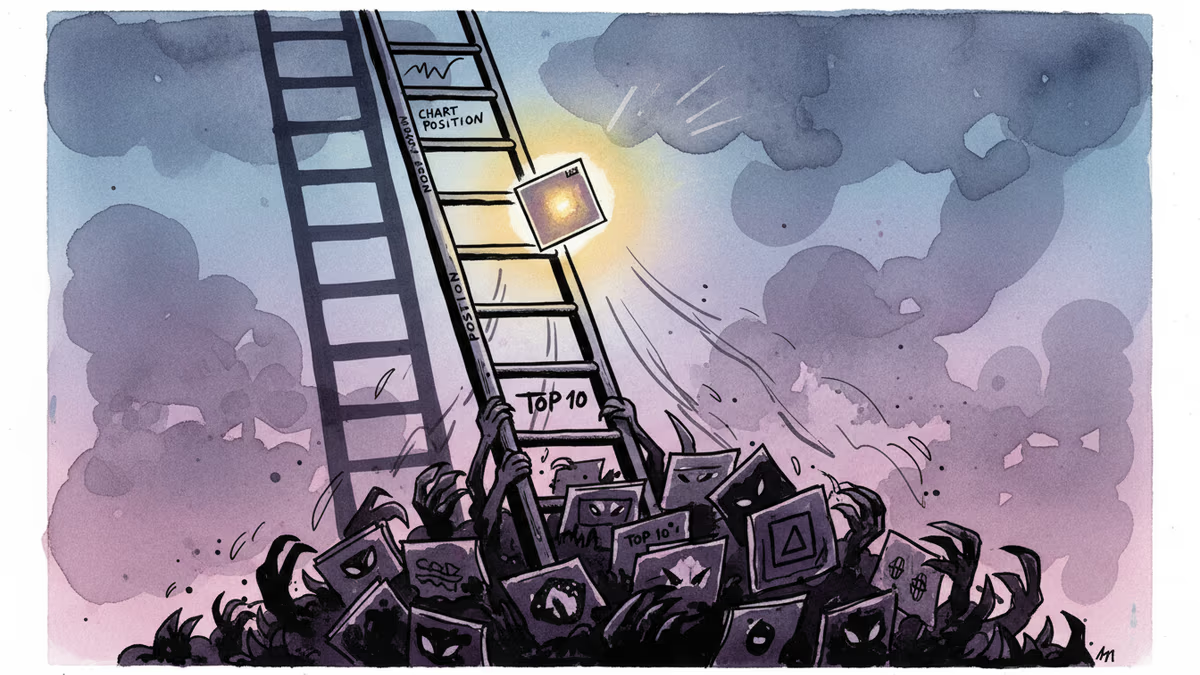
ILLIT Hits No. 26 on Billboard 200 — What the Number Actually Tells Us
ILLIT's mini album 'MAMIHLAPINATAPAI' debuted at No. 26 on the Billboard 200, their highest chart position yet. Here's what that ranking means inside the 4th-gen K-pop landscape.
A word no one can pronounce just cracked the top 30 of the Billboard 200. That's either a clever marketing gambit or a genuine signal — and the answer matters more than the chart position itself.
On May 12, 2026, Billboard confirmed that ILLIT's third mini album 'MAMIHLAPINATAPAI' debuted at No. 26 on the Billboard 200, marking the group's highest-ever entry on the chart. The milestone was confirmed by HYBE-affiliated label Belift Lab.
Where No. 26 Sits in the 4th-Gen K-Pop Map
Raw chart numbers need coordinates to mean anything. The Billboard 200 in early 2026 is a crowded space for 4th-generation K-pop acts — aespa, NMIXX, and TWS are all cycling through comeback schedules, each with their own charting ambitions. Against that backdrop, No. 26 at the two-year mark of a group's career is a credible upward trajectory, not a ceiling.
The more useful comparison isn't BTS or BLACKPINK — those benchmarks belong to a different market era. The relevant question is how ILLIT stacks up against 4th-gen peers at the same career stage. By that measure, the group is tracking ahead of several contemporaries, though still behind the fastest-rising acts of the generation.
For HYBE, the number carries strategic weight beyond fandom pride. Following the high-profile fallout with ADOR and the NewJeans situation, Belift Lab has been quietly rebuilding its brand identity narrative. ILLIT's consistent global chart growth gives that narrative a concrete data point — the label can manage an act through turbulence and still deliver commercial results.
The Album Title as Strategy

'MAMIHLAPINATAPAI' comes from the Yaghan language of Tierra del Fuego and describes the wordless moment when two people each hope the other will make the first move. It's a genuinely obscure word — and that obscurity is almost certainly intentional.
K-pop album titling in the mid-2020s has increasingly leaned into words that demand explanation: aespa's lore-heavy terminology, Le Sserafim's Latin borrowings, and now ILLIT's Yaghan-language choice. The logic is consistent — a title that requires a search creates engagement, and engagement feeds algorithms. Inside the fandom, the word's meaning gets woven into the group's emotional narrative. Outside the fandom, it's a curiosity that might pull in casual listeners, or might not.
That tension is worth watching. A No. 26 debut on the Billboard 200 is largely driven by coordinated fan purchasing and streaming in the first tracking week. Whether 'MAMIHLAPINATAPAI' has legs beyond that initial mobilization — whether it reaches listeners who didn't already know ILLIT's name — is a question the streaming data over the next four weeks will answer more honestly than the chart debut did.
How Billboard 200 Rankings Actually Work for K-Pop
Since Billboard overhauled its methodology in 2017 to incorporate streaming equivalents, K-pop groups have found the chart structurally more accessible. Organized fan streaming campaigns, bulk album purchases, and coordinated release-week activity have become industry standard. This doesn't make the achievement less real — it makes it differently real.
The No. 26 debut reflects ILLIT's fandom size, organizational capacity, and label infrastructure as much as it reflects the music's reach. Neither reading cancels the other out. But conflating the two produces a distorted picture of where an artist actually stands in the broader market.
The harder metric to track — and the one that separates sustained careers from one-cycle acts — is whether the chart position holds or grows across multiple release cycles. Among 4th-gen K-pop groups, the ones who've maintained or improved their Billboard 200 trajectory over three or more comebacks are a notably short list.
This content is AI-generated based on source articles. While we strive for accuracy, errors may occur. We recommend verifying with the original source.
Related Articles

Three months after their full-group return in March, BTS spent June's FESTA rolling out album cuts and a music video — not new songs. Come Over cracked a global top 5 with zero new music behind it. Did the play work?
PRISM Trend Pipeline caught LE SSERAFIM's YouTube KR trending peak. Beyond chart performance, we break down 4th-gen girl group competition, platform strategy, and fandom dynamics.
&TEAM's 'We on Fire' debuted on the Billboard 200 for the first time. Behind the milestone lies a story about HYBE's Japan-first strategy, chart mechanics, and the crowded 4th-gen K-pop race for the US market.

BABYMONSTER announces digital single 'SUGAR HONEY ICE TEA' for June 8. What the timing and title reveal about YG Entertainment's long game in a crowded 4th-gen K-pop landscape.
Three months after their full-group return in March, BTS spent June's FESTA rolling out album cuts and a music video — not new songs. Come Over cracked a global top 5 with zero new music behind it. Did the play work?
PRISM Trend Pipeline caught LE SSERAFIM's YouTube KR trending peak. Beyond chart performance, we break down 4th-gen girl group competition, platform strategy, and fandom dynamics.
&TEAM's 'We on Fire' debuted on the Billboard 200 for the first time. Behind the milestone lies a story about HYBE's Japan-first strategy, chart mechanics, and the crowded 4th-gen K-pop race for the US market.
BABYMONSTER announces digital single 'SUGAR HONEY ICE TEA' for June 8. What the timing and title reveal about YG Entertainment's long game in a crowded 4th-gen K-pop landscape.
Thoughts
Share your thoughts on this article
Sign in to join the conversation