
A Tiger in the DMZ — What 'HOPE' Reveals About Korean Cinema
Hwang Jung Min and Zo In Sung team up in 'HOPE,' set in Korea's DMZ. Unpacking the film's symbolism, its star power economics, and what it signals for Korean cinema in 2026.
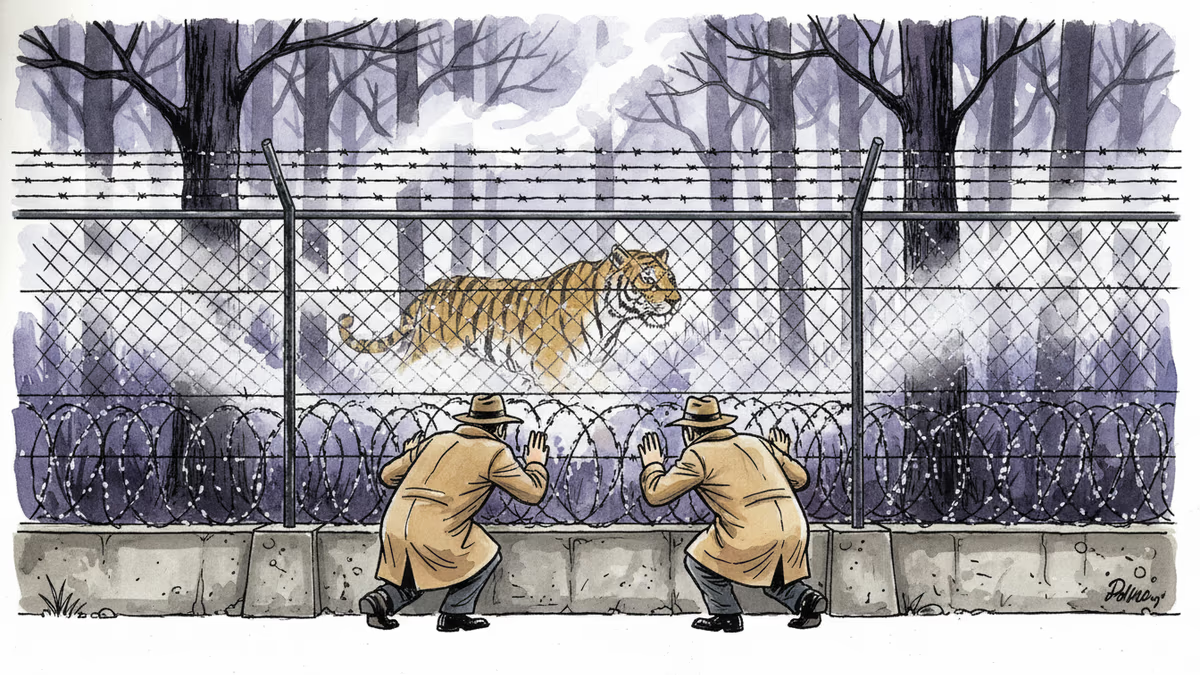
A tiger sighting in the most militarized strip of land on Earth. That's the premise HOPE is betting on — and in Korean cultural logic, it's a bigger bet than it sounds.
The upcoming film has released its first preview clip, and the setup is deceptively simple: Bum Seok (Hwang Jung Min), the chief of a small police branch near the Demilitarized Zone, gets a tip from local teenagers about a tiger spotted in the area. The whole village goes on edge. His partner in investigation, played by Zo In Sung, is pulled into the chaos alongside him. The clip doesn't fully reveal the film's genre identity — thriller? comedy? something stranger? — but the buddy-cop energy between the two leads is unmistakable.
Why the DMZ, and Why a Tiger
The DMZ has been a recurring setting in Korean cinema for over two decades, but the way filmmakers use it has shifted considerably. Early entries like JSA (2000) and Welcome to Dongmakgol (2005) used the border zone to interrogate ideology and national trauma head-on. HOPE appears to take a different angle: the DMZ as a place where ordinary, even absurd, things happen to ordinary people. A police chief dealing with a tiger sighting is not a story about geopolitics. It's a story about a bureaucrat suddenly confronted by something that shouldn't exist.
The tiger, though, carries weight in Korean symbolism that a Western audience might miss. It's the national animal, a figure woven into folklore, and — crucially — a creature that vanished from the Korean peninsula during the Japanese colonial period. The last confirmed sighting of a wild Korean tiger was in 1922. In that context, a tiger appearing in the DMZ isn't just a plot device. It's a loaded image: the one part of Korea where nature has been left undisturbed for over 70 years, potentially harboring something the rest of the country lost long ago.
The Star Power Calculation

Casting Hwang Jung Min and Zo In Sung together is a deliberate high-stakes move. Hwang Jung Min drew 13 million admissions with 12.12: The Day (2023), playing a villain so compelling that audiences reportedly applauded his scenes. He's the definitive character-actor anchor of his generation in Korean cinema. Zo In Sung, meanwhile, rebuilt his global fanbase through King the Land (2023), a JTBC/Netflix co-production that performed strongly across Southeast Asia and beyond. He operates at the intersection of star charisma and streaming reach that domestic productions increasingly need to justify their budgets.
The pairing works on paper precisely because the two men represent opposite poles of Korean screen masculinity. Hwang is the actor who disappears into roles; Zo is the star whose presence is the role. Buddy films have long thrived on exactly this kind of contrast — think of it as controlled friction. The question is whether HOPE's script gives that friction somewhere meaningful to go, or whether the DMZ-tiger premise stays in quirky-premise territory without deepening.
Where This Fits in 2026 Korean Cinema
Korean theatrical attendance has been recovering, but the industry's structural reality has shifted permanently. The first-weekend box office now functions as a near-binary verdict — films either open big and sustain, or they migrate to streaming within weeks. For a film pairing two of Korea's most bankable names, the pressure to deliver an immediate, unambiguous genre experience is higher than ever.
HOPE doesn't yet have a confirmed release date or distributor announced publicly. But the timing of the clip release — building anticipation well ahead of a likely second-half 2026 theatrical window — suggests a campaign designed for maximum opening-weekend impact rather than a slow-burn awards rollout. Whether it targets Chuseok (late September) or the year-end holiday corridor will tell us a lot about how the studio reads the film's commercial profile.
One additional layer worth watching: how HOPE handles its international distribution rights. Post-Parasite and post-12.12, Korean films with strong domestic stars are increasingly pre-sold to streaming platforms for non-Korean territories. If Netflix or another platform picks up international rights, the film's global visibility — and the careers of both leads in markets outside Korea — gets a significant lift.
This content is AI-generated based on source articles. While we strive for accuracy, errors may occur. We recommend verifying with the original source.
Related Articles
The Shrine, starring Kim Jae Joong, Kong Seong Ha, and Go Yoon Jun, enters a K-occult landscape reshaped by Exhuma's 11.9M ticket milestone. What does the film's Japan setting signal?
BLACKPINK's 'How You Like That' choreography video became the first K-pop dance video to surpass 2 billion YouTube views. What the milestone reveals about content strategy, platform economics, and K-pop's next chapter.
Jae Seok's B&B Rules!" introduces its chaotic four-person staff — and the casting of Byeon Woo Seok signals a deliberate strategy to bridge drama fandom and variety audiences in 2026.

MBC's Perfect Crown held the No. 1 spot on Korea's buzz rankings even in its final week on air, with Park Ji Hoon topping the actor chart. Here's what the numbers reveal about the K-drama market right now.
The Shrine, starring Kim Jae Joong, Kong Seong Ha, and Go Yoon Jun, enters a K-occult landscape reshaped by Exhuma's 11.9M ticket milestone. What does the film's Japan setting signal?
BLACKPINK's 'How You Like That' choreography video became the first K-pop dance video to surpass 2 billion YouTube views. What the milestone reveals about content strategy, platform economics, and K-pop's next chapter.
Jae Seok's B&B Rules!" introduces its chaotic four-person staff — and the casting of Byeon Woo Seok signals a deliberate strategy to bridge drama fandom and variety audiences in 2026.
MBC's Perfect Crown held the No. 1 spot on Korea's buzz rankings even in its final week on air, with Park Ji Hoon topping the actor chart. Here's what the numbers reveal about the K-drama market right now.
Thoughts
Share your thoughts on this article
Sign in to join the conversation