

Baeksang 2026: The Night Netflix Became Normal
The 62nd Baeksang Arts Awards crowned Ryu Seung Ryong and Yoo Hae Jin as Grand Prize winners. But the real story is how OTT dominance and indie cinema reshaped Korea's most prestigious night in entertainment.
When a Netflix drama wins Best Drama at South Korea's most storied awards show and it barely raises an eyebrow, something fundamental has shifted. The 62nd Baeksang Arts Awards, held May 8, 2026 at COEX in Seoul, didn't just hand out trophies — it quietly confirmed that the battle between OTT and traditional broadcast is over. What's left is the negotiation over who gets credit.
Hosted by Shin Dong Yup, Suzy, and Park Bo Gum, the ceremony stretched across television, film, theater, and musical categories. Founded in 1965, the Baeksang is South Korea's longest-running entertainment awards — the kind of institution whose winners double as a yearly audit of the industry's priorities.
The Grand Prize Split: A Deliberate Balance
The broadcast Grand Prize went to Ryu Seung Ryong for The Dream Life of Mr. Kim. Best Drama, however, went to Netflix's You and Everything Else — which also swept Best Screenplay (Song Hye Jin). Park Bo Young took Best Actress for Our Unwritten Seoul, while Hyun Bin won Best Actor for Made in Korea.
The split between Grand Prize and Best Drama is worth pausing on. It follows a pattern the Baeksang has maintained for several years: OTT titles collect the genre prizes, while the top individual honor — the Grand Prize — tends to land on performances from outside the streaming giants. Whether this reflects deliberate editorial balancing by the jury or simply the nature of which performances are most visible is an open question. But the consistency of the pattern suggests it isn't accidental.
Hyun Bin's Best Actor win carries its own subtext. Since Crash Landing on You made him a pan-Asian phenomenon in 2020, his domestic awards recognition has been modest relative to his global profile. Made in Korea appears to have recalibrated that gap.
Film: Indie Precision Over Blockbuster Scale

The film side of the evening told a different story. Yoo Hae Jin claimed the Movie Grand Prize for The King's Warden, while Best Movie went to No Other Choice — again, two different films, the same deliberate split. Best Director went to Yoon Ga Eun for The World of Love. Yoon first drew attention with The World of Us (2016), a micro-budget film about childhood friendship that punched far above its weight critically. Her Baeksang win a decade later marks the long arc of an auteur working outside the commercial mainstream.
Park Jeong Min (Best Actor, The Ugly) and Mun Ka Young (Best Actress, Once We Were Us) represent a generation of performers who built their reputations on mid-budget, character-driven projects rather than franchise blockbusters. Shin Sae Kyeong's Supporting Actress win for HUMINT — a spy thriller — signals the genre's growing legitimacy on the awards circuit, a category that Korean cinema had historically underserved.
Perhaps the most closely watched name of the night: Park Ji Hoon, the idol-turned-actor who won Best New Actor for The King's Warden and the Naver Popularity Award in the same evening. The dual win encapsulates a structural shift in Korean entertainment — the idol-to-actor pipeline is no longer a side door into the industry. It's a main entrance, and the awards circuit has formally acknowledged it.
Musical and Theater: The Legitimacy of Korean Originals
In the musical category, ARANG took Best Musical — a Korean original over imported licensed productions. The domestic musical industry has grown steadily since the mid-2010s, but original Korean works beating out Broadway adaptations at a major awards show still registers as a data point worth tracking.
Kim Junsu won Best Performer for Beetlejuice. His trajectory is unusual: a founding member of JYJ who faced systemic broadcast restrictions during his group's legal dispute with SM Entertainment, he built an independent fanbase almost entirely through musical theater. The Baeksang win functions as institutional recognition of a career path that was, for years, deliberately blocked by industry gatekeepers.
In theater, Kim Shin Rok won Best Performer for PRIMA FACIE, a one-woman play about sexual violence and the legal system. The fact that this work received the theater category's top acting prize reflects a broader willingness in Korean performing arts to stage social confrontation directly — a contrast to the more cautious approach often seen in mainstream drama.
This content is AI-generated based on source articles. While we strive for accuracy, errors may occur. We recommend verifying with the original source.
Related Articles

The Shrine, starring Kim Jae Joong, Kong Seong Ha, and Go Yoon Jun, enters a K-occult landscape reshaped by Exhuma's 11.9M ticket milestone. What does the film's Japan setting signal?

MBC's action-comedy Fifties Professionals introduces Kwon Yul as an unpredictable new antagonist. Here's why this drama's premise matters beyond the casting news.

tvN's Spooky in Love teaser drops with Park Eun Bin as a ghost-seeing hotel heiress. Behind the occult romance lies a calculated industry strategy worth unpacking.
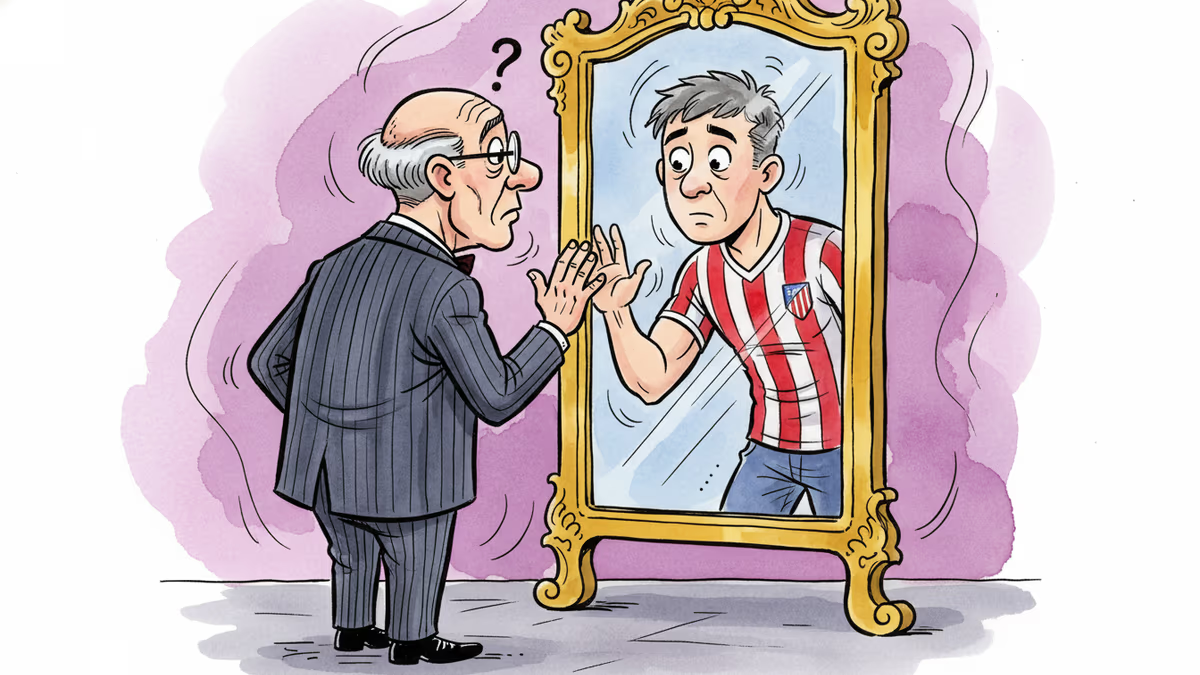
JTBC's Reborn Rookie pairs veteran actor Son Hyun Joo with idol-turned-actor Lee Jun Young in a body-swap drama. A look at the genre's industrial logic and what it signals about Korean TV's audience strategy.
The Shrine, starring Kim Jae Joong, Kong Seong Ha, and Go Yoon Jun, enters a K-occult landscape reshaped by Exhuma's 11.9M ticket milestone. What does the film's Japan setting signal?
MBC's action-comedy Fifties Professionals introduces Kwon Yul as an unpredictable new antagonist. Here's why this drama's premise matters beyond the casting news.
tvN's Spooky in Love teaser drops with Park Eun Bin as a ghost-seeing hotel heiress. Behind the occult romance lies a calculated industry strategy worth unpacking.
JTBC's Reborn Rookie pairs veteran actor Son Hyun Joo with idol-turned-actor Lee Jun Young in a body-swap drama. A look at the genre's industrial logic and what it signals about Korean TV's audience strategy.
Thoughts
Share your thoughts on this article
Sign in to join the conversation