
A Joseon Concubine Wakes Up in Seoul — What My Royal Nemesis Is Really Betting On
SBS fantasy rom-com My Royal Nemesis premieres May 9 with Im Ji-yeon leading a time-slip story. Here's what the drama signals about K-drama's genre economy and Netflix's SBS partnership.
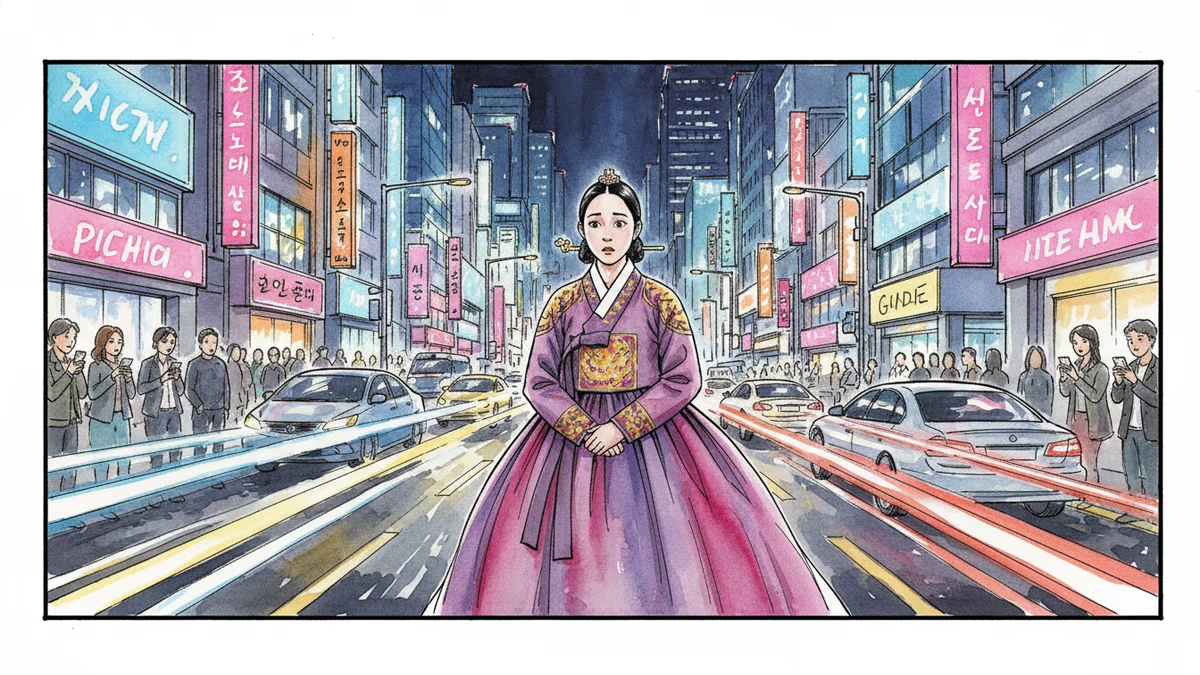
She was poisoned in Joseon. She woke up in Seoul. Now she has to survive both a chaebol heir and a smartphone.
What's Actually Happening
SBS premieres My Royal Nemesis on May 9, 2026, airing every Friday and Saturday in a 14-episode run, with Netflix handling global simultaneous release.
The setup: Im Ji-yeon plays a once-favored royal concubine who, after falling from grace and being sentenced to death by poison, somehow wakes up very much alive — in present-day Seoul, inside the body of a struggling actress. She has to decode modern life from scratch while navigating a hostile-then-romantic dynamic with Heo Nam-joon, playing an arrogant chaebol heir. Jang Seung-jo rounds out the leads as a second male lead who, the show hints, carries a connection to Im's character that stretches back centuries.
The genre blend — sageuk (historical drama) meets fish-out-of-water rom-com — isn't new territory for K-drama. But the specific combination of Im Ji-yeon's casting and the Netflix pipeline gives this one a particular industrial logic worth unpacking.
Why Im Ji-yeon, Why Now
Im Ji-yeon spent much of her career as a scene-stealing supporting player before The Tale of Lady Ok (2025) repositioned her as a lead-capable actress. That drama's villain arc gave her room to demonstrate both sageuk discipline and emotional range — a credential that matters when a show asks you to carry both a period drama and a modern comedy simultaneously.
My Royal Nemesis is structurally demanding in that sense. The character has to be believable as a calculating Joseon-era survivor and as a comedic fish out of water in contemporary Seoul. That's two distinct performance registers in one role. The 14-episode count gives her more runway than a cable mini-series would, but it's still compressed compared to the 16-episode standard that longer SBS dramas typically use for character development.

For Heo Nam-joon, this is a step up in profile — the chaebol-heir archetype is well-worn K-drama territory, but the show's trailers suggest his character has a past-life dimension that could add complexity beyond the standard cold-and-rude love interest.
The Netflix-SBS Architecture
Global simultaneous release on Netflix has become the default packaging for SBS weekend dramas, but it's worth being precise about what that means commercially. Netflix doesn't just distribute — it typically acquires partial IP rights in exchange for co-financing and global marketing. For SBS, that means reduced production risk and an algorithmic amplification that can extend a drama's viewership window well past its broadcast run.
The trade-off is structural. Distributed IP rights make sequel seasons harder to negotiate. My Royal Nemesis's self-contained 14-episode arc reflects this reality: a complete story that works as a Netflix binge object, designed to perform in the algorithm rather than seed a franchise. This is a different bet than, say, Disney+'s approach with JTBC co-productions, where season-extension clauses have become more common.
The timing also matters. The show enters a crowded weekend drama landscape: tvN's Perfect Crown, MBC's We Are All Trying Here, and several others are all competing for the same Friday-Saturday viewing window. SBS is betting that the sageuk-meets-modern-Seoul hybrid offers enough genre distinctiveness to carve out its own audience segment rather than split the existing rom-com base.
The Recurring Narrative Pattern
Stripped of its fantasy mechanics, My Royal Nemesis tells a story about a woman who loses everything — status, safety, her own body — and has to rebuild from nothing in an unfamiliar system. That's not a coincidental framing.
K-drama has returned repeatedly over the past few years to what might be called the reset narrative: a protagonist expelled from the system they were operating in, forced to start over. My Liberation Notes (2022) did it through burnout. Castaway Diva (2023) did it through industry exile. The Tale of Lady Ok (2025) did it through social class inversion. My Royal Nemesis takes the most extreme version — literal death and rebirth — but the emotional architecture is the same.
What's notable is that the protagonist here is active rather than passive. She's not waiting to be rescued from modernity; she's strategizing her way through it. Whether the show follows through on that framing or softens it into a more conventional romance trajectory is the open question the first few episodes will answer.
This content is AI-generated based on source articles. While we strive for accuracy, errors may occur. We recommend verifying with the original source.
Related Articles

Lim Ji-yeon-led My Royal Nemesis reportedly hit No. 1 on Netflix's global non-English chart in its opening week. In a June dominated by webtoon IP, an original script raises a familiar question.

MBC's action-comedy Fifties Professionals introduces Kwon Yul as an unpredictable new antagonist. Here's why this drama's premise matters beyond the casting news.

Netflix drops character stills for Husbands in Action, an action-comedy starring Jin Sun Kyu, Gong Myoung, Kim Ji Suk, and Yoon Kyung Ho. Here's what the casting and premise signal about K-film's global strategy.
tvN's Spooky in Love teaser drops with Park Eun Bin as a ghost-seeing hotel heiress. Behind the occult romance lies a calculated industry strategy worth unpacking.
Lim Ji-yeon-led My Royal Nemesis reportedly hit No. 1 on Netflix's global non-English chart in its opening week. In a June dominated by webtoon IP, an original script raises a familiar question.
MBC's action-comedy Fifties Professionals introduces Kwon Yul as an unpredictable new antagonist. Here's why this drama's premise matters beyond the casting news.
Netflix drops character stills for Husbands in Action, an action-comedy starring Jin Sun Kyu, Gong Myoung, Kim Ji Suk, and Yoon Kyung Ho. Here's what the casting and premise signal about K-film's global strategy.
tvN's Spooky in Love teaser drops with Park Eun Bin as a ghost-seeing hotel heiress. Behind the occult romance lies a calculated industry strategy worth unpacking.
Thoughts
Share your thoughts on this article
Sign in to join the conversation