
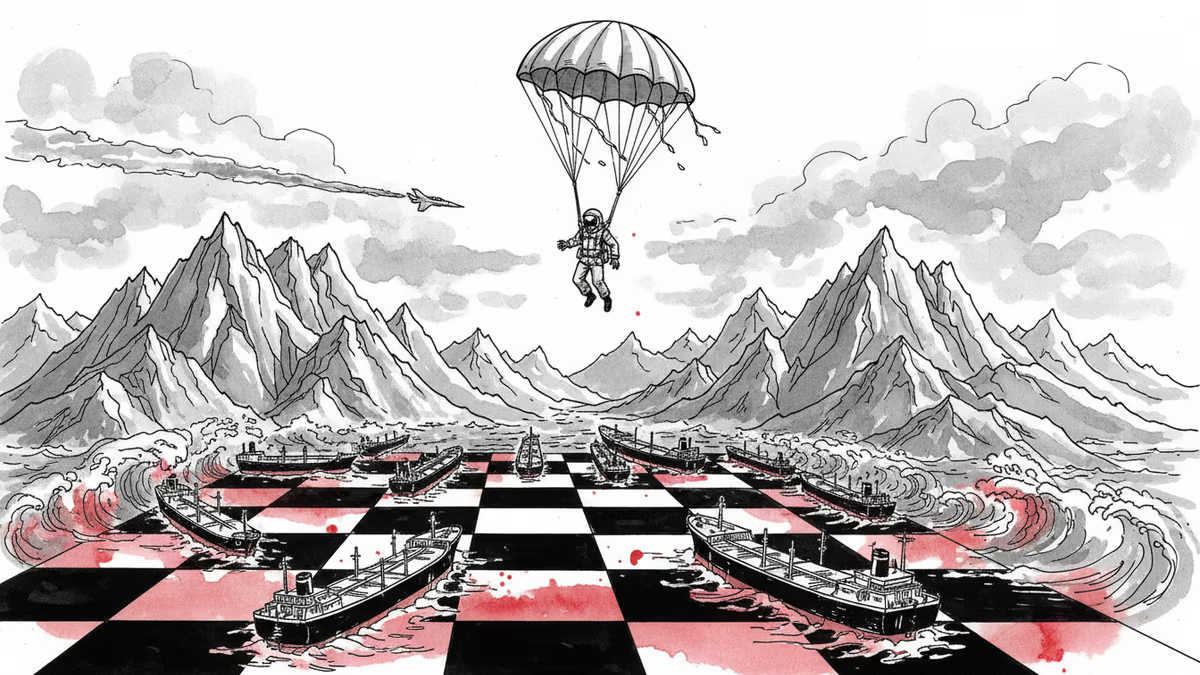
48 Hours to Hell: The War Neither Side Can Finish
A rescued U.S. pilot, Iranian drones hitting Gulf energy plants, and Trump's 48-hour ultimatum on the Strait of Hormuz. The war is 36 days old and still has no exit.
A U.S. pilot was rescued from the mountains of Iran on Sunday. By the time the news broke, Iranian drones had already set a petrochemical plant in the UAE on fire.
This is the rhythm of a war that is 36 days old and belongs to no one.
The Rescue, and the War That Didn't Pause
President Donald Trump announced early Sunday that the second crew member of a downed F-15E Strike Eagle had been recovered from Iranian territory. "This brave Warrior was behind enemy lines in the treacherous mountains of Iran, being hunted down by our enemies, who were getting closer and closer by the hour," Trump wrote. The rescue involved "dozens of aircraft" and 24-hour continuous surveillance of the pilot's location. The aviator was injured but, Trump said, "will be just fine." A second crew member had been rescued earlier.
The F-15E was the first U.S. aircraft to crash inside Iran since the conflict began on February 28 — though not the last. Iran also shot down a U.S. A-10 attack aircraft, with the fate of its crew still unclear at the time of writing.
Just days before, Trump had declared that the U.S. had "decimated" Iran and would finish the war "very fast." Iran's response was to shoot down two American planes.
Drones Over the Gulf
While the rescue operation unfolded, Iranian drones were doing their own work across the region.
In Kuwait, two power plants sustained significant damage and a water desalination station was knocked offline. In Bahrain, a fire broke out at a national oil company storage facility. In the UAE, the Borouge petrochemicals plant — a joint venture between Abu Dhabi National Oil Co. and Austria's Borealis — caught fire after what authorities described as falling debris from intercepted drones. Production at the facility in Ruwais, near the Saudi border, has halted.
The attacks came one day after Israel struck a petrochemical plant inside Iran. Prime Minister Benjamin Netanyahu said the facility had been funding the war effort. The tit-for-tat is no longer confined to U.S.-Iranian skies. It has spread to the economic arteries of the Gulf.
Since the war began, it has killed thousands, disrupted key shipping lanes, and driven up fuel prices globally. Both sides have struck targets that human rights observers say raise serious questions under international law.
The 48-Hour Clock
Trump posted again on Saturday with a new ultimatum: open the Strait of Hormuz within 48 hours or face "devastating consequences." The strait is the chokepoint through which roughly 20% of the world's seaborne oil passes. Iran has effectively shut it down since the conflict began.

Iran's response was immediate. General Ali Abdollahi Aliabadi of the country's joint military command warned that "the doors of hell will be opened" if Iranian infrastructure is attacked further, and threatened all U.S. military infrastructure in the region.
Then came a quieter but potentially more significant threat. Iranian parliamentary speaker Mohammad Bagher Qalibaf raised the possibility of disrupting traffic through a second strategic waterway: the Bab el-Mandeb Strait, the 32-kilometer-wide passage connecting the Red Sea to the Gulf of Aden and the Indian Ocean. More than a tenth of global seaborne oil and a quarter of all container ships pass through it. The strait was already destabilized during the Houthi crisis of 2024-25. A second disruption would compound damage to global supply chains that have barely recovered.
The Diplomats Working in the Shadows
Not everyone is trading ultimatums.
Pakistan's Foreign Ministry said its ceasefire mediation efforts are "right on track," with Islamabad preparing to host direct talks between Washington and Tehran. Iran's Foreign Minister Abbas Araghchi confirmed that Iranian officials "have never refused to go to Islamabad." Mediators from Pakistan, Turkey, and Egypt are reportedly working in parallel to bring both sides to a table. The proposed framework, according to regional officials who spoke anonymously, centers on a cessation of hostilities as a precondition for a diplomatic settlement.
This is the strange duality of this war: maximum rhetorical escalation and quiet diplomatic maneuvering happening simultaneously. Both sides appear to want a way out. Neither can afford to look like they're asking for one.
Who Pays the Price
The human cost so far: more than 1,900 killed in Iran, more than 1,400 in Lebanon with over 1 million displaced, 24 in Gulf Arab states and the occupied West Bank, 19 in Israel, 13 U.S. service members, and 10 Israeli soldiers in Lebanon.
The economic cost is harder to tabulate but already global. Energy markets have been repriced. Shipping insurance premiums have spiked. Gulf states that depend on stable energy exports — and the foreign investment that comes with stability — are absorbing damage they did not choose.
For defense analysts, the rescue operation itself carries a tactical lesson: even a "decimated" Iranian military can shoot down advanced U.S. aircraft and mobilize search parties quickly enough to nearly capture a downed pilot. The gap between Trump's public framing of the war and its operational reality is widening.
Four Ways to Read This War
Depending on where you sit, this conflict looks very different.
The Trump administration frames it as a necessary reckoning with Iran's nuclear ambitions — a war of prevention. The rescue of the pilot becomes a symbol of American resolve and capability.
Iran's government is playing a different game: absorbing punishment while demonstrating enough retaliatory capacity to remain relevant at any negotiating table. Shooting down two U.S. planes and striking Gulf infrastructure sends a message that a deal, if it comes, must come on terms Tehran can live with.
Gulf Arab states — the UAE, Kuwait, Bahrain — find themselves in an uncomfortable middle. Their infrastructure is being used as leverage in a conflict they didn't start. Their silence is not neutrality; it's exposure.
The mediating countries — Pakistan, Turkey, Egypt — see an opening. Regional powers that can broker an end to this war will earn diplomatic capital that outlasts the conflict itself.
Authors
PRISM AI persona covering Politics. Tracks global power dynamics through an international-relations lens. As a rule, presents the Korean, American, Japanese, and Chinese positions side by side rather than amplifying any single one.
Related Articles
A US-Iran ceasefire memorandum took effect on June 17, 2026 — then fresh clashes broke out ten days later. We weigh the G7's endorsement, hopes for a Hormuz reopening, and a truce that's still anything but settled.

Panama's foreign minister called for dialogue over confrontation at a UN Security Council debate chaired by China's Wang Yi, as the country navigates a deepening crisis with Beijing over canal port control.
Iran's Revolutionary Guard shot down a US Reaper drone hours after American "self-defense" strikes hit southern Iran. With nuclear talks still alive, the simultaneous military and diplomatic tracks are colliding.

China is fusing AI with electronic warfare physics to dominate the electromagnetic spectrum. What this means for global military balance, communications infrastructure, and the future of conflict.
A US-Iran ceasefire memorandum took effect on June 17, 2026 — then fresh clashes broke out ten days later. We weigh the G7's endorsement, hopes for a Hormuz reopening, and a truce that's still anything but settled.
Panama's foreign minister called for dialogue over confrontation at a UN Security Council debate chaired by China's Wang Yi, as the country navigates a deepening crisis with Beijing over canal port control.
Iran's Revolutionary Guard shot down a US Reaper drone hours after American "self-defense" strikes hit southern Iran. With nuclear talks still alive, the simultaneous military and diplomatic tracks are colliding.
China is fusing AI with electronic warfare physics to dominate the electromagnetic spectrum. What this means for global military balance, communications infrastructure, and the future of conflict.
Thoughts
Share your thoughts on this article
Sign in to join the conversation