
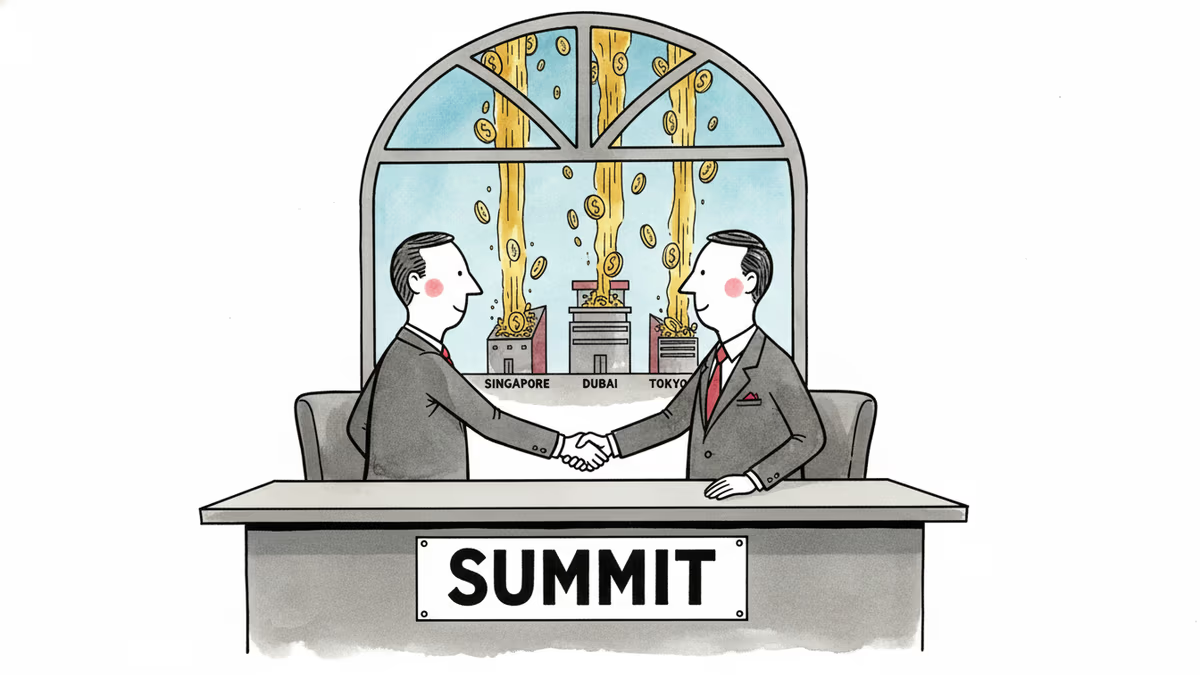
The Summit Was Theater. The Money Had Already Moved.
While US and China leaders met in Beijing in May 2026, Asia's wealthy had already repositioned trillions across Singapore, Dubai, and Tokyo. The biggest capital shift in two decades went unreported.
The leaders met in Beijing. The capital had already left.
When US and Chinese leaders sat down in Beijing on May 14 and 15, 2026, the global press delivered its predictable dispatch: tariffs, Taiwan, Iran, Boeing. The coverage was accurate. It also missed the most consequential shift in Asian capital flows in two decades—one that no summit communiqué could capture, because no government authorized it.
What the Numbers Show
The evidence is hiding in plain sight. According to the Monetary Authority of Singapore, the number of single family offices in Singapore grew from roughly 400 at the end of 2020 to over 2,000 by the end of 2024—a fivefold increase in four years. Deloitte's latest market study puts Hong Kong's count at 3,384 single family offices as of Q1 2026. The wealth is not leaving Asia. It is repositioning within Asia, deliberately moving outside any single government's regulatory perimeter.
Behind those numbers is a specific lesson. Between 2019 and 2022, wealthy families across Asia watched Hong Kong's political and regulatory environment transform sharply. The capital movement that followed wasn't panic. It was an updated risk model: capital tied to a single government's commitments is capital exposed to that government's reversals—regardless of how those reversals are justified. Singapore became one answer. Dubai became another. Multi-jurisdictional family office structures, almost unheard of a decade ago, are now standard among Asian families with assets above $100 million.
The Gap Western Capital Left Behind
At the same time, Western institutional money has been quietly retreating. US pension funds and university endowments—once the backbone of Asian growth financing—are pulling back. Geopolitical scrutiny from Washington, compounded by poor returns from the China venture cycle of 2018 to 2022, has made many large Western limited partners unwilling to commit fresh capital to Asia at the scale they once did. Several major American endowments have quietly stopped writing new China-specific checks. Some have stopped writing Asia checks entirely.

According to data from KPMG, Bain, and Moonfare, China's share of regional private equity deal value has fallen to roughly 27 percent—about half of what it was four years ago. That gap is being filled, but not by Western replacements. Indian family offices are co-investing with Japanese conglomerates in Southeast Asian manufacturing. Saudi sovereign wealth is anchoring rounds in Indian fintech. Singapore family offices are leading rounds in Indonesian healthcare. The map is being redrawn from the inside.
For Asian founders, the implication is direct: the investor across the table is increasingly an Asian operator, not a Western institution. The decision criteria are different. The timelines are different. The expectations are different. For Asian governments, the implication is more uncomfortable.
What Summits Can No Longer Reach
The traditional toolkit of summit diplomacy—treaty negotiation, currency coordination, joint communiqués—was engineered for a world in which government decisions shaped private capital flows. That world is ending. Asia's wealthy are now moving capital based on their own assessment of which jurisdictions will preserve property rights and which will not. They are not waiting for the summit to clear. They no longer need the treaty to deploy.
Generational change is accelerating this. The next-generation principals of Asia's family offices were educated in the United States and Europe, hold multiple passports, and view themselves as global citizens with assets in Asia—not as Asian citizens with assets abroad. Their loyalty to any single jurisdiction is conditional, not inherited. The regimes that win their capital over the next decade will be the ones that compete for it on transparent, rule-of-law terms. The ones that assume it will find it gone.
The summit format cannot capture this because there is nothing to announce. No single press conference, no signed agreement, no joint statement. There is only the slow, deliberate redirection of trillions in private wealth, executed by people who have decided that the political moment matters less than the structural one.
In 2010, a regional operator needed two things: a tariff deal and Western capital. The summit shaped both. In 2026, the tariff deal still matters. But the capital has already moved into position, deployed by Asian wealth that did not wait for anyone's permission.
This content is AI-generated based on source articles. While we strive for accuracy, errors may occur. We recommend verifying with the original source.
Related Articles
Panama's foreign minister called for dialogue over confrontation at a UN Security Council debate chaired by China's Wang Yi, as the country navigates a deepening crisis with Beijing over canal port control.

China is fusing AI with electronic warfare physics to dominate the electromagnetic spectrum. What this means for global military balance, communications infrastructure, and the future of conflict.
Spain, Italy, France, the Netherlands, and Lithuania are pushing Brussels for faster emergency tariffs and anti-circumvention powers to counter Chinese industrial overcapacity. Here's what's at stake.
Trump says a US-Iran nuclear deal is 'largely negotiated.' Iran calls it a 'Persian-style peace.' Both sides claim victory. Here's what's actually at stake.
Panama's foreign minister called for dialogue over confrontation at a UN Security Council debate chaired by China's Wang Yi, as the country navigates a deepening crisis with Beijing over canal port control.
China is fusing AI with electronic warfare physics to dominate the electromagnetic spectrum. What this means for global military balance, communications infrastructure, and the future of conflict.
Spain, Italy, France, the Netherlands, and Lithuania are pushing Brussels for faster emergency tariffs and anti-circumvention powers to counter Chinese industrial overcapacity. Here's what's at stake.
Trump says a US-Iran nuclear deal is 'largely negotiated.' Iran calls it a 'Persian-style peace.' Both sides claim victory. Here's what's actually at stake.
Thoughts
Share your thoughts on this article
Sign in to join the conversation