
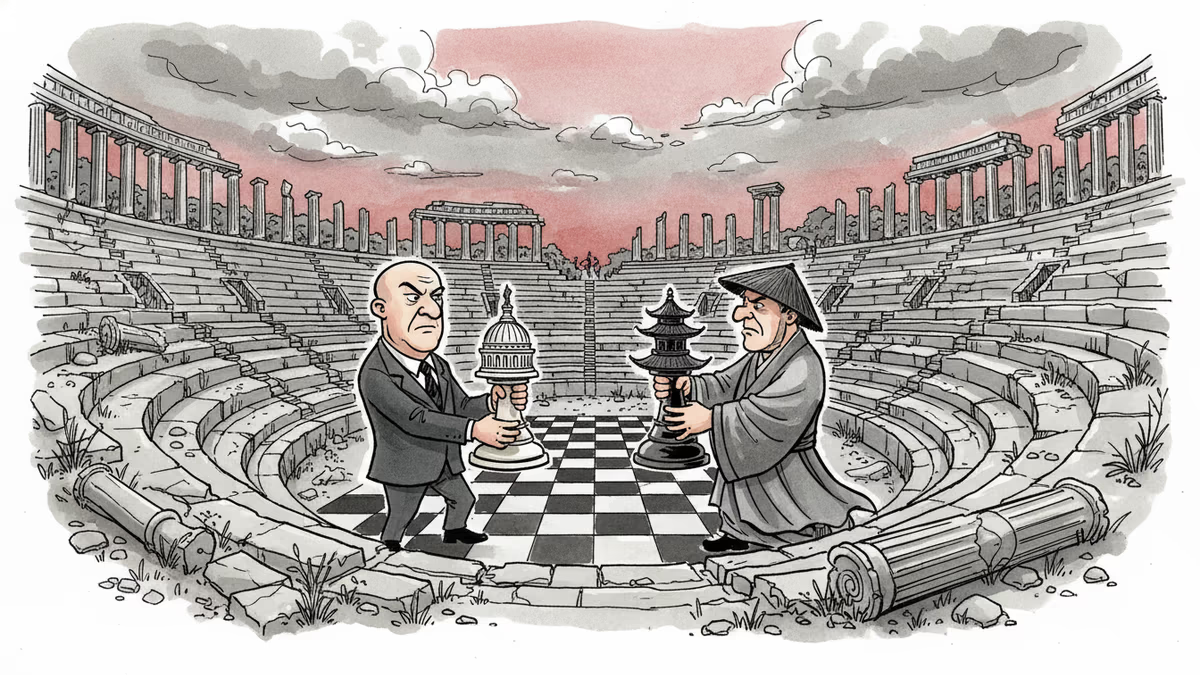
Xi Named the Trap. That's the Point.
At a summit with Trump, Xi Jinping invoked the 'Thucydides Trap' — the theory that rising powers and ruling ones tend toward war. Whether it was a warning or a warning shot is the question worth asking.
The last time a world order broke down slowly, most people didn't notice until the shooting started.
At a recent summit in Beijing, Xi Jinping looked across the table at Donald Trump and invoked the Thucydides Trap — the idea that when a rising power threatens an established one, the structural pressure toward war becomes almost gravitational. He framed it as something both nations should work to avoid. It was, on its surface, a conciliatory gesture. But the choice of that particular concept, at this particular moment, deserves more than a diplomatic read.
What the Trap Actually Says
The theory was popularized by Harvard political scientist Graham Allison, whose 2017 book Destined for War applied it to the US-China relationship with unsettling precision. The source is ancient: the Greek historian Thucydides wrote that the Peloponnesian War was made inevitable not by the ambitions of Athens or Sparta alone, but by the fear Sparta felt as Athens grew stronger.
Allison examined 16 cases over the past 500 years in which a rising power challenged a ruling one. Twelve ended in war. The four that didn't shared a common thread: leaders who recognized the structural trap and made deliberate choices to absorb short-term political costs in exchange for avoiding catastrophe.
Xi has cited this theory before — notably in 2015 during a visit to the United States. That he returns to it now is not coincidence. It signals that Beijing thinks in these terms, tracks this literature, and wants Washington to know it does.
The Order That Was, and What Replaced It

The end of the Cold War carried a promise: that the spread of liberal democracy and open markets would make great-power war structurally irrational. For roughly two decades, that held. Trade interdependence deepened. Institutions — the WTO, NATO, the UN Security Council — functioned as friction-reducers.
That architecture is now under visible strain. Russia's invasion of Ukraine shattered the post-1945 norm against territorial conquest by force in Europe. The Middle East remains a theater of proxy competition. And the US-China relationship has shifted from managed rivalry to something that increasingly resembles a systemic contest — not just over trade balances, but over which model of political economy governs the 21st century.
Some international relations scholars describe this as the end of the "unipolar moment" — the roughly 30-year window in which American primacy went largely unchallenged. Whether what comes next is a stable multipolar order, a bipolar cold war, or something more chaotic is genuinely uncertain. What is less uncertain is that the transition itself is dangerous.
Two Narratives, One Trap
The United States and China each have a coherent, internally consistent account of who is the aggressor.
From Washington's perspective, China's military buildup in the South China Sea, its pressure on Taiwan, its technology transfer practices, and its alignment with Russia constitute a deliberate challenge to a rules-based international order that has benefited everyone — including China. Skeptics of Xi's Thucydides invocation argue it is rhetorical cover: a way to frame American defensive measures as provocations while China continues to expand its strategic footprint.
From Beijing's perspective, the Indo-Pacific strategy, semiconductor export controls, the strengthening of AUKUS and the Quad, and US arms sales to Taiwan are encirclement — a concerted effort to cap Chinese power before it reaches parity. China's narrative is not that it seeks to overturn the international order, but that the existing order was designed to keep it subordinate.
Both narratives contain evidence. Both contain motivated reasoning. And both are held by populations and political classes that will punish leaders perceived as weak. That combination — competing threat perceptions, domestic political constraints, and genuine security dilemmas — is precisely what the Thucydides framework identifies as the mechanism of catastrophe.
This content is AI-generated based on source articles. While we strive for accuracy, errors may occur. We recommend verifying with the original source.
Related Articles

Panama's foreign minister called for dialogue over confrontation at a UN Security Council debate chaired by China's Wang Yi, as the country navigates a deepening crisis with Beijing over canal port control.

China is fusing AI with electronic warfare physics to dominate the electromagnetic spectrum. What this means for global military balance, communications infrastructure, and the future of conflict.

Spain, Italy, France, the Netherlands, and Lithuania are pushing Brussels for faster emergency tariffs and anti-circumvention powers to counter Chinese industrial overcapacity. Here's what's at stake.

Trump says a US-Iran nuclear deal is 'largely negotiated.' Iran calls it a 'Persian-style peace.' Both sides claim victory. Here's what's actually at stake.
Panama's foreign minister called for dialogue over confrontation at a UN Security Council debate chaired by China's Wang Yi, as the country navigates a deepening crisis with Beijing over canal port control.
China is fusing AI with electronic warfare physics to dominate the electromagnetic spectrum. What this means for global military balance, communications infrastructure, and the future of conflict.
Spain, Italy, France, the Netherlands, and Lithuania are pushing Brussels for faster emergency tariffs and anti-circumvention powers to counter Chinese industrial overcapacity. Here's what's at stake.
Trump says a US-Iran nuclear deal is 'largely negotiated.' Iran calls it a 'Persian-style peace.' Both sides claim victory. Here's what's actually at stake.
Thoughts
Share your thoughts on this article
Sign in to join the conversation