
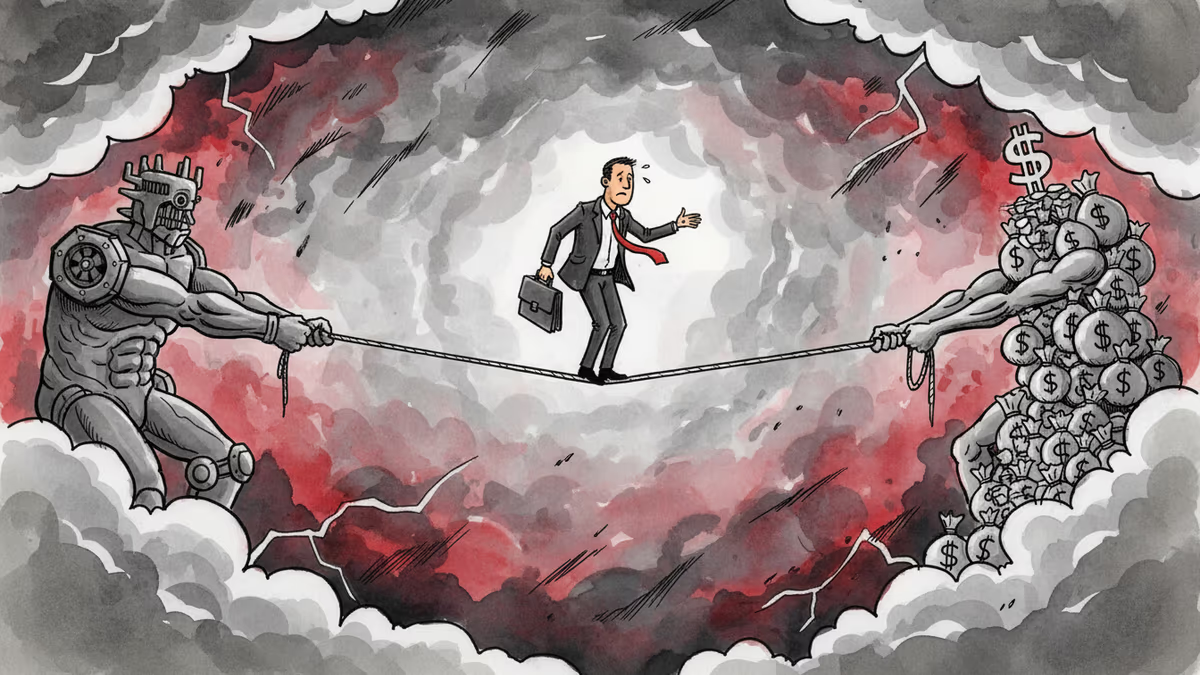
Xi Just Met Trump. Now He's Meeting Putin.
Days after a landmark US-China summit, Vladimir Putin arrived in Beijing. Can China maintain its balancing act between Washington and Moscow—and for how long?
The ink on one summit was barely dry when the next guest arrived.
Vladimir Putin touched down in Beijing on Tuesday evening, May 19, ahead of scheduled talks with Xi Jinping on Wednesday. The timing is the story. Just days earlier, Xi had sat across from Donald Trump in what both sides called a reset of US-China relations—framed under a new diplomatic label: "constructive strategic stability." Now the Russian president is in the same city, almost certainly watching how Beijing handles the optics.
China is running the most complicated diplomatic calendar on the planet right now.
What Happened, and Why the Timing Matters
The US-China summit marked a genuine shift in tone after years of escalating tariff wars and tech-sector confrontations. The phrase "constructive strategic stability" signals something beyond trade negotiations—it suggests a managed coexistence, with both powers agreeing, at least rhetorically, to keep tensions from spiraling out of control.
Putin's arrival immediately after is not incidental. Russia needs this visit. With the war in Ukraine entering its fourth year, Moscow faces sustained Western sanctions and a narrowing circle of reliable partners. China has become Russia's economic lifeline: bilateral trade has grown steadily since 2022, with estimates now placing annual trade volume at roughly $240 billion. Russia's energy exports—rerouted away from Europe—flow overwhelmingly eastward, with China as the primary buyer.
For Beijing, however, the calculus is more delicate. A visible embrace of Putin immediately after warming up to Trump risks undercutting the credibility of the US-China reset. Washington has long accused China of providing indirect economic support to Russia's war effort, and American lawmakers have repeatedly threatened secondary sanctions against Chinese firms doing business with Moscow. If the new US-China framework is to hold, Beijing may need to at least appear to be keeping Moscow at arm's length.
The question is whether China can keep playing both sides—and whether Washington will let it.

The Triangle That Defines Global Order
Triangular great-power diplomacy has a long history, and its logic is ruthless: the actor in the middle holds the most leverage, but only as long as the other two need it more than they need each other.
Nixon's 1972 opening to China worked precisely because it drove a wedge between Beijing and Moscow during the Cold War. Some analysts see Trump's overture to China through a similar lens—an attempt to peel Beijing away from Russia, or at least to complicate the partnership enough to pressure Moscow toward a Ukraine settlement. Trump has repeatedly cited ending the Ukraine war as a foreign policy priority, and Chinese cooperation, or at least Chinese neutrality, is seen as a prerequisite.
But Xi has little incentive to abandon Russia entirely. From Beijing's perspective, Russia serves as a strategic buffer against American unipolarity. The logic, widely shared among Chinese foreign policy thinkers, is blunt: if China allows Russia to be isolated and weakened, it becomes the next target. Structural alignment between China and Russia is not simply about affection—it's about threat perception.
Putin, for his part, understands that a warming US-China relationship reduces Russia's strategic value to Beijing. His visit is partly about reassurance—demonstrating to his own domestic audience, and to the world, that China has not switched sides.
What It Means Beyond the Summits
The consequences of this triangular maneuvering reach well beyond diplomatic protocol.
Energy markets are the most immediate transmission belt. As China continues absorbing Russian crude at discounted prices, it reshapes global oil flows and affects the pricing power of Middle Eastern producers. Any shift in that dynamic—say, if US pressure leads China to quietly reduce Russian energy purchases—would ripple through commodity markets worldwide.
Technology and sanctions enforcement matter too. The US has accused Chinese companies of supplying components that end up in Russian weapons systems. Whether the new "constructive strategic stability" framework includes any concrete commitments on this front remains unclear. If it does, it would represent a significant concession by Beijing. If it doesn't, Washington's goodwill may prove short-lived.
For European governments watching from the sidelines, the concern is different: a US-China deal that sidelines European interests in Ukraine's reconstruction or security architecture could leave the continent strategically exposed.
This content is AI-generated based on source articles. While we strive for accuracy, errors may occur. We recommend verifying with the original source.
Related Articles
Panama's foreign minister called for dialogue over confrontation at a UN Security Council debate chaired by China's Wang Yi, as the country navigates a deepening crisis with Beijing over canal port control.
Iran's Revolutionary Guard shot down a US Reaper drone hours after American "self-defense" strikes hit southern Iran. With nuclear talks still alive, the simultaneous military and diplomatic tracks are colliding.

Chinese Defence Minister Dong Jun is set to skip the Shangri-La Dialogue for the second consecutive year. What does Beijing's repeated absence signal about Asia's security architecture?

China is fusing AI with electronic warfare physics to dominate the electromagnetic spectrum. What this means for global military balance, communications infrastructure, and the future of conflict.
Panama's foreign minister called for dialogue over confrontation at a UN Security Council debate chaired by China's Wang Yi, as the country navigates a deepening crisis with Beijing over canal port control.
Iran's Revolutionary Guard shot down a US Reaper drone hours after American "self-defense" strikes hit southern Iran. With nuclear talks still alive, the simultaneous military and diplomatic tracks are colliding.
Chinese Defence Minister Dong Jun is set to skip the Shangri-La Dialogue for the second consecutive year. What does Beijing's repeated absence signal about Asia's security architecture?
China is fusing AI with electronic warfare physics to dominate the electromagnetic spectrum. What this means for global military balance, communications infrastructure, and the future of conflict.
Thoughts
Share your thoughts on this article
Sign in to join the conversation