
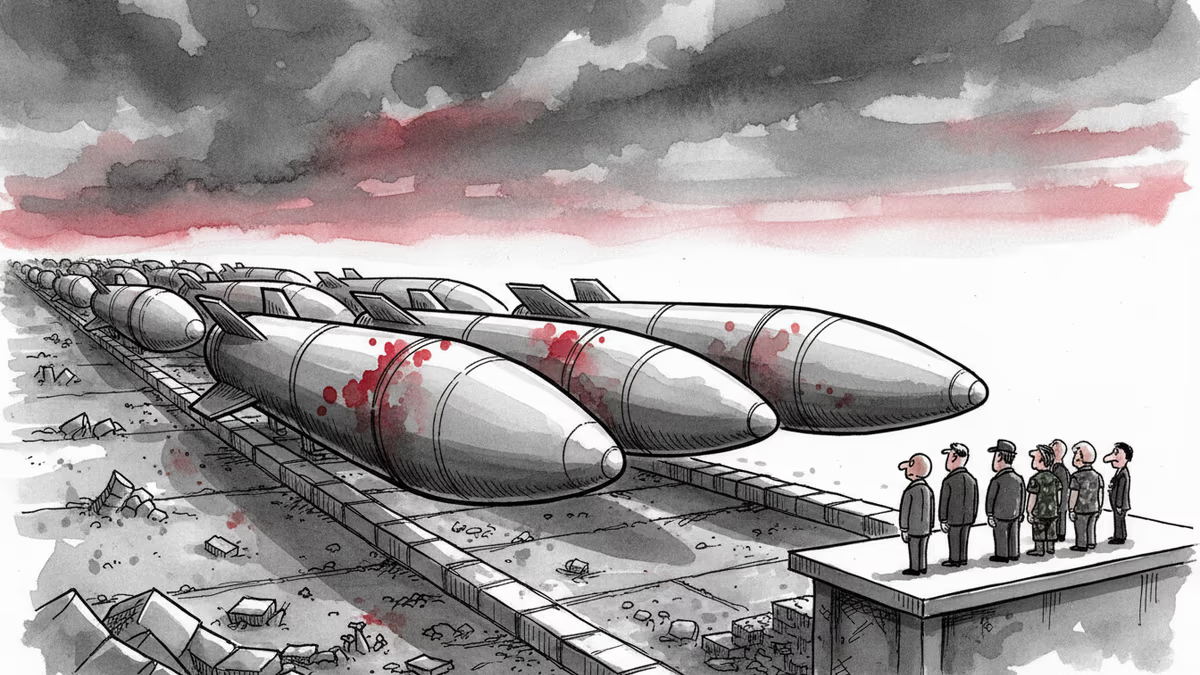
China's Missile Buildup: When Factory Output Becomes Strategy
China has sharply accelerated missile production in 2025, with 81 listed firms supplying the chain. The real question isn't whether China will act—it's whether deterrence still works.
Wars aren't decided by the first shot. They're decided by who can keep shooting.
That's the uncomfortable logic behind a Bloomberg report published this month: China has sharply accelerated missile production in 2025. An analysis of corporate filings identified 81 listed Chinese companies now supplying components, materials, or subsystems to the missile production chain. The figure isn't just a data point about weapons counts. It's a signal about industrial architecture—and what it means for the military balance over Taiwan.
What the Numbers Actually Mean
Military analysts have long tracked China's missile inventory—how many DF-21D anti-ship ballistic missiles, how many land-attack cruise missiles, how far along is the hypersonic program. But inventory is a snapshot. What matters in a prolonged conflict is the reload rate: how fast can you replenish what you've expended?
Ukraine answered that question for anyone still in doubt. Russia burned through precision-guided munitions in the early months of the war at a pace its defense industry couldn't sustain. The conflict's character changed as a result. China watched that lesson closely.
Distributing supply across 81 firms—rather than concentrating it in a handful of state-owned defense giants—does several things at once. It expands throughput. It reduces bottlenecks. And critically, it makes the production network harder to disrupt through targeted strikes in the opening hours of a conflict. That last point is not incidental. It's the point.
Why 2025, Why Now
The timing carries weight. Donald Trump's second administration has reintroduced strategic ambiguity into U.S. commitments to Taiwan's defense. Europe remains absorbed by Ukraine. Japan and the Philippines are ramping up their own defense spending, but both are still years away from meaningful independent deterrence capacity.
For Xi Jinping's leadership, the current window may look more permissive than any in recent memory. Alliance cohesion is under strain. American strategic attention is divided. And China's own defense industrial base is accelerating precisely when rivals are still working through the hangover of decades of underinvestment.

2027—the centenary of the People's Liberation Army and a year Xi has reportedly tied to Taiwan unification timelines—is less than two years away. That doesn't mean war is imminent. Military buildups serve diplomatic pressure and deterrence functions, not just operational ones. But deterrence only works if the other side believes it.
The Stakeholder Calculus
For Taiwan, the buildup simultaneously justifies defense budget increases and raises the ceiling on what those increases need to achieve. President Lai Ching-te has set a target of raising defense spending to 3% of GDP. The harder question is whether Taiwan's population and economic depth can sustain the kind of attrition a prolonged conflict would demand—regardless of how many missiles it has at the start.
For the U.S. Pentagon, the Bloomberg data lands as useful ammunition for budget arguments and Indo-Pacific force posture reviews. But the American defense industrial base has its own vulnerabilities: years of underinvestment, strained supply chains, and a backlog of promised arms deliveries to Taiwan that have already slipped. The U.S. can credibly argue it needs to accelerate production too—the harder argument is whether it can close the gap fast enough.
Japan, South Korea, and Australia each face versions of the same dilemma: they sit within the operational radius of China's missile forces, they depend on the same global supply chains that run through or near the Taiwan Strait, and they're being asked to shoulder more of their own deterrence burden at a moment when the geopolitical ground is shifting under their feet.
Inside China, the missile buildup isn't only a military strategy. It's also domestic political language. Nationalist narratives serve as a pressure valve amid economic slowdown and elevated youth unemployment. That dual function makes the buildup harder to walk back—even if Beijing's calculus on Taiwan itself remains unchanged.
What Deterrence Actually Requires
The conventional framing of this story is: China is building up, therefore the risk of conflict is rising. That's not wrong, but it's incomplete.
Deterrence theory holds that a buildup can reduce the probability of conflict if it convinces the adversary that the costs of action outweigh the benefits. The question is whether the current trajectory is moving toward that equilibrium or away from it. If Washington reads Beijing's acceleration as preparation for conflict, and Beijing reads Washington's response as confirmation of encirclement, the spiral dynamic becomes its own risk—independent of anyone's actual intentions.
None of that is settled. And that uncertainty is precisely what makes the next 24 months the most consequential period for Indo-Pacific security in a generation.
This content is AI-generated based on source articles. While we strive for accuracy, errors may occur. We recommend verifying with the original source.
Related Articles

Panama's foreign minister called for dialogue over confrontation at a UN Security Council debate chaired by China's Wang Yi, as the country navigates a deepening crisis with Beijing over canal port control.
Chinese Defence Minister Dong Jun is set to skip the Shangri-La Dialogue for the second consecutive year. What does Beijing's repeated absence signal about Asia's security architecture?

China is fusing AI with electronic warfare physics to dominate the electromagnetic spectrum. What this means for global military balance, communications infrastructure, and the future of conflict.
Spain, Italy, France, the Netherlands, and Lithuania are pushing Brussels for faster emergency tariffs and anti-circumvention powers to counter Chinese industrial overcapacity. Here's what's at stake.
Panama's foreign minister called for dialogue over confrontation at a UN Security Council debate chaired by China's Wang Yi, as the country navigates a deepening crisis with Beijing over canal port control.
Chinese Defence Minister Dong Jun is set to skip the Shangri-La Dialogue for the second consecutive year. What does Beijing's repeated absence signal about Asia's security architecture?
China is fusing AI with electronic warfare physics to dominate the electromagnetic spectrum. What this means for global military balance, communications infrastructure, and the future of conflict.
Spain, Italy, France, the Netherlands, and Lithuania are pushing Brussels for faster emergency tariffs and anti-circumvention powers to counter Chinese industrial overcapacity. Here's what's at stake.
Thoughts
Share your thoughts on this article
Sign in to join the conversation