
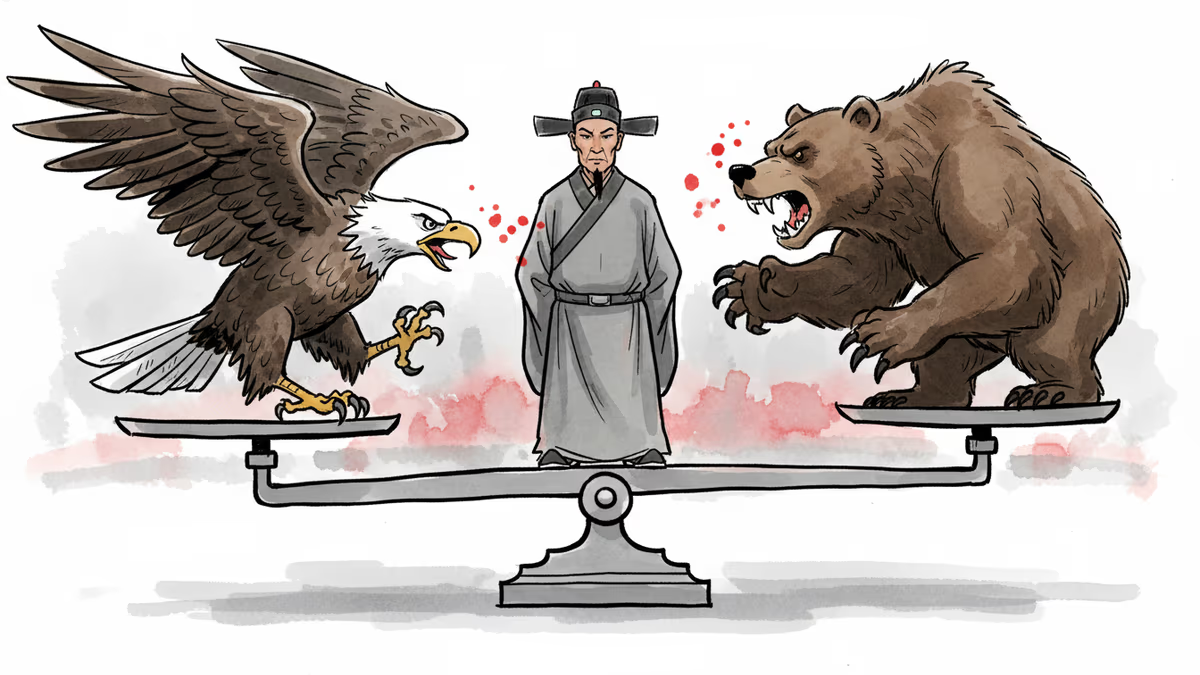
The Country Both Washington and Moscow Need
Xi Jinping's recent diplomacy with both US and Russian leaders reveals China's growing role as an indispensable player in global crises — from Ukraine to Iran. What does this mean for the international order?
Two rival superpowers. One country they both can't afford to ignore.
In the span of recent months, Xi Jinping has held high-profile diplomatic engagements with the leaders of both the United States and Russia. Taken separately, these look like routine bilateral meetings. Taken together, they reveal something more consequential: China has engineered a position where both Washington and Moscow believe they need Beijing more than Beijing needs them.
The Architecture of Indispensability
For Vladimir Putin, Xi is an economic lifeline. Since Russia's full-scale invasion of Ukraine, trade between the two countries has surged. The Chinese yuan has effectively become a parallel reserve currency for Russia's sanctions-battered economy. Beijing publicly denies supplying weapons while maintaining what the two leaders have called a "no-limits partnership." For Moscow, this isn't a preference — it's a structural dependency.
For Washington, the calculus is more uncomfortable. The Trump administration has officially framed China as a strategic competitor, yet finds itself in a position where it quietly needs Beijing's cooperation on some of the most urgent files in international security. Iran's nuclear ambitions can't be contained without engaging China, which absorbs a significant share of Iranian oil exports and maintains active diplomatic channels with Tehran. And any credible path toward ending the war in Ukraine runs through a capital that can actually move Putin — which, increasingly, means Beijing.
This is the paradox defining global politics in 2026: the country Washington designates as its primary long-term rival is simultaneously the country it most needs to call when crises escalate.
Three Ways to Read China's Position

How you interpret China's role depends heavily on where you're standing.
Beijing's own framing is consistent: China is a responsible major power that seeks peace, rejects bloc politics, and offers a model of engagement without the conditions that Western powers typically attach. The 2023 China-brokered normalization between Saudi Arabia and Iran is a frequently cited proof point. Xi's diplomacy is presented as evidence of a multipolar world taking shape — one where American hegemony is no longer the only organizing principle.
European policymakers see it differently. Their core frustration is that China claims the mantle of peacemaker while sustaining the economic relationships that keep Russia's war machine funded. Calling yourself a mediator while refusing to use your leverage, the argument goes, is a form of diplomatic theater. Several European officials have privately noted that China has more ability to pressure Putin than any other actor — and has consistently chosen not to use it.
For much of the Global South — across Africa, Southeast Asia, and the Middle East — China's positioning carries a different kind of appeal. Many governments in these regions have grown weary of Western conditionality: aid tied to governance reforms, partnerships contingent on geopolitical alignment. China's "non-interference" model offers an alternative, even if its critics argue that this non-interference is itself a form of strategic choice.
The Limits of Playing All Sides
China's balancing act is not without risk. The more Beijing is seen as indispensable, the more pressure accumulates from all directions to actually do something. The United States will eventually want concrete deliverables on Iran and Ukraine, not just diplomatic presence. European governments are already conditioning deeper economic ties on China's behavior toward Russia. And domestically, Xi faces the challenge of sustaining an economy that needs stable trade relationships with the West while deepening strategic ties with a sanctioned Russia.
There is also a credibility question that no amount of diplomatic positioning can indefinitely defer: a mediator who never pressures either side eventually stops being seen as a mediator and starts being seen as a bystander with good PR.
This content is AI-generated based on source articles. While we strive for accuracy, errors may occur. We recommend verifying with the original source.
Related Articles

Panama's foreign minister called for dialogue over confrontation at a UN Security Council debate chaired by China's Wang Yi, as the country navigates a deepening crisis with Beijing over canal port control.
Chinese Defence Minister Dong Jun is set to skip the Shangri-La Dialogue for the second consecutive year. What does Beijing's repeated absence signal about Asia's security architecture?

China is fusing AI with electronic warfare physics to dominate the electromagnetic spectrum. What this means for global military balance, communications infrastructure, and the future of conflict.

Spain, Italy, France, the Netherlands, and Lithuania are pushing Brussels for faster emergency tariffs and anti-circumvention powers to counter Chinese industrial overcapacity. Here's what's at stake.
Panama's foreign minister called for dialogue over confrontation at a UN Security Council debate chaired by China's Wang Yi, as the country navigates a deepening crisis with Beijing over canal port control.
Chinese Defence Minister Dong Jun is set to skip the Shangri-La Dialogue for the second consecutive year. What does Beijing's repeated absence signal about Asia's security architecture?
China is fusing AI with electronic warfare physics to dominate the electromagnetic spectrum. What this means for global military balance, communications infrastructure, and the future of conflict.
Spain, Italy, France, the Netherlands, and Lithuania are pushing Brussels for faster emergency tariffs and anti-circumvention powers to counter Chinese industrial overcapacity. Here's what's at stake.
Thoughts
Share your thoughts on this article
Sign in to join the conversation