
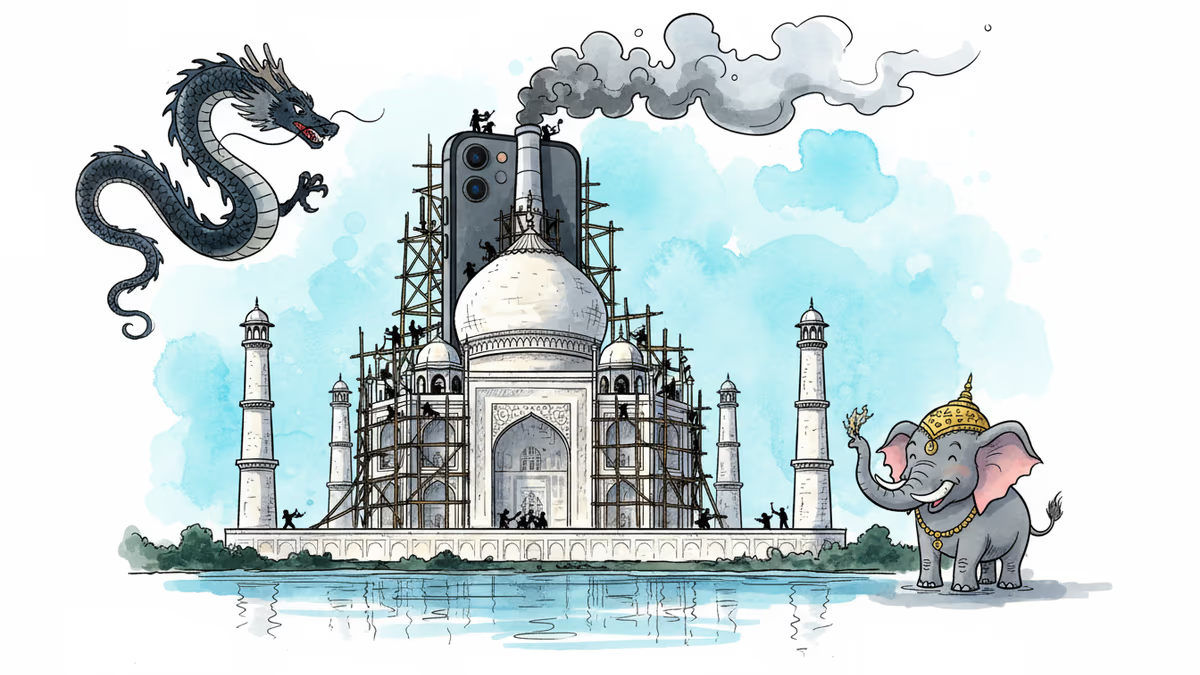
One in Four iPhones Is Now Made in India
Apple has hit 25% iPhone production in India, a milestone years in the making. What it means for supply chains, consumers, and the geopolitics of where things get made.
Donald Trump personally warned Tim Cook to stop moving production to India. That was May 2025, at a business summit in Doha. The numbers suggest Cook didn't listen.
The Milestone Nobody Should Be Surprised By
Apple now manufactures 25% of its iPhones in India — roughly 55 million units out of the 220–230 million produced globally last year, according to a Bloomberg report. That's not a sudden pivot. JPMorgan predicted this exact threshold back in 2022. What's changed is that it's now real.
The speed of the shift is what stands out. Ahead of last September's launch, Apple began producing the entire iPhone 17 lineup in India simultaneously — not as a secondary run, but as a primary manufacturing track. CEO Tim Cook confirmed that the majority of U.S. demand is now fulfilled by India-made iPhones. The device in an American's pocket is increasingly assembled in Chennai or Pune, not Shenzhen.
The accelerant was tariff uncertainty. As U.S.-China trade tensions churned through 2025, a supply chain anchored in China stopped being an operational decision and became a geopolitical liability. India was the hedge.
Why This Is Harder Than It Looks
Moving iPhone production isn't like relocating a warehouse. The supply chain ecosystem that built up around Zhengzhou — Foxconn's "iPhone City" — took decades and enormous state subsidy to construct. India is building that ecosystem now, and it's moving faster than most expected, but it's not frictionless.
Skilled labor, component logistics, and local supplier networks are still maturing. That's partly why Trump's pitch — make iPhones in America — remains a non-starter in the near term. The infrastructure simply isn't there, and no tariff threat changes that overnight.

India's government, for its part, has been aggressively courting Apple with production-linked incentive schemes. The result is a rare alignment: Apple wants to diversify, India wants the jobs and the prestige, and the economics are increasingly viable.
India: Factory and Customer
What makes this story more than a supply chain reshuffle is that India is simultaneously becoming one of Apple's most important consumer markets.
The company shipped 14 million iPhones in India last year — up 9% year-over-year — with total iPhone sales crossing $9 billion. Apple opened its sixth Indian retail store last month and is reportedly in talks to launch Apple Pay in the country this year. The playbook is familiar: establish manufacturing credibility, build consumer trust, then roll out the full services ecosystem.
For context, India now has over 800 million smartphone users. The premium segment is still small relative to the total, but it's growing faster than almost any other major market. Apple is planting flags early.
The Stakeholders Who Are Watching Closely
For competitors:Samsung has run one of the world's largest smartphone factories in Noida, India for years. Apple's deepening commitment intensifies competition in the premium segment of a market Samsung has long dominated in volume. The pressure is real.
For component suppliers: Korean firms like LG Innotek, Samsung Electro-Mechanics, and others supplying Apple face a logistical question: as the assembly hub shifts from China to India, do their own production footprints need to follow? Proximity to the customer still matters in hardware.
For the U.S. government: Trump's warning to Cook reflects a broader frustration — the administration wants reshoring, not re-routing. From Washington's perspective, swapping Chinese factories for Indian ones doesn't solve the "made in America" problem. But Apple's calculation is that India is a far lower geopolitical risk than China, even if it's not zero.
For Indian workers: The manufacturing jobs are real and growing. But questions about labor conditions, wages relative to the value being created, and long-term skills development remain open. Being the world's iPhone factory is an opportunity — how India captures the full value of that opportunity is a separate question.
Authors
Related Articles
China is restricting AI researchers and startup founders from traveling abroad as the U.S.-China AI performance gap narrows to just 2.7%. What Beijing's talent lockdown means for the global AI race.

SolarSquare is raising $55-60M at a $450-500M valuation, more than doubling its worth in 18 months. Here's what's driving investor conviction in India's residential solar market.
Indian venture capital has quietly displaced Silicon Valley in its own backyard. Only one American VC made India's top 10 investor list last year. Here's why that matters beyond India.
After 15 years of fragmented mobile messaging, Apple and Google are rolling out end-to-end encrypted RCS messaging between iPhones and Android devices. Here's what changed, why it took so long, and what it means for your privacy.
China is restricting AI researchers and startup founders from traveling abroad as the U.S.-China AI performance gap narrows to just 2.7%. What Beijing's talent lockdown means for the global AI race.
SolarSquare is raising $55-60M at a $450-500M valuation, more than doubling its worth in 18 months. Here's what's driving investor conviction in India's residential solar market.
Indian venture capital has quietly displaced Silicon Valley in its own backyard. Only one American VC made India's top 10 investor list last year. Here's why that matters beyond India.
After 15 years of fragmented mobile messaging, Apple and Google are rolling out end-to-end encrypted RCS messaging between iPhones and Android devices. Here's what changed, why it took so long, and what it means for your privacy.
Thoughts
Share your thoughts on this article
Sign in to join the conversation