

Russia's 'Nesting Doll' Satellites Are Hunting US Spies in Space
US Space Command confirms Russia has deployed operational anti-satellite weapons tracking American spy satellites in low-Earth orbit. What does this mean for space security?
Something Is Following America's Eyes in Space
Somewhere above 400 kilometers, a Russian satellite has been quietly shadowing one of America's most sensitive spy satellites. And it's not alone — there's something else hiding inside it.
This week, four-star General Stephen Whiting, commander of US Space Command, confirmed publicly what intelligence analysts have been tracking for years: Russia has moved beyond testing and is now fielding operational anti-satellite weapons with real American government satellites in their sights.
Whiting didn't name the system by name, but the reference was unmistakable. The Russian military program known as Nivelir has launched four satellites into low-Earth orbit — each one shadowing a spy satellite operated by the National Reconnaissance Office (NRO), the secretive US agency that runs America's orbital intelligence network.
How the Matryoshka Weapon Works
US officials have compared the Nivelir architecture to a Matryoshka — a Russian nesting doll. The outer shell looks like an ordinary satellite. Once in orbit, it opens up and releases a smaller craft that begins its own independent maneuvering.
In 2020, one of those inner craft fired an unidentified object at high velocity during what appeared to be a test. American analysts concluded it was a projectile — something designed to be fired at another satellite. Not a jamming device. Not a laser. A physical weapon that could physically destroy or disable an orbiting asset.
The strategic logic is elegant and unsettling. By pre-positioning these weapons close to their targets during peacetime, Russia compresses the warning time for any potential attack to near zero. There's no ballistic arc to track, no launch to detect. The weapon is already there.
Why This Announcement, Why Now

General Whiting's public confirmation isn't just an intelligence disclosure — it's a signal. The timing matters.
Ukraine has been the most visible demonstration in history of how dependent modern warfare is on space assets. From Starlink terminals guiding drone strikes to NRO imagery informing battlefield decisions, satellites have become the nervous system of the conflict. Russia knows this. And Russia has apparently decided to put weapons next to the nodes of that nervous system.
There's also a domestic dimension. The Space Force — still the youngest and, in some quarters, most skeptical-of branch of the US military — is navigating budget pressures under the current administration. A public declaration that an adversary is actively targeting American satellites is, among other things, a compelling argument for investment.
Three Ways to Read This
From Moscow's perspective, Nivelir is asymmetric deterrence in its purest form. The United States enjoys overwhelming superiority in space — more satellites, more capability, more dependence. Threatening that superiority doesn't require matching it. It requires only making the cost of conflict high enough to give Washington pause.
For the commercial space industry, the implications are more complicated. SpaceX, Planet Labs, OneWeb and dozens of other companies are building constellations of hundreds or thousands of satellites in the same low-Earth orbit where Nivelir operates. The existence of proximity-attack weapons raises the geopolitical risk profile of the entire sector — while simultaneously creating demand for satellite protection, space situational awareness services, and debris mitigation technology. Threat and opportunity, as usual, arrive together.
International law experts are asking a harder question: where exactly does Nivelir sit under existing legal frameworks? The 1967Outer Space Treaty prohibits weapons of mass destruction in space, but says relatively little about conventional weapons. Shadowing a satellite is not illegal. Firing a projectile near one occupies a legal gray zone that no international body has yet resolved. The rules of engagement in space remain, to a striking degree, unwritten.
The Bigger Picture: Space Is Already a Contested Domain
Russia is not alone in this race. China has demonstrated its own anti-satellite capabilities, most prominently in a 2007 test that destroyed one of its own weather satellites and created a debris field still tracked today. Both countries have invested in directed-energy weapons, electronic jamming, and cyberattacks targeting ground stations.
The United States has responded with a combination of satellite hardening, redundancy through commercial partnerships, and the development of its own counter-space capabilities — most of which remain classified. The Space Force has also been building out a network of sensors to track objects in orbit with greater precision, a capability that becomes essential when the threat isn't a missile launched from the ground but a small craft already in your neighbor's orbit.
What's changed with Whiting's statement is the explicit acknowledgment that this is no longer a future threat to be prepared for. It is a present one.
Authors
Related Articles

China is restricting AI researchers and startup founders from traveling abroad as the U.S.-China AI performance gap narrows to just 2.7%. What Beijing's talent lockdown means for the global AI race.

Over 270 Russian universities are offering students free tuition and up to $70,000 to serve as military drone pilots. Recruiters promise no frontline risk. The reality is more complicated.
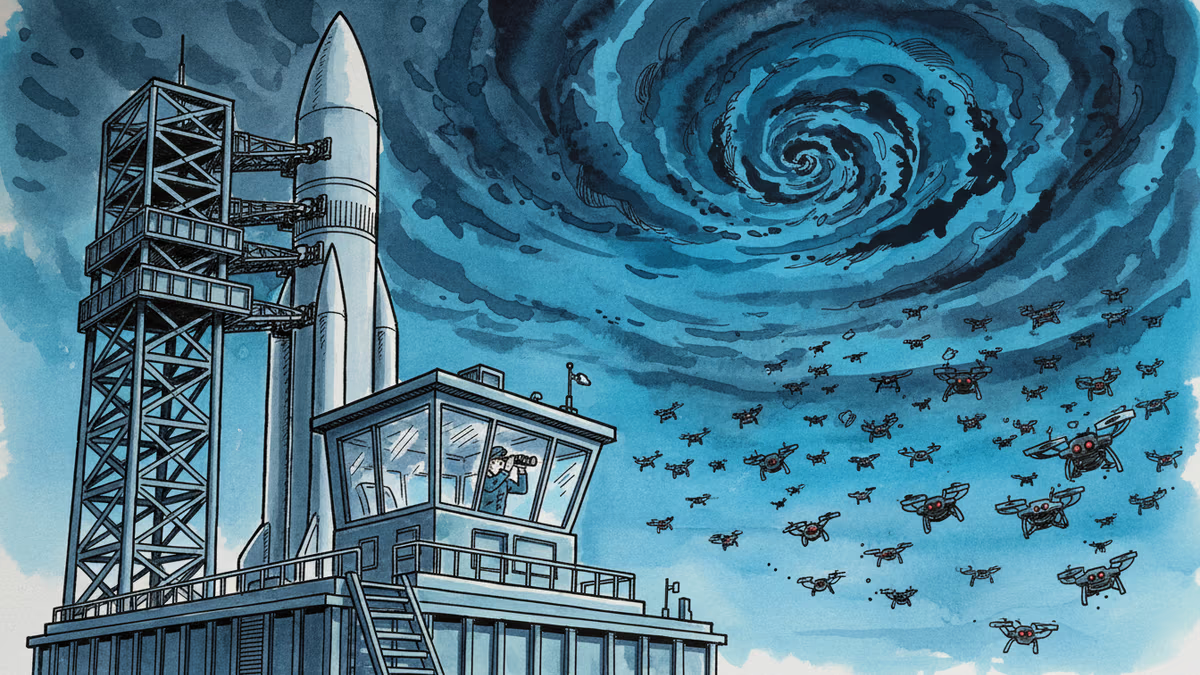
Russia's Plesetsk Cosmodrome has faced multiple drone attacks as Moscow races to build its own Starlink-like satellite network. What does this mean for the future of space warfare?

Scammers posing as Iranian authorities are demanding bitcoin and tether from ships near the Strait of Hormuz—exploiting the fact that Iran already does exactly this.
China is restricting AI researchers and startup founders from traveling abroad as the U.S.-China AI performance gap narrows to just 2.7%. What Beijing's talent lockdown means for the global AI race.
Over 270 Russian universities are offering students free tuition and up to $70,000 to serve as military drone pilots. Recruiters promise no frontline risk. The reality is more complicated.
Russia's Plesetsk Cosmodrome has faced multiple drone attacks as Moscow races to build its own Starlink-like satellite network. What does this mean for the future of space warfare?
Scammers posing as Iranian authorities are demanding bitcoin and tether from ships near the Strait of Hormuz—exploiting the fact that Iran already does exactly this.
Thoughts
Share your thoughts on this article
Sign in to join the conversation