
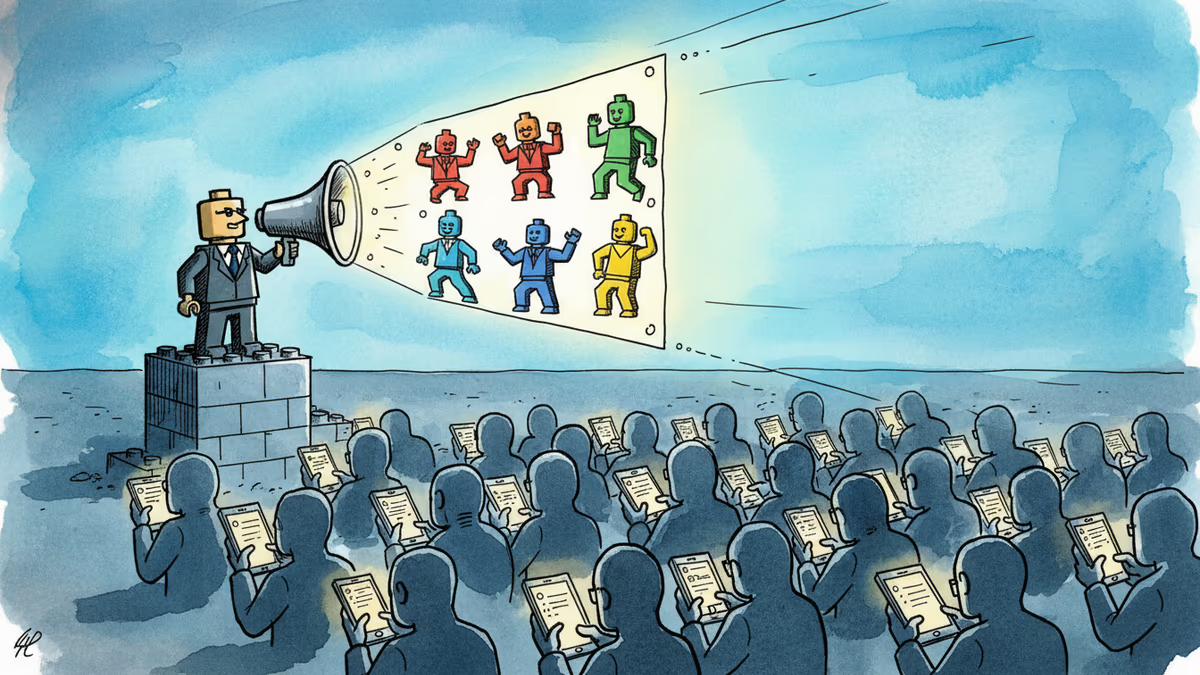
Iran's Lego Memes Are Winning the Attention War
A small pro-Iran team is racking up millions of views with AI-generated Lego videos that mock Trump — and Americans are sharing them. What does that tell us about information warfare?
A Lego Trump is crying, holding a white flag, eating a taco. Millions of people watched it. Many of them were American.
The Video That Shipped Before the News Did
Minutes after President Trump announced he wouldn't destroy "a whole civilization" — a de-facto step back from the brink with Iran — a team calling itself Explosive Media was already uploading their response. They'd seen it coming. The video was mostly done. They just tweaked the ending.
The finished product: a Lego-style AI animation featuring a Trump mini-figure huddling with Gulf state leaders, Iranian officials gleefully pressing a button labeled "back to the stone age," and Trump hurling a chair at US generals. At the close, the Lego Trump slumps beside a ceasefire document, sobbing, white flag in hand, taco in the other — a deliberate nod to TACO, the acronym that's been circulating online: Trump Always Chickens Out.
The caption on X and Telegram read: "IRAN WON! The way to crush imperialism has been shown to the world. Trump Surrendered."
Within hours, it had racked up millions of views.
How a Failed YouTube Channel Became a Psyop
Explosive Media didn't start this way. In early 2025, it was a modest YouTube channel — a young Iranian man delivering political commentary to audiences of a few hundred. Most videos barely broke 200 views.
Then the Twelve-Day War between Israel and Iran erupted in February 2025, and the team pivoted. They started producing AI-generated Lego-style animations, scripted and edited using tools they declined to name. The format spread fast — TikTok, X, Instagram — and the numbers followed.

The content is sharp, culturally literate, and deliberately provocative. One video shows Trump ordering airstrikes after reviewing an "Epstein File," flanked by Satan and Benjamin Netanyahu. Another features Iranian missiles with the names of Malcolm X and Jeffrey Epstein's victims etched on their sides. There are original English-language rap tracks. The group even set up a Spotify page for the music.
"We've committed ourselves to learning more every day about American people and culture," a team member told WIRED, speaking anonymously. "Americans themselves have been helping us — they share impactful tips and ideas with us."
The Access Problem Nobody Can Explain Away
The group insists it has no ties to the Iranian government. But that claim runs into an awkward reality: Iran has effectively severed its citizens from the global internet. YouTube, Instagram, X — all blocked. Yet Explosive Media operates freely across all of them.
The team says it received internet access because authorities recognized it as a media organization, citing 2.5 million followers across Iranian messaging channels.
Moustafa Ayad, a researcher at the Institute for Strategic Dialogue who has tracked Iranian online activity throughout the conflict, isn't buying the independence narrative. "Seeing as how the regime in Iran has effectively cut off the internet to everyone else, I think you'd have to be pretty close to the government to have access to the internet," he told WIRED.
Iran's official diplomatic accounts have been running a parallel operation. After Trump warned Iranians they'd soon be "living in Hell," the Iranian embassy in Zimbabwe posted that they'd lost the keys to the Strait of Hormuz. The embassy in Tunisia posted an AI-generated clip of Trump stepping off Air Force One clutching a white flag. These are state accounts — openly attributed. Explosive Media operates in a grayer space.
Why It's Working Where Official Propaganda Fails
Here's what makes this worth paying attention to beyond the Iran-US conflict itself: the content is reaching people who would never engage with traditional state media.
Ayad draws a direct contrast with the Trump administration's own social media strategy — war footage spliced with movie clips, content that "appeals to a narrow audience of loyal followers." Explosive Media's Lego videos are doing something different. They're using a universally recognizable toy aesthetic, English-language humor, and a precise read on what makes Americans click share — regardless of political affiliation.
"They're making it easily accessible to understand the conflict from Iran's point of view," Ayad says, "and it's hitting on points of disaffection in the United States at the same time. It's working on two fronts."
The Lego format isn't accidental. It creates distance. Real war footage triggers grief or outrage; Lego figures trigger something closer to a smirk. That emotional register — low-stakes, playful, slightly absurd — is precisely what lowers the audience's guard. You share a meme. You don't share propaganda.
Authors
Related Articles

China is restricting AI researchers and startup founders from traveling abroad as the U.S.-China AI performance gap narrows to just 2.7%. What Beijing's talent lockdown means for the global AI race.
Snap, YouTube, and TikTok settled a landmark school district lawsuit over social media addiction. With 1,000+ similar cases pending, this could reshape Big Tech's liability landscape.
New Mexico already won $375 million from Meta. Now it wants something harder to give: a court order forcing Facebook, Instagram, and WhatsApp to redesign themselves. A three-week trial starts Monday.

US Space Command confirms Russia has deployed operational anti-satellite weapons tracking American spy satellites in low-Earth orbit. What does this mean for space security?
China is restricting AI researchers and startup founders from traveling abroad as the U.S.-China AI performance gap narrows to just 2.7%. What Beijing's talent lockdown means for the global AI race.
Snap, YouTube, and TikTok settled a landmark school district lawsuit over social media addiction. With 1,000+ similar cases pending, this could reshape Big Tech's liability landscape.
New Mexico already won $375 million from Meta. Now it wants something harder to give: a court order forcing Facebook, Instagram, and WhatsApp to redesign themselves. A three-week trial starts Monday.
US Space Command confirms Russia has deployed operational anti-satellite weapons tracking American spy satellites in low-Earth orbit. What does this mean for space security?
Thoughts
Share your thoughts on this article
Sign in to join the conversation