

Humanity's Return to the Moon — But Who Really Owns It?
NASA's Artemis II sends four astronauts around the Moon this week. It's more than a space mission — it's the opening move in a geopolitical race for lunar resources that could reshape the next century.
The last human footprint on the Moon was made in December 1972. Since then, we've built the internet, decoded the human genome, and put supercomputers in everyone's pocket. But nobody went back.
That changes this week.
What's Actually Happening
NASA is launching four astronauts aboard the Orion capsule on Wednesday as part of the Artemis II mission — the first crewed lunar mission since Apollo 17. They won't land. The mission is a 10-day loop around the Moon and back, a live systems test of the hardware and life support that will eventually carry humans to the lunar surface.
That surface landing is the goal of Artemis IV, currently scheduled for 2028. And beyond that, NASA's stated ambition isn't just a visit — it's a sustained human presence on the Moon. A base. A foothold.
The rocket doing the heavy lifting is the Space Launch System (SLS), one of the most powerful ever built. The Orion capsule sitting on top is designed for deep space, not just low Earth orbit. Together, they represent roughly $93 billion in development costs — a number that draws as much criticism as admiration.
Why Now: The Moon Has Become a Strategic Asset
This isn't just about planting flags or satisfying scientific curiosity. The timing matters.
China has officially targeted a crewed lunar landing by 2030. Its Chang'e program has already returned soil samples from the Moon's far side — a feat no other nation has matched. India landed near the lunar south pole in 2023, becoming only the fourth country to achieve a soft lunar landing. Russia, despite the crash of Luna-25 in 2023, hasn't abandoned its lunar ambitions.

The south pole is the prize. Permanently shadowed craters there are estimated to hold hundreds of millions of tons of water ice. Split water into hydrogen and oxygen, and you have rocket propellant. Whoever controls the south pole controls the gas station for deep space exploration. That's not poetry — that's logistics.
This is why the Artemis Accords, the US-led framework for lunar cooperation, now has 26 signatory nations. It's as much a geopolitical alignment exercise as a scientific one.
The Skeptics Aren't Wrong
Not everyone is cheering. The $93 billion price tag for Artemis invites uncomfortable questions. Could that money have done more good fighting climate change, disease, or poverty on the planet we already live on?
There's also a more pragmatic challenge from an unexpected direction: SpaceX. Elon Musk's Starship — designed to carry far more payload at a fraction of the cost — is being developed in parallel as the actual lunar lander for Artemis. If commercial launch costs keep falling, the logic of a government-run mega-program becomes harder to defend.
And then there's the schedule. Artemis I slipped from 2021 to 2022. Artemis II has been delayed multiple times. The 2028 landing target is optimistic by the standards of this program's history.
The Rulebook Hasn't Been Written Yet
Here's the part that doesn't get enough attention: international law says no country can own the Moon. The 1967 Outer Space Treaty is clear on that. But it says nothing definitive about extracting resources from it.
NASA and its Artemis partners are operating under the assumption that mining lunar water ice — or rare minerals — is legally permissible. China and Russia haven't signed the Artemis Accords and dispute that framework. The result is a race to the surface happening faster than the legal infrastructure can keep up.
Whoever gets there first won't just plant a flag. They'll start writing the rules.
Authors
Related Articles

China is restricting AI researchers and startup founders from traveling abroad as the U.S.-China AI performance gap narrows to just 2.7%. What Beijing's talent lockdown means for the global AI race.
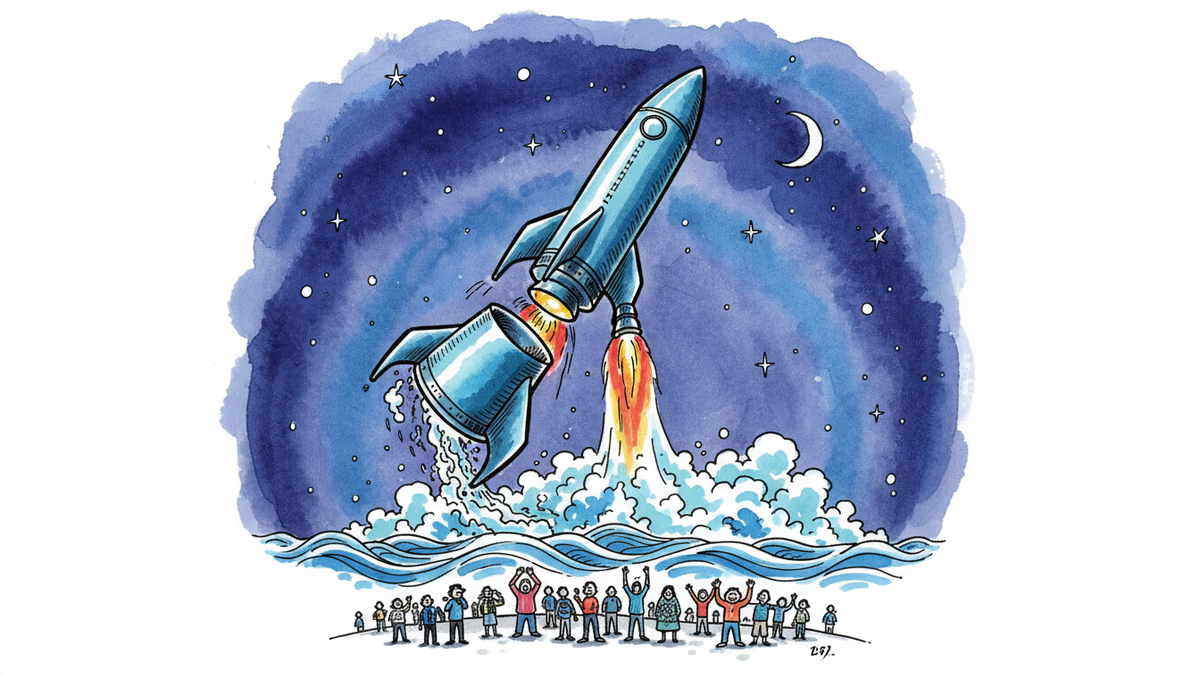
SpaceX's upgraded Starship V3 completed its first test flight, deploying 20 Starlink simulators but losing the Super Heavy booster. With an IPO weeks away, the stakes just got higher.
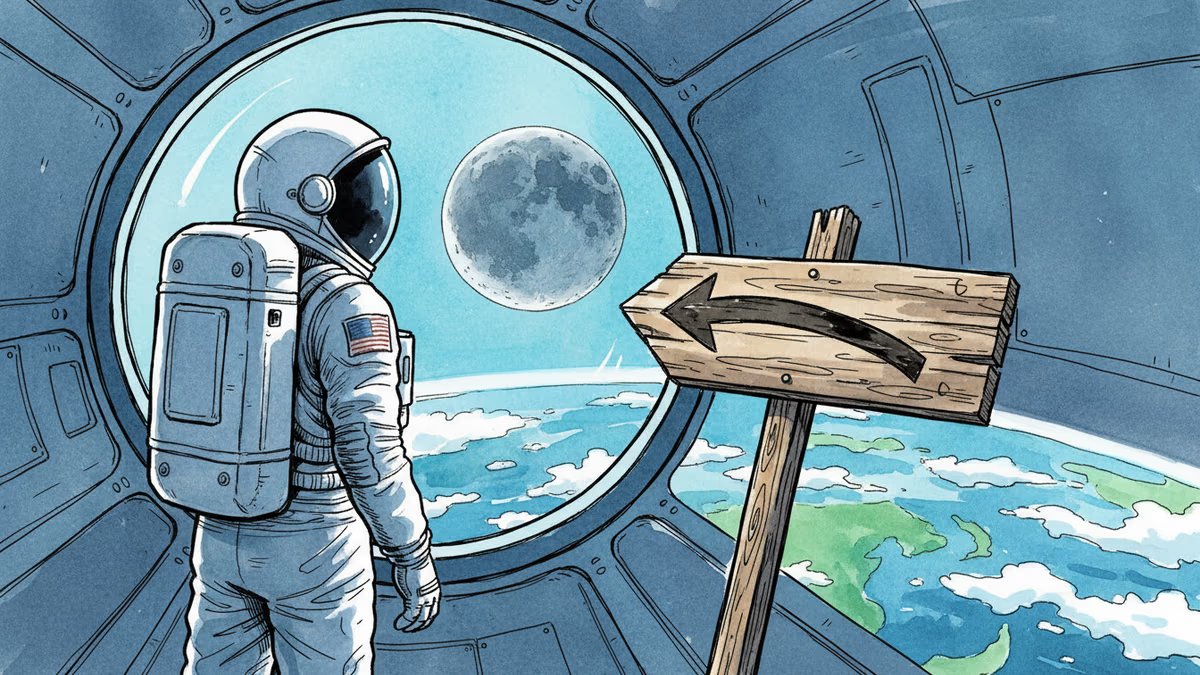
NASA's Artemis III has been redesigned as an Earth-orbit mission. SpaceX and Blue Origin say their landers won't be ready until late 2027. What does this mean for the future of lunar exploration?
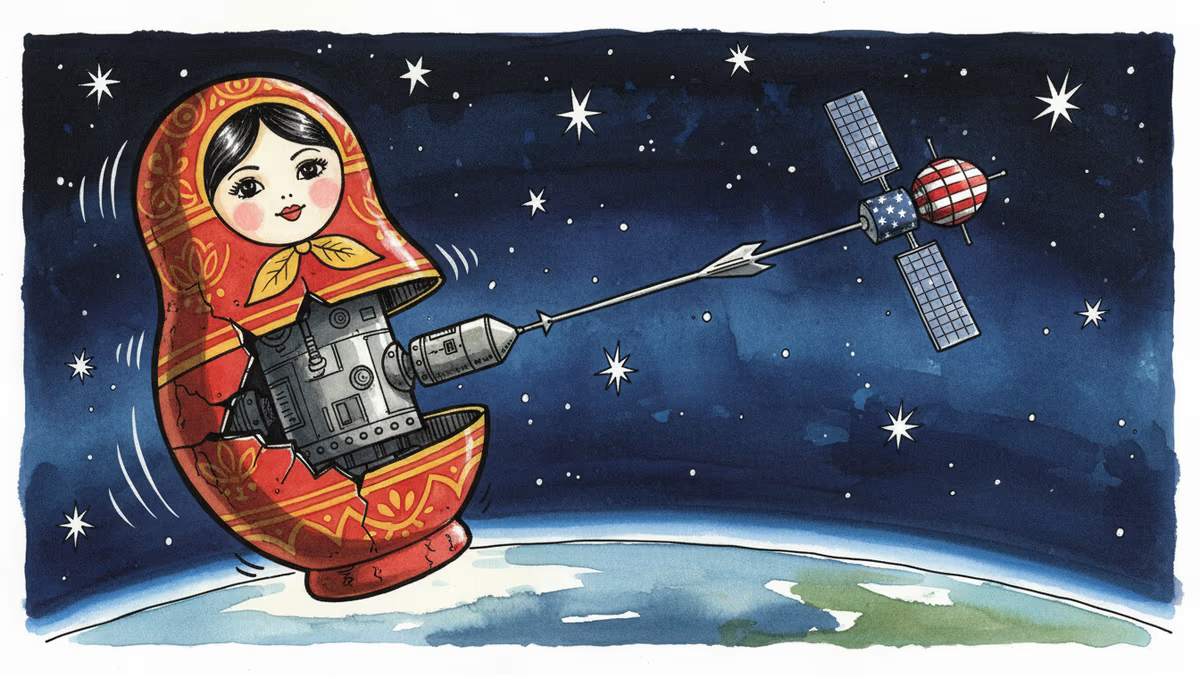
US Space Command confirms Russia has deployed operational anti-satellite weapons tracking American spy satellites in low-Earth orbit. What does this mean for space security?
China is restricting AI researchers and startup founders from traveling abroad as the U.S.-China AI performance gap narrows to just 2.7%. What Beijing's talent lockdown means for the global AI race.
SpaceX's upgraded Starship V3 completed its first test flight, deploying 20 Starlink simulators but losing the Super Heavy booster. With an IPO weeks away, the stakes just got higher.
NASA's Artemis III has been redesigned as an Earth-orbit mission. SpaceX and Blue Origin say their landers won't be ready until late 2027. What does this mean for the future of lunar exploration?
US Space Command confirms Russia has deployed operational anti-satellite weapons tracking American spy satellites in low-Earth orbit. What does this mean for space security?
Thoughts
Share your thoughts on this article
Sign in to join the conversation