
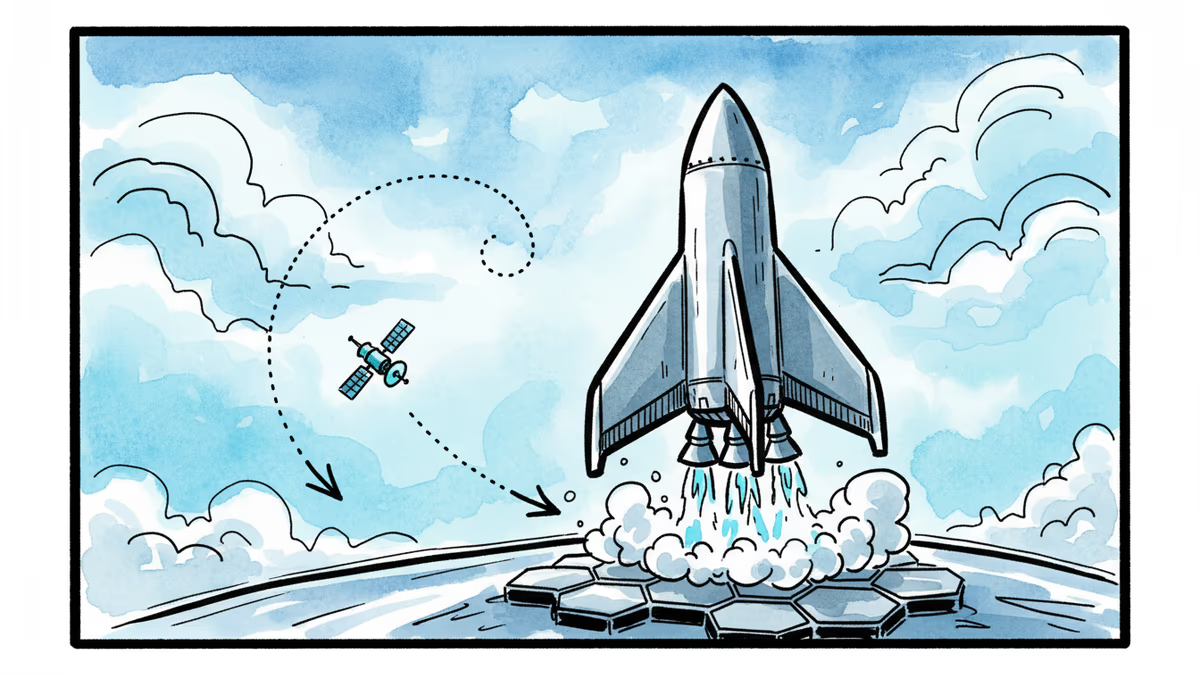
The Rocket Landed. The Satellite Didn't Make It.
Blue Origin's New Glenn nailed its second booster landing, but AST SpaceMobile's BlueBird 7 satellite ended up in the wrong orbit—effectively useless. What this split outcome reveals about the space race.
One vehicle had a perfect day. The other didn't.
On April 20, 2026, Blue Origin's New Glenn rocket lifted off carrying AST SpaceMobile's BlueBird 7 satellite. The first-stage booster came back down flawlessly—its second successful landing, cementing Jeff Bezos's place among the operators of genuinely reusable orbital rockets. But the second stage delivered the satellite to a lower orbit than planned. In the language of spaceflight, that's not a rounding error. BlueBird 7 is, for all practical purposes, dead on arrival.
What Actually Happened
AST SpaceMobile confirmed the satellite separated from the launch vehicle and powered on. That's where the good news ends. The company acknowledged the satellite was placed in an altitude it was never designed to operate from. In space, orbit height determines everything: atmospheric drag, communication geometry, ground station coverage angles. A satellite in the wrong orbit isn't a satellite doing a slightly worse job—it's a satellite that can't do its job at all.
To understand why this stings, you need to know what AST SpaceMobile is trying to build. The company's pitch is audacious: a network of large, powerful satellites that can communicate directly with ordinary smartphones—no special hardware, no satellite phone, just your existing device. AT&T, Verizon, and Samsung have all invested. The promise is eliminating dead zones everywhere on Earth. BlueBird 7 was meant to be one of the first commercial pieces of that puzzle.
Two Companies, Two Completely Different Days
The split outcome here is worth sitting with.

For Blue Origin, April 20 was a genuine milestone. Two successful booster recoveries means New Glenn is no longer a promising prototype—it's a vehicle with a track record. That matters enormously in a market where SpaceX's Falcon 9 has spent years building a reputation for reliability that translates directly into launch contracts. Every recovered booster is a data point that Bezos's rocket program is maturing.
For AST SpaceMobile, the calculus is brutal. The satellite cost money to build. The launch contract cost money. Insurance, engineering hours, ground operations—all spent. The stock market will price in the setback quickly. And the company's path to commercial viability runs through deploying dozens of these satellites. Losing one doesn't just cost the price of one satellite; it costs time, and in a race against Starlink, time is the one resource that can't be bought back.
The Bigger Race This Fits Into
SpaceX's Starlink already has thousands of satellites in orbit and paying customers across 100+ countries. Amazon's Project Kuiper is ramping up. AST SpaceMobile is competing in a different lane—direct-to-device rather than dish-to-home—but it's still a race, and the finish line keeps moving.
The direct-to-device angle is where things get interesting for the broader industry. Apple already embedded satellite SOS capability in iPhones via Globalstar. T-Mobile partnered with SpaceX to offer satellite texting in dead zones. The question of which company cracks truly seamless satellite-to-phone connectivity—and which phone manufacturers and carriers they partner with—has real consequences for how billions of people experience connectivity in the next decade.
This also raises a harder question about the launch industry itself. New Glenn's booster performed. The failure point was the upper stage—a component that doesn't get recovered or reused. Reusability has transformed the economics of getting to orbit, but it hasn't eliminated the complexity of what happens once you're there.
What Investors Are Watching
For anyone with exposure to AST SpaceMobile stock, the immediate concern is timeline slippage. The company has been burning cash while scaling toward commercial service. A satellite loss doesn't change the long-term thesis—if the technology works, the market is enormous—but it stretches the runway. How the company communicates the path forward in the coming days will matter as much as the technical setback itself.
For Blue Origin, the investment story is quietly strengthening. A reusable rocket that reliably comes back is a fundamentally different business than one that doesn't. The question is whether New Glenn can build the launch cadence and pricing that pulls customers away from Falcon 9—and whether a stumble by a payload customer colors perception of the rocket unfairly.
Authors
Related Articles

SpaceX's upgraded Starship V3 completed its first test flight, deploying 20 Starlink simulators but losing the Super Heavy booster. With an IPO weeks away, the stakes just got higher.

NASA's Artemis III has been redesigned as an Earth-orbit mission. SpaceX and Blue Origin say their landers won't be ready until late 2027. What does this mean for the future of lunar exploration?
Blue Origin successfully reflew an orbital-class booster for the first time, but New Glenn's upper stage failed on its third mission — raising questions about NASA's Artemis timeline.
Blue Origin's New Glenn rocket nailed its first booster reuse — but lost a customer satellite to a botched upper stage. What this split verdict means for the space industry, NASA's moon plans, and the race against SpaceX.
SpaceX's upgraded Starship V3 completed its first test flight, deploying 20 Starlink simulators but losing the Super Heavy booster. With an IPO weeks away, the stakes just got higher.
NASA's Artemis III has been redesigned as an Earth-orbit mission. SpaceX and Blue Origin say their landers won't be ready until late 2027. What does this mean for the future of lunar exploration?
Blue Origin successfully reflew an orbital-class booster for the first time, but New Glenn's upper stage failed on its third mission — raising questions about NASA's Artemis timeline.
Blue Origin's New Glenn rocket nailed its first booster reuse — but lost a customer satellite to a botched upper stage. What this split verdict means for the space industry, NASA's moon plans, and the race against SpaceX.
Thoughts
Share your thoughts on this article
Sign in to join the conversation