
The Booster Landed. The Satellite Didn't.
Blue Origin's New Glenn rocket nailed its first booster reuse — but lost a customer satellite to a botched upper stage. What this split verdict means for the space industry, NASA's moon plans, and the race against SpaceX.
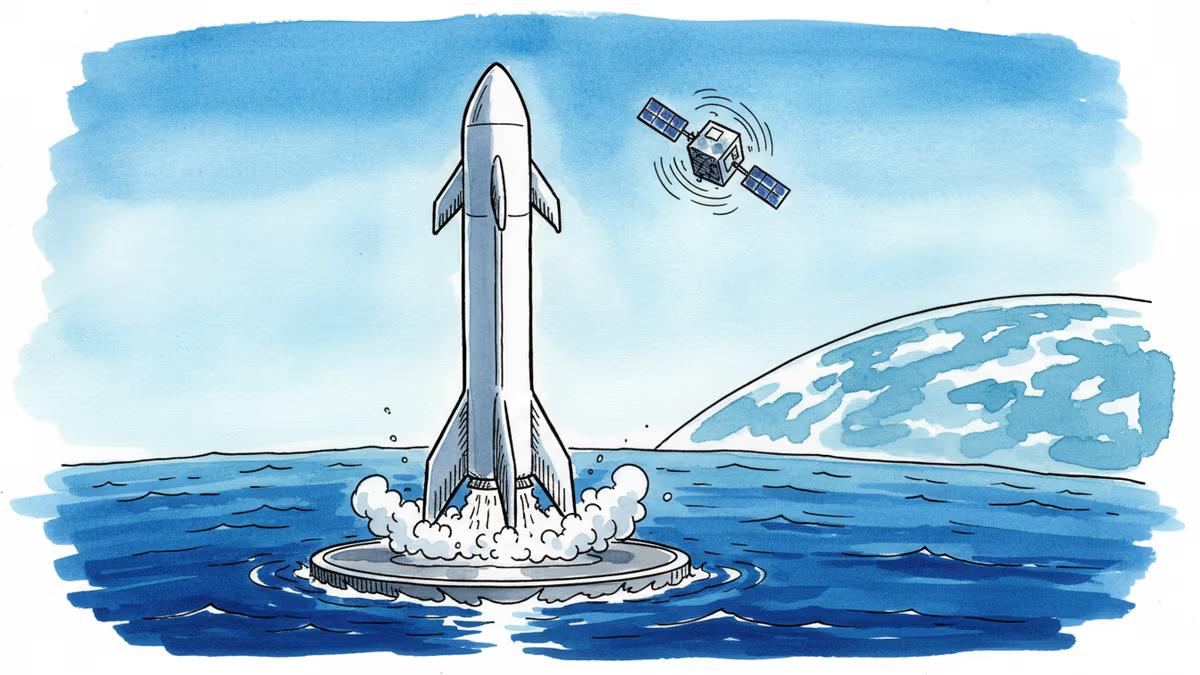
Sunday morning at Cape Canaveral looked like a highlight reel. New Glenn lifted off at 7:35 a.m., the booster came back down on a drone ship ten minutes later, and Jeff Bezos posted the footage to X — the platform owned by his rival Elon Musk. Musk replied with congratulations. The crowd, real and virtual, cheered.
Two hours later, the mood shifted. Blue Origin posted a single, clinical update: the upper stage had placed the AST SpaceMobile satellite into an "off-nominal orbit." Translation: the wrong one. Customer AST SpaceMobile confirmed the BlueBird 7 satellite ended up in an orbit "lower than planned" — too low to operate. It will be de-orbited, burning up in Earth's atmosphere.
In a single launch, Blue Origin achieved its most significant technical milestone and suffered its first major commercial failure. That contradiction is now the most important story in commercial spaceflight.
What Actually Happened
This was New Glenn's third mission. The rocket only made its debut in January 2025, after more than a decade in development. Its second mission, last November, successfully delivered twin NASA spacecraft bound for Mars. This time, Blue Origin did something no New Glenn had done before: it flew a previously-used booster. Reusability is the whole economic argument for modern launch vehicles — fly the same hardware again, cut costs, build a business.
On that front, Sunday worked. The booster landed cleanly.
But the upper stage — the second-stage engine responsible for pushing payloads to their final orbital altitude — underperformed. BlueBird 7 separated from the rocket and powered on, but it was stranded in an orbit it couldn't sustain. The satellite is insured, AST SpaceMobile says, and the next BlueBird satellite will be ready in roughly a month. The company still expects to launch 45 more satellites by the end of 2026, with multiple launch providers on contract.
The financial damage is contained. The reputational damage is harder to quantify.
The SpaceX Comparison Nobody Can Avoid
Blue Origin made a deliberate choice that now looks costly: it started flying real customer payloads on early missions. SpaceX, by contrast, has spent years testing its massive Starship with dummy payloads, absorbing failures before commercial cargo ever went aboard. Blue Origin framed its approach as confidence in its engineering process.

That confidence just took a hit — publicly, on only the third flight.
To be fair, SpaceX has its own graveyard. On the 19th Falcon 9 mission in 2015, the rocket disintegrated mid-flight, destroying an entire International Space Station resupply ship. In 2016, a Falcon 9 exploded on the pad during a test, taking Meta's internet satellite with it. Failures at this stage of a rocket program aren't unusual. They're expected.
What's different here is the stakes attached to New Glenn right now.
The Moon Problem
Blue Origin isn't just trying to be a commercial launch provider. It's positioning itself as a core partner for NASA's Artemis program — the effort to return humans to the lunar surface. CEO Dave Limp has publicly pledged his company will "move heaven and Earth" to help NASA meet the Trump administration's aggressive lunar timeline.
Blue Origin recently completed testing its first lunar lander. The company had considered launching it on this very mission — New Glenn's third flight — before opting to carry the AST SpaceMobile satellite instead. That lander is still expected to launch sometime this year, uncrewed.
The question now: does a second-stage failure on mission three change how NASA — and the White House — views New Glenn as a platform for lunar cargo? The space agency and the Trump administration have been leaning on both Blue Origin and SpaceX to deliver landers before the president's term ends. Blue Origin has not commented on how this failure affects those plans.
Three Ways to Read This
For AST SpaceMobile, Sunday is painful but survivable. Insurance covers the loss, production continues, and the company's satellite broadband ambitions aren't riding on a single rocket provider. Diversified launch contracts are exactly the kind of hedge that makes this manageable.
For NASA, the calculus is more delicate. Artemis needs reliability. Putting a lunar lander on a rocket whose upper stage just failed to reach the right orbit is a harder sell internally — and politically. Every delay in the moon program is measured against a presidential deadline.
For SpaceX, the silence is comfortable. Falcon 9 has become the workhorse of commercial spaceflight precisely because of its track record. A stumble by Blue Origin doesn't automatically strengthen SpaceX's position, but it doesn't weaken it either. The gap in proven reliability just got a little wider.
There's a broader industry question here too. The commercial launch market is growing fast, with Rocket Lab, United Launch Alliance, and international providers all competing for slots. A credibility gap at Blue Origin — even a temporary one — creates openings. Whether any competitor is positioned to fill them quickly is another matter.
Authors
Related Articles
American Airlines just signed Starlink for 500+ aircraft. It's not just about faster inflight internet — it's a calculated move in the run-up to what could be the largest IPO in history.

SpaceX's upgraded Starship V3 completed its first test flight, deploying 20 Starlink simulators but losing the Super Heavy booster. With an IPO weeks away, the stakes just got higher.
SpaceX's IPO filing puts AI at the center, claiming a $26.5 trillion market opportunity. But can Grok compete with OpenAI and Anthropic for enterprise customers?
SpaceX filed a nearly 400-page S-1 with the SEC, targeting an IPO as early as June 12. Here's what the filing reveals—and what it doesn't.
American Airlines just signed Starlink for 500+ aircraft. It's not just about faster inflight internet — it's a calculated move in the run-up to what could be the largest IPO in history.
SpaceX's upgraded Starship V3 completed its first test flight, deploying 20 Starlink simulators but losing the Super Heavy booster. With an IPO weeks away, the stakes just got higher.
SpaceX's IPO filing puts AI at the center, claiming a $26.5 trillion market opportunity. But can Grok compete with OpenAI and Anthropic for enterprise customers?
SpaceX filed a nearly 400-page S-1 with the SEC, targeting an IPO as early as June 12. Here's what the filing reveals—and what it doesn't.
Thoughts
Share your thoughts on this article
Sign in to join the conversation