
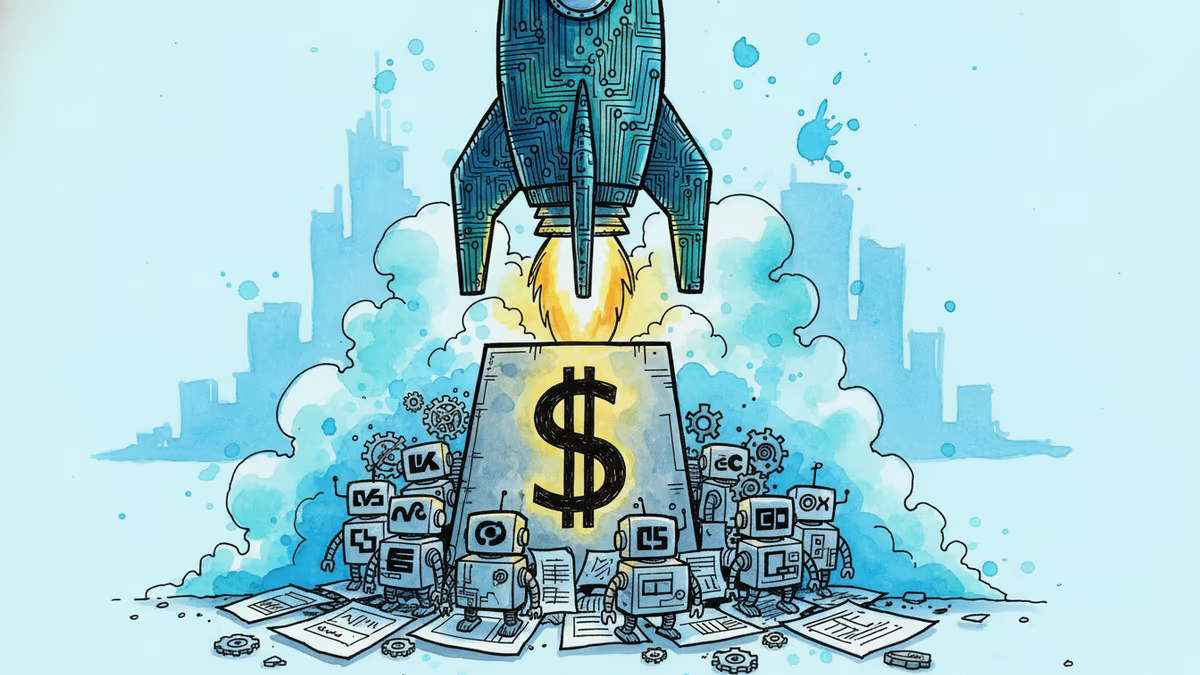
SpaceX Says It's an AI Company Now
SpaceX's IPO filing puts AI at the center, claiming a $26.5 trillion market opportunity. But can Grok compete with OpenAI and Anthropic for enterprise customers?
The Rocket Company That Wants to Be Valued Like an AI Company
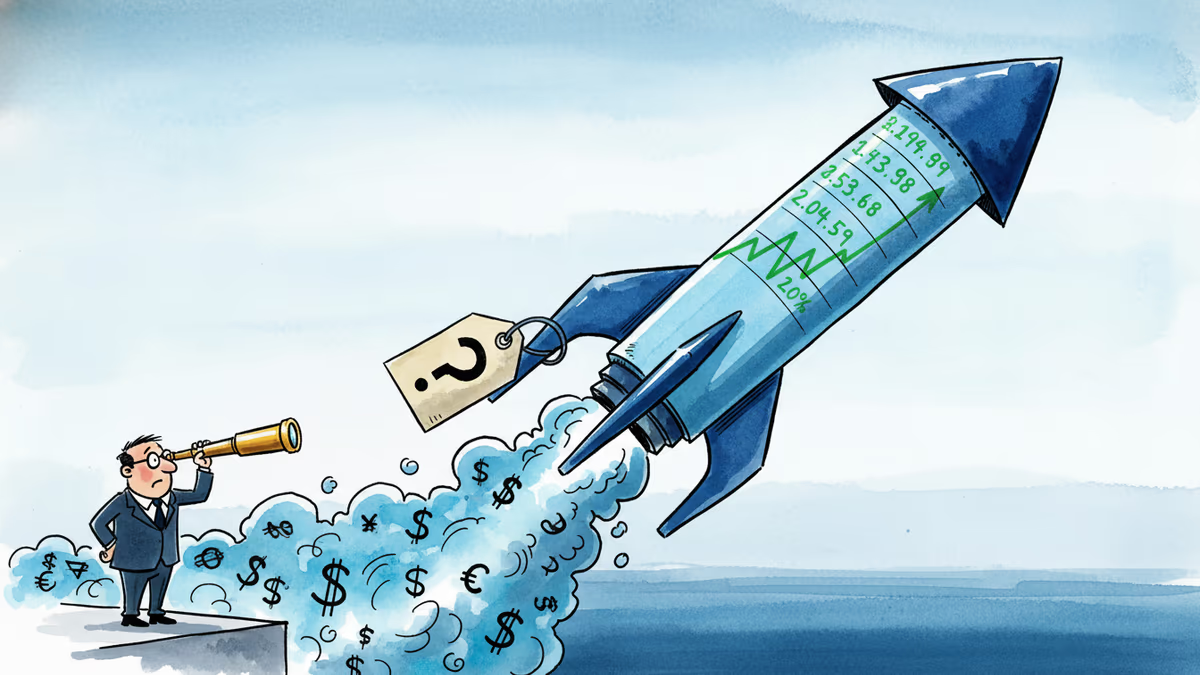
The US economy produced roughly $32 trillion in nominal GDP in the first quarter of 2026. SpaceX's IPO filing cites a $26.5 trillion addressable market for AI. That's not a typo—it's a deliberate framing designed to answer one question before investors even ask it: why should a rocket company trade at a tech multiple?
The answer, according to SpaceX, is that it's no longer just a rocket company. Earlier this year, SpaceX formally acquired Elon Musk's AI venture xAI, folding the Grok models and chatbot into a new internal division called SpaceXAI. The S-1 filing then went a step further, describing the legacy launch and satellite business—the one that made SpaceX famous—as a supporting role to the AI operation. A company built on getting things into orbit is now telling Wall Street that orbit is the side hustle.
What the S-1 Actually Claims
IPO filings are, by design, optimistic documents. SpaceX's describes the company as having "the largest actionable total addressable market in human history." The $26.5 trillion AI figure is the centerpiece of that claim.

But the filing also contains an admission that's easy to miss: enterprise customers currently prefer AI models from competitors. OpenAI, Anthropic, and Google's Gemini have meaningful footholds in the markets SpaceX wants to enter. The filing frames this as a challenge to overcome rather than a reason to doubt the strategy—but the gap is real.
SpaceX's pitch for why it can close that gap rests on vertical integration. The company controls Starlink, a global satellite internet network with hundreds of thousands of terminals already deployed. It controls launch infrastructure. And now it controls an AI layer. The argument is that no competitor can offer all three. Whether enterprise buyers actually want all three from the same vendor is a different question.
Three Stakeholders, Three Very Different Reads
For investors, the filing is a reframing exercise with real financial logic underneath. SpaceX is rare among space companies in generating substantial cash flow, largely through Starlink subscriptions. Layering an AI growth narrative onto that base could justify a valuation multiple more common in software than aerospace. The risk is that $26.5 trillion is a theoretical ceiling, not a realistic near-term target—and investors who've seen inflated TAM claims before will price that in.
**For competitors like OpenAI and Anthropic**, the move is both a threat and a reveal. Neither company has physical infrastructure at SpaceX's scale. But both have years of enterprise relationships, larger model ecosystems, and brand recognition in the AI space that Grok currently lacks. SpaceX entering the market validates the sector's size while also signaling that the next competitive axis might shift toward infrastructure ownership rather than model benchmarks alone.
For regulators, the picture is more unsettling. One individual now controls a private launch provider that governments depend on, a satellite network embedded in military and civilian communications, a major social media platform, and an AI model with ambitions to serve enterprise clients globally. Antitrust frameworks weren't designed for this configuration. Neither were national security reviews. The regulatory response—or lack of one—will shape how far this integration can actually go.
This content is AI-generated based on source articles. While we strive for accuracy, errors may occur. We recommend verifying with the original source.
Related Articles
American Airlines just signed Starlink for 500+ aircraft. It's not just about faster inflight internet — it's a calculated move in the run-up to what could be the largest IPO in history.
SpaceX's upgraded Starship V3 completed its first test flight, deploying 20 Starlink simulators but losing the Super Heavy booster. With an IPO weeks away, the stakes just got higher.
SpaceX filed a nearly 400-page S-1 with the SEC, targeting an IPO as early as June 12. Here's what the filing reveals—and what it doesn't.
SpaceX has filed its S-1 with the SEC, targeting the Nasdaq under ticker SPCX. With $18.67B in revenue but a $4.9B loss, the IPO forces investors to answer one hard question.
American Airlines just signed Starlink for 500+ aircraft. It's not just about faster inflight internet — it's a calculated move in the run-up to what could be the largest IPO in history.
SpaceX's upgraded Starship V3 completed its first test flight, deploying 20 Starlink simulators but losing the Super Heavy booster. With an IPO weeks away, the stakes just got higher.
SpaceX filed a nearly 400-page S-1 with the SEC, targeting an IPO as early as June 12. Here's what the filing reveals—and what it doesn't.
SpaceX has filed its S-1 with the SEC, targeting the Nasdaq under ticker SPCX. With $18.67B in revenue but a $4.9B loss, the IPO forces investors to answer one hard question.
Thoughts
Share your thoughts on this article
Sign in to join the conversation