
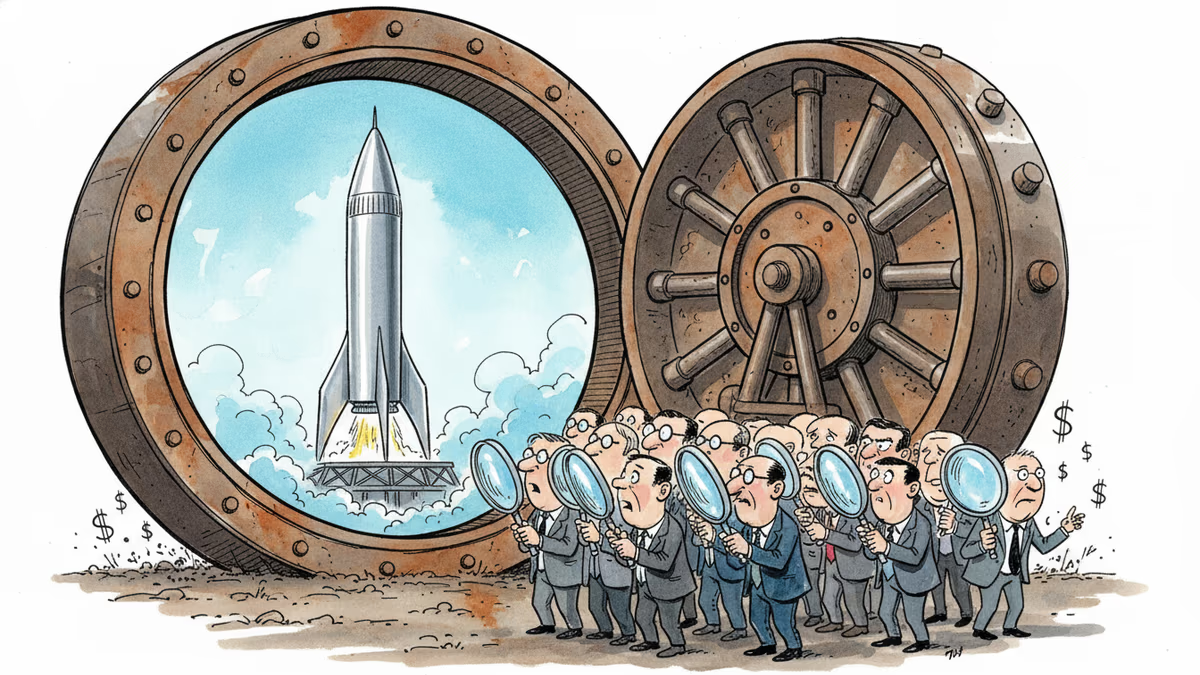
SpaceX Opens Its Books—After 23 Years of Silence
SpaceX filed a nearly 400-page S-1 with the SEC, targeting an IPO as early as June 12. Here's what the filing reveals—and what it doesn't.
For 23 years, SpaceX operated like a black box with engines. Competitors went public, burned through investor cash, and watched their stock prices crater—while Elon Musk's rocket company quietly became the most dominant force in commercial spaceflight without ever showing the world a balance sheet. That ended Wednesday.
What the Filing Actually Says
SpaceX submitted a nearly 400-page S-1 registration document to the U.S. Securities and Exchange Commission, targeting an IPO as early as June 12, 2026. The S-1 is the mandatory disclosure document for any company seeking to list on a U.S. exchange—it requires detailed financials, business structure, and risk factors.
The filing confirms what the industry already suspected: SpaceX is no longer just a rocket company. Its business now spans four distinct pillars—launch services, crewed and uncrewed spaceflight, the Starlink satellite internet network, and, following the recent acquisition of xAI, artificial intelligence and social media. That last one is new territory for an S-1. Folding Musk's AI venture into the SpaceX corporate structure means investors buying into the IPO aren't just betting on rockets—they're buying a stake in a technology conglomerate.
The filing contained no operational bombshells. No surprise Starship milestones, no undisclosed government contracts. But the significance isn't in what's new—it's in what's now official.
Why Now—and What's the Real Play
The timing of this filing isn't arbitrary. Three forces appear to be converging.
First, Starlink has reached a scale where profitability—not just growth—is a credible story to tell institutional investors. Subscriber numbers have grown substantially across dozens of countries, and the recurring revenue model is finally mature enough to anchor a valuation.

Second, the xAI integration reshapes how Wall Street will price the company. A pure-play launch provider gets valued on launch cadence and contract revenue. A company that also owns an AI platform and a social media asset gets a very different multiple. Musk is effectively asking the market to price SpaceX the way it prices Alphabet or Meta—as a platform business, not an aerospace contractor.
Third, the political environment is favorable. U.S. government spending on space has expanded, NASA dependencies on SpaceX have deepened, and the current administration has shown little appetite for the kind of antitrust scrutiny that might complicate a high-profile tech listing.
What Investors Should Actually Scrutinize
The more interesting exercise isn't reading what the S-1 says—it's interrogating what it might obscure.
Key questions that analysts will be stress-testing: What is Starlink's average revenue per user, and what does churn look like in mature markets? What is the true unit economics of a reused Falcon 9 launch? How much capital does Starship commercialization still require, and does that come from IPO proceeds or ongoing operations? And perhaps most critically—how does the filing characterize the risk of Musk's attention being divided across Tesla, X, xAI, and now a newly public SpaceX?
For retail investors, the IPO will likely be accessible through standard brokerage accounts once listed. But the more relevant question for most people isn't whether to buy the stock—it's what SpaceX's public valuation will do to the broader space sector. A successful listing at a high multiple resets the benchmark for every other space company, from Rocket Lab to Blue Origin, if and when it ever files.
The Skeptic's View
Not everyone is treating this as a straightforward win. Some institutional investors will raise concerns about governance—specifically, the degree to which a single founder's decisions can move the company in ways that don't require board approval. Musk's track record of surprise pivots (the xAI acquisition itself being a recent example) makes the standard S-1 risk language about "key person dependency" feel like an understatement.
Environmental groups have also flagged SpaceX's launch cadence and Starship test activity as areas of regulatory exposure, particularly around the Boca Chica facility. These are disclosed risks, but how the market prices them is another matter.
This content is AI-generated based on source articles. While we strive for accuracy, errors may occur. We recommend verifying with the original source.
Related Articles
American Airlines just signed Starlink for 500+ aircraft. It's not just about faster inflight internet — it's a calculated move in the run-up to what could be the largest IPO in history.
SpaceX's upgraded Starship V3 completed its first test flight, deploying 20 Starlink simulators but losing the Super Heavy booster. With an IPO weeks away, the stakes just got higher.
SpaceX's IPO filing puts AI at the center, claiming a $26.5 trillion market opportunity. But can Grok compete with OpenAI and Anthropic for enterprise customers?
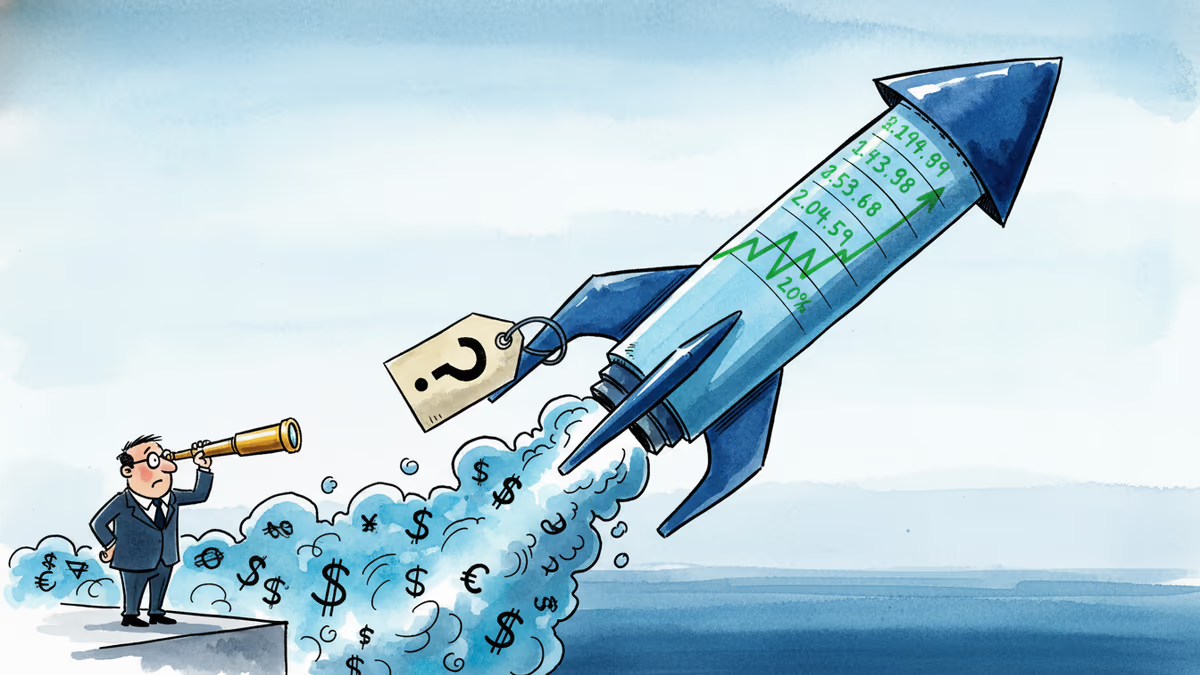
SpaceX has filed its S-1 with the SEC, targeting the Nasdaq under ticker SPCX. With $18.67B in revenue but a $4.9B loss, the IPO forces investors to answer one hard question.
American Airlines just signed Starlink for 500+ aircraft. It's not just about faster inflight internet — it's a calculated move in the run-up to what could be the largest IPO in history.
SpaceX's upgraded Starship V3 completed its first test flight, deploying 20 Starlink simulators but losing the Super Heavy booster. With an IPO weeks away, the stakes just got higher.
SpaceX's IPO filing puts AI at the center, claiming a $26.5 trillion market opportunity. But can Grok compete with OpenAI and Anthropic for enterprise customers?
SpaceX has filed its S-1 with the SEC, targeting the Nasdaq under ticker SPCX. With $18.67B in revenue but a $4.9B loss, the IPO forces investors to answer one hard question.
Thoughts
Share your thoughts on this article
Sign in to join the conversation