
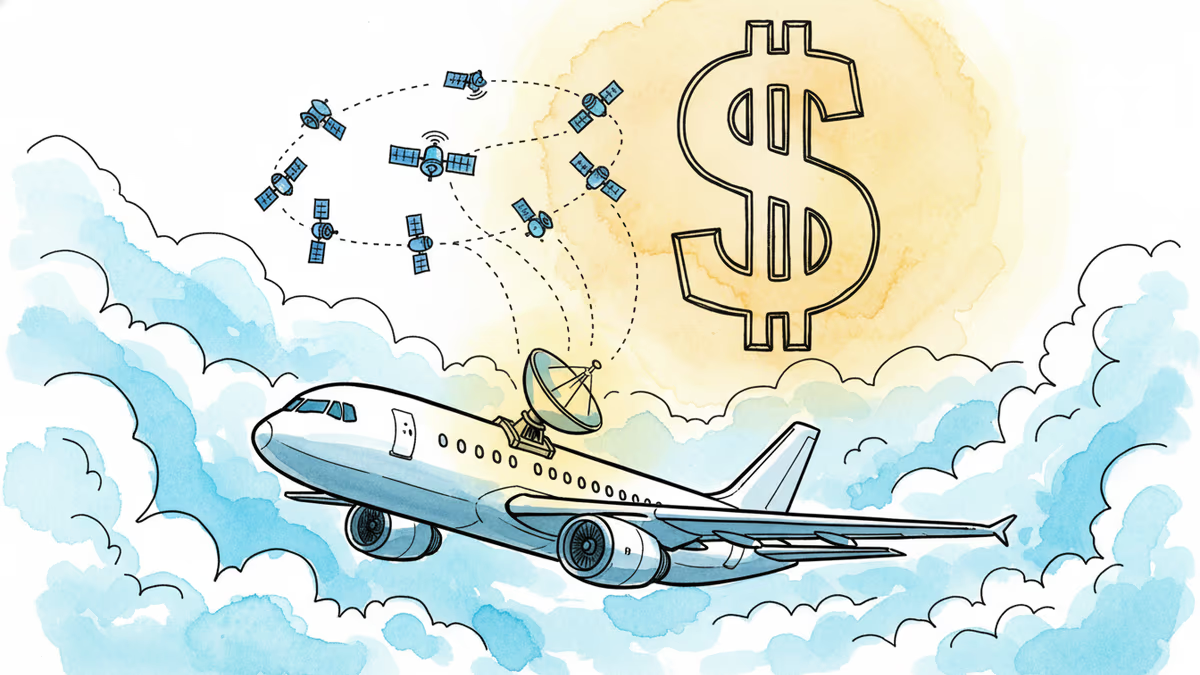
The Wi-Fi Deal That's Helping Build SpaceX's IPO Story
American Airlines just signed Starlink for 500+ aircraft. It's not just about faster inflight internet — it's a calculated move in the run-up to what could be the largest IPO in history.
For most of commercial aviation's history, inflight Wi-Fi has been the service passengers tolerate rather than enjoy — slow, expensive, and unreliable enough to make a crossword puzzle look appealing. That reputation is now becoming a financial asset worth billions.
The Contract, and Why the Timing Is Everything
American Airlines announced Tuesday it will install Starlink on more than 500 narrow-body Airbus aircraft — specifically the A321XLR and A320neo — beginning early next year. Boeing aircraft are not part of the deal.
On its own, this is a meaningful but unremarkable business story. In context, it's something else. Just one week ago, SpaceX filed its IPO registration documents. The offering is projected to be the largest in history. And Starlink — the satellite communications network — is the only SpaceX business unit generating meaningful revenue. Every airline contract signed between now and the IPO date isn't just a customer win. It's a data point for the prospectus.
SpaceX's filing already names United Airlines, Southwest Airlines, Qatar Airways, Lufthansa Group, British Airways, and Alaska Airlines (which merged with Hawaiian Airlines) as carriers that have equipped some aircraft with Starlink. American Airlines is the newest addition to that list — and the largest U.S. carrier yet to formally commit.
What Makes Starlink Different (And What Could Challenge It)

Starlink's technical edge comes from its low Earth orbit (LEO) constellation, positioned roughly 550 kilometers above the surface — compared to traditional geostationary satellites sitting at around 35,000 kilometers. That distance difference translates to latency roughly 10 times lower, which is why passengers on Starlink-equipped flights report speeds that actually resemble ground-level broadband.
But the competitive landscape is shifting. Amazon's Project Kuiper is building its own LEO constellation and has begun commercial launches. Unlike Starlink, Kuiper can be bundled with AWS cloud infrastructure — a potentially compelling pitch for airlines that want more than a connectivity pipe. Legacy providers like Viasat still hold contracts with carriers and aren't walking away quietly.
The question isn't whether Starlink leads today. It's whether that lead is structural or just a head start.
Three Different Scoreboards
For passengers, the calculus is simple: faster, more reliable Wi-Fi is better. Starlink-equipped routes have generally received positive reviews. Whether American Airlines will offer it free, bundled with fares, or as a paid add-on hasn't been announced — and that pricing decision will matter more to most travelers than the satellite architecture behind it.
For airlines, the math is more nuanced. Installing hardware on 500+ aircraft is a capital commitment, and switching costs are high once antennas are fitted. The fact that American Airlines excluded its Boeing fleet from this agreement is notable — it may reflect technical constraints, ongoing Boeing delivery uncertainties, or simply a phased rollout strategy.
For investors eyeing the SpaceX IPO, the core question is unit economics. Launching and maintaining thousands of satellites is extraordinarily expensive. The bull case rests on whether enterprise and carrier contracts can scale fast enough to justify the infrastructure cost. Each airline deal narrows the uncertainty — but doesn't eliminate it.
This content is AI-generated based on source articles. While we strive for accuracy, errors may occur. We recommend verifying with the original source.
Related Articles

SpaceX's upgraded Starship V3 completed its first test flight, deploying 20 Starlink simulators but losing the Super Heavy booster. With an IPO weeks away, the stakes just got higher.
SpaceX's IPO filing puts AI at the center, claiming a $26.5 trillion market opportunity. But can Grok compete with OpenAI and Anthropic for enterprise customers?
SpaceX filed a nearly 400-page S-1 with the SEC, targeting an IPO as early as June 12. Here's what the filing reveals—and what it doesn't.

SpaceX has filed its S-1 with the SEC, targeting the Nasdaq under ticker SPCX. With $18.67B in revenue but a $4.9B loss, the IPO forces investors to answer one hard question.
SpaceX's upgraded Starship V3 completed its first test flight, deploying 20 Starlink simulators but losing the Super Heavy booster. With an IPO weeks away, the stakes just got higher.
SpaceX's IPO filing puts AI at the center, claiming a $26.5 trillion market opportunity. But can Grok compete with OpenAI and Anthropic for enterprise customers?
SpaceX filed a nearly 400-page S-1 with the SEC, targeting an IPO as early as June 12. Here's what the filing reveals—and what it doesn't.
SpaceX has filed its S-1 with the SEC, targeting the Nasdaq under ticker SPCX. With $18.67B in revenue but a $4.9B loss, the IPO forces investors to answer one hard question.
Thoughts
Share your thoughts on this article
Sign in to join the conversation