
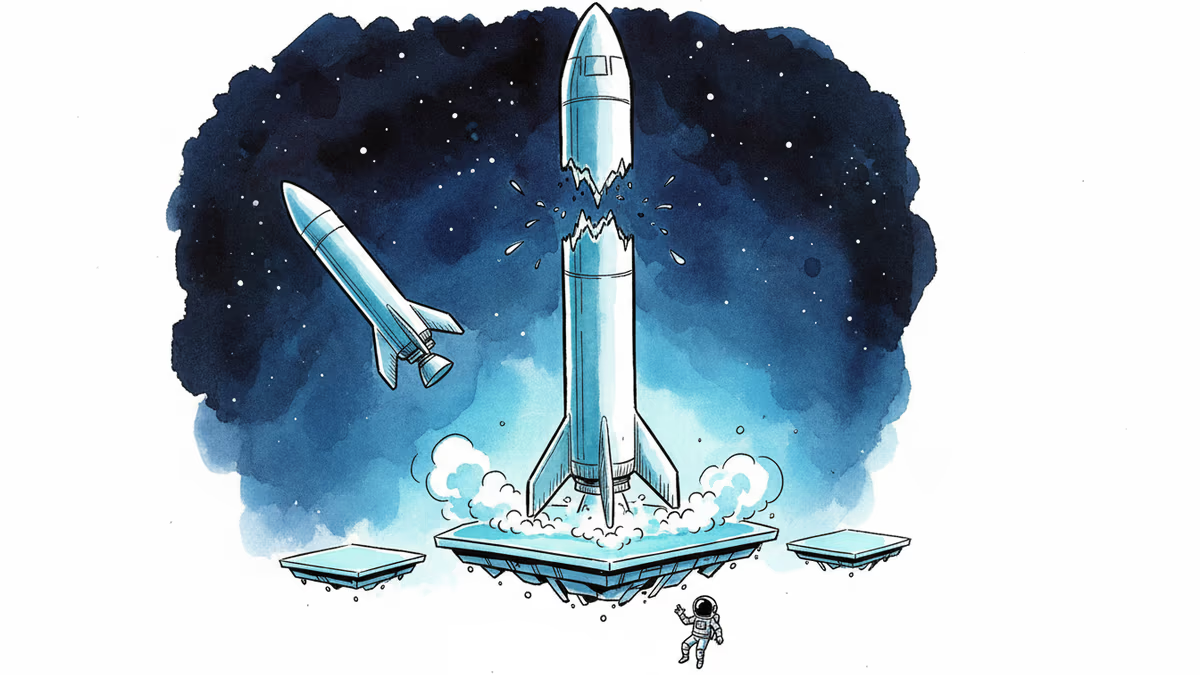
New Glenn's Third Flight: One Win, One Miss
Blue Origin successfully reflew an orbital-class booster for the first time, but New Glenn's upper stage failed on its third mission — raising questions about NASA's Artemis timeline.
The booster stuck the landing. The upper stage didn't make it.
On Sunday morning, Blue Origin's 321-foot New Glenn rocket lit up the Florida sky at 7:25 am EDT, its seven methane-burning BE-4 engines each delivering over half a million pounds of thrust. The rocket broke the sound barrier in roughly 90 seconds. Three minutes in, the first-stage booster cut its engines, separated cleanly, and returned to Earth — becoming the first orbital-class booster in New Glenn's history to fly twice. A genuine milestone.
Then the upper stage, powered by two BE-3U engines running on liquid hydrogen and liquid oxygen, fell short of completing its mission. The details of what exactly went wrong haven't been fully disclosed, but the outcome is clear: a partial success on New Glenn's third flight.
What 'Half a Win' Actually Means
In rocket development, a partial success isn't unusual — it's practically a rite of passage. SpaceX's Falcon 9 stumbled through early failures before becoming the workhorse it is today. New Glenn's own track record follows a visible arc: first flight (January 2025) lost the booster, second flight landed it, third flight re-flew it. That progression on the booster side is real and meaningful.
But the stakes here go beyond a single mission. New Glenn isn't just another commercial launcher. It's central to NASA's Artemis lunar program. Blue Origin is developing the Blue Moon lunar lander — built around New Glenn's capabilities — as part of America's goal to return humans to the Moon by the late 2020s. An upper stage failure at this stage of development isn't catastrophic, but it's not nothing either.
Artemis has already slipped multiple times. Each additional delay compounds the political and budgetary pressure on NASA, which is simultaneously managing cost overruns on the Space Launch System (SLS) and navigating an increasingly skeptical Congress.

The SpaceX Gap — And Why It's Complicated
SpaceX has reflown individual Falcon 9 boosters more than 20 times. Starship is already in advanced testing. By comparison, New Glenn's first booster reuse feels like an early chapter in a much longer story.
But the comparison has limits. Falcon 9 flew its first mission in 2010 and spent years building toward its current reliability. New Glenn is three flights old. Every launch vehicle that's now considered dependable was once unreliable. The question isn't whether New Glenn is behind SpaceX — it clearly is — but whether the gap is closable, and on what timeline.
For Blue Origin, the structural advantage is unusual in this industry: Jeff Bezos funds the company largely out of pocket, insulating it from the quarterly earnings pressure that shapes most aerospace programs. That patience is an asset. Whether it's enough to close the gap with SpaceX before Artemis deadlines bite is a different question.
Three Stakeholders, Three Reads
For NASA, this is a mixed signal at a difficult moment. The agency needs New Glenn — or something like it — to work reliably for Artemis. A booster reuse success is encouraging. An upper stage failure is a reminder that the program still has maturing to do, and time isn't unlimited.
For investors and the broader launch market, the picture is more nuanced. New Glenn's eventual commercial viability depends on demonstrating consistent mission success, not just hardware recovery. Payload customers — satellite operators, government agencies — book rockets based on reliability records. Right now, SpaceX holds that advantage decisively.
For the space industry overall, Sunday's flight adds another data point to an ongoing experiment: can a second well-funded American heavy-lift provider genuinely compete with SpaceX? The answer matters for pricing, market diversity, and national security launch capacity. A monopoly in launch services, even a capable one, carries its own risks.
Authors
Related Articles

SpaceX filed a nearly 400-page S-1 with the SEC, targeting an IPO as early as June 12. Here's what the filing reveals—and what it doesn't.

SpaceX has filed its S-1 with the SEC, targeting the Nasdaq under ticker SPCX. With $18.67B in revenue but a $4.9B loss, the IPO forces investors to answer one hard question.

NASA's Artemis III has been redesigned as an Earth-orbit mission. SpaceX and Blue Origin say their landers won't be ready until late 2027. What does this mean for the future of lunar exploration?
Blue Origin's New Glenn nailed its second booster landing, but AST SpaceMobile's BlueBird 7 satellite ended up in the wrong orbit—effectively useless. What this split outcome reveals about the space race.
SpaceX filed a nearly 400-page S-1 with the SEC, targeting an IPO as early as June 12. Here's what the filing reveals—and what it doesn't.
SpaceX has filed its S-1 with the SEC, targeting the Nasdaq under ticker SPCX. With $18.67B in revenue but a $4.9B loss, the IPO forces investors to answer one hard question.
NASA's Artemis III has been redesigned as an Earth-orbit mission. SpaceX and Blue Origin say their landers won't be ready until late 2027. What does this mean for the future of lunar exploration?
Blue Origin's New Glenn nailed its second booster landing, but AST SpaceMobile's BlueBird 7 satellite ended up in the wrong orbit—effectively useless. What this split outcome reveals about the space race.
Thoughts
Share your thoughts on this article
Sign in to join the conversation