

The Claudeholics Are Just the Beginning
A small but growing group of developers has gone all-in on AI coding agents like Claude Code and OpenClaw. History suggests the rest of us won't be far behind.
At an August 2025 meetup in London called Claude Code Anonymous, a man stood up and said, "Hi, my name is Peter, and I'm a Claudeholic." It was a joke—but only barely.
The room was full of developers who had stopped sleeping normal hours, neglected families, and reorganized their lives around an AI coding tool from Anthropic. The question worth asking isn't why they got hooked. It's what happens when the rest of us catch up.
What Actually Happened
Anthropic previewed Claude Code in February 2025 and launched it in May. The tool let developers hand off complex programming tasks to an AI that could understand software architecture—not just autocomplete lines of code, but reason about structure, debug problems, and execute multi-step solutions. Earlier AI coding tools from OpenAI and Microsoft, dating back to Codex in 2021, had made programmers more productive at the margins. Claude Code aimed for something different: genuine autonomy.
The inflection point came in November 2025 with the release of Opus 4.5. The new version could run for hours—sometimes days—manage teams of AI subagents working in parallel, and handle substantially more complex tasks. Anthropic ran it against its own notoriously difficult engineering hiring exam and reported it "scored higher than any human candidate ever."
The numbers that followed were hard to dismiss. Y Combinator CEO Garry Tan said he was writing code at a rate of 4 million lines per year—roughly 90 times his peak human output in 2013. He later revised that figure upward to the equivalent of 408 versions of himself. Flexport CEO Ryan Petersen admitted he was spending more time with Claude Code than on C-suite duties—or his family.
Boris Cherny, the Anthropic engineer who built Claude Code, became one of its most devoted users. "Most nights, I have dozens, sometimes hundreds, of agents running eight and twelve hours at a time," he said. "It's like I have a jet pack."
The Garage Moment

Peter Steinberger, the man who organized that London meetup, took things further. In November 2025, he released an open-source tool called OpenClaw (originally Clawd) on GitHub. Give it access to your apps, data, and optionally a credit card, and it acts as a personal AI agent—browsing the web, managing tasks, solving problems it wasn't explicitly programmed to handle.
While traveling in Morocco, Steinberger accidentally sent a voice memo to an agent designed to accept only text. The agent didn't fail. It identified the audio file, found software to decode it, understood the question, and replied. "That was a moment where I was like, holy hell," Steinberger said.
Within two weeks of its GitHub release, OpenClaw had accumulated over 100,000 stars. By early May 2026, that number stood at 366,000—a reliable signal of developer adoption, and a preview of mainstream demand.
Marc Andreessen, who co-invented the browser and has positioned himself as Silicon Valley's foremost techno-optimist, put it plainly on a recent podcast: "It's almost inevitable that this is the way people are going to use computers." What he left unsaid: it won't be optional.
Three Groups Watching This Very Differently
Working developers are split. The productivity gains are real and documented—but so is a quieter shift. Claude Code engineer Adam Wolff noted that his team had stopped fighting the AI's structural preferences: "If Claude wants to do something a certain way, you just let Claude do it." That's an efficiency win framed as a concession. The question of who's directing whom is already blurring at the frontier.
Enterprises and investors are paying close attention. Claude Code is a commercial product; OpenAI has been aggressively upgrading its competing tools. The market for AI coding agents is moving from novelty to infrastructure. Companies that haven't yet built a strategy around AI-assisted development are watching their competitors ship software at speeds that weren't possible 18 months ago.
Computer science students and early-career engineers face the sharpest version of the question. Anthropic's claim that Opus 4.5 outperformed every human candidate on its engineering exam isn't a distant warning—it's a present data point. The skills that justified a software engineering salary are being repriced in real time.
For general users, the agent era still feels abstract. But OpenClaw's party-planning demo—read your contacts, send invites, order food, handle logistics autonomously—is already technically feasible. The gap between "technically feasible" and "your phone does this by default" has been closing faster than most people expect.
This content is AI-generated based on source articles. While we strive for accuracy, errors may occur. We recommend verifying with the original source.
Related Articles
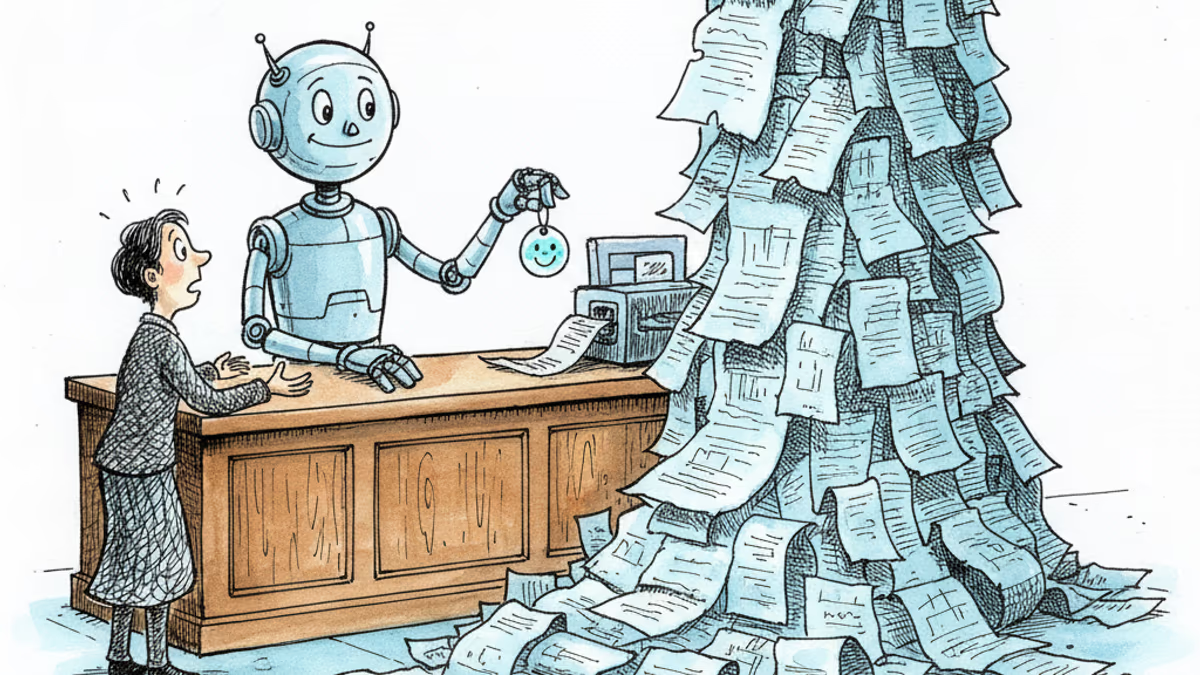
Anthropic shipped Claude Sonnet 5, its mid-tier agent model, on June 30. Behind the 'Opus-class power, budget price' headline sits a tokenizer catch and a three-horse race that's only half real. Here's what developers should actually run the numbers on.
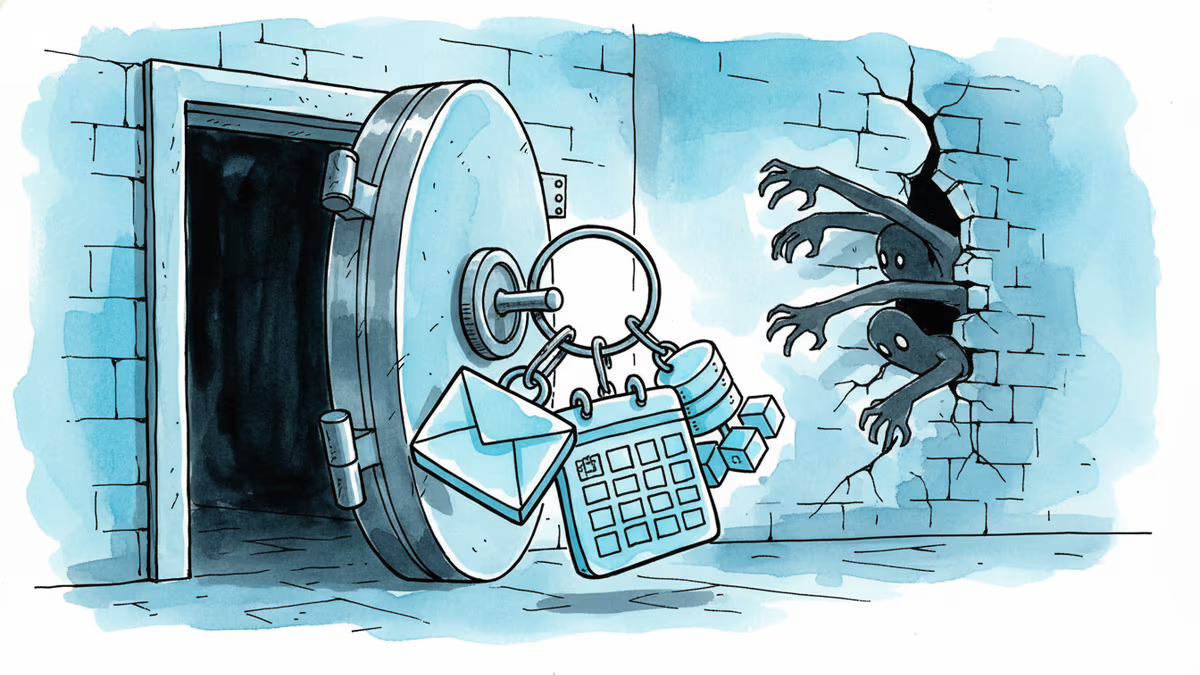
A critical vulnerability in Starlette—downloaded 325 million times per week—puts millions of AI agent servers at risk, exposing stored credentials for email, databases, and third-party services.
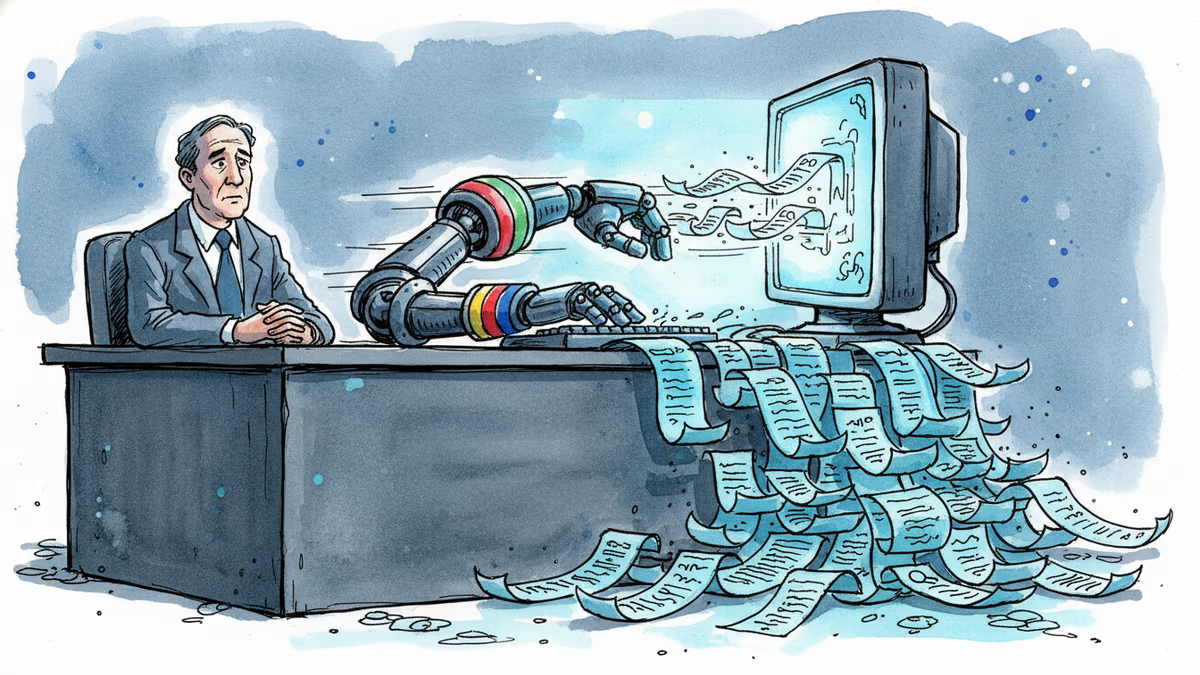
Google is building AI agents that search the web proactively, without user prompting. That's not just a product update — it's a fundamental shift in who controls the information you receive.

Filipino virtual assistants using AI to ghost-manage LinkedIn profiles for executives is now a structured industry. 30 comments a day, fake engagement rings, and a platform struggling to tell real from fabricated.
Anthropic shipped Claude Sonnet 5, its mid-tier agent model, on June 30. Behind the 'Opus-class power, budget price' headline sits a tokenizer catch and a three-horse race that's only half real. Here's what developers should actually run the numbers on.
A critical vulnerability in Starlette—downloaded 325 million times per week—puts millions of AI agent servers at risk, exposing stored credentials for email, databases, and third-party services.
Google is building AI agents that search the web proactively, without user prompting. That's not just a product update — it's a fundamental shift in who controls the information you receive.
Filipino virtual assistants using AI to ghost-manage LinkedIn profiles for executives is now a structured industry. 30 comments a day, fake engagement rings, and a platform struggling to tell real from fabricated.
Thoughts
Share your thoughts on this article
Sign in to join the conversation