
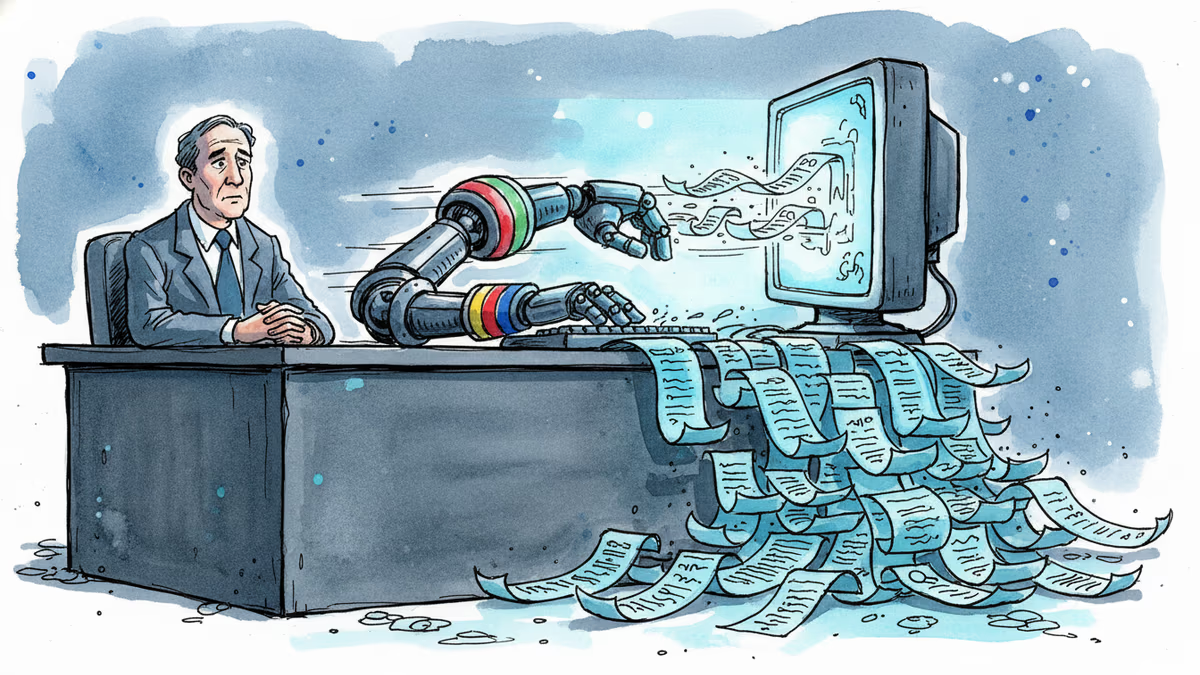
If Google Searches for You, Is It Still a Search Engine?
Google is building AI agents that search the web proactively, without user prompting. That's not just a product update — it's a fundamental shift in who controls the information you receive.
"Google it" has been a verb for over two decades. What happens when you're no longer the one doing the googling?
That's the quiet but consequential question at the center of Google's current AI push. The company is building toward a world where AI agents search the internet on your behalf — proactively, autonomously, and sometimes without you ever asking. You don't type a query. You don't click a link. The agent just... handles it.
It sounds convenient. It probably is. But it's worth slowing down to understand what's actually changing — and for whom.
What Google Is Actually Building
Google has been layering AI into search for years, but the current direction is more fundamental. Through Gemini and its expanding suite of AI features, the company is moving toward agents that don't just answer questions — they anticipate them. They monitor context, track preferences, and surface information before a user formulates a request.
The AI Overview feature, already rolling out in search results, is an early version of this shift: users get synthesized answers at the top of the page, often without needing to visit any underlying website. Traffic to publishers and content sites has dropped noticeably as a result for many outlets.
The next step — fully autonomous agents doing the searching in the background — extends this logic further. The user becomes a passive recipient of curated information rather than an active navigator of the web.
The Business Model Problem Nobody's Talking About
Here's the tension Google hasn't fully resolved: roughly 57% of its revenue in 2024 came from search advertising. That model is built on the moment a user types something into a search box. Advertisers pay to appear at that moment of intent.

If the agent handles the searching — if there's no search box moment — what does the ad model look like? Google hasn't given a clear public answer. The company is presumably working on one, but the transition from intent-based advertising to agent-mediated advertising is not a small engineering problem. It's a restructuring of how commercial attention works online.
Microsoft faces the same challenge with Copilot. Perplexity AI is building a subscription model that sidesteps ads entirely. OpenAI is experimenting with operator partnerships. Each is betting on a different answer to the same underlying question.
Three Stakeholders, Three Very Different Problems
For everyday users, the appeal is real. Less friction, faster answers, fewer rabbit holes. If an agent can handle your travel research, price comparisons, or background reading, that's time back in your day. The convenience case is strong.
For content creators and publishers, the picture is bleaker. The web's content ecosystem runs on traffic — visits that generate ad revenue or subscription conversions. AI agents that consume and summarize content without sending users to the source don't just reduce traffic; they potentially hollow out the economic incentive to produce original reporting, research, or analysis in the first place. The New York Times lawsuit against OpenAI is one early skirmish in what will likely be a longer legal and structural conflict.
For regulators, the concern is more systemic. An AI agent that decides what information you receive — without your active query — concentrates an enormous amount of editorial power in a single algorithm. The EU's Digital Markets Act and ongoing US antitrust scrutiny of Google were designed for a world where search was still a human-initiated act. Proactive AI agents may require an entirely different regulatory framework.
The Deeper Shift: From Map to Driver
Search engines were always analogous to maps — you decided where to go, they showed you how to get there. The AI agent model changes the metaphor. Now it's a driver who knows your habits, anticipates your destination, and takes you there without being asked.
That's not inherently sinister. But it does mean the relationship between a person and their information environment becomes more mediated, more opaque, and more dependent on the values embedded in the algorithm doing the driving.
History offers a useful reference point: when social media platforms shifted from chronological feeds to algorithmic ones around 2012–2016, the change was framed as a convenience upgrade. It took nearly a decade for the downstream effects on public discourse, mental health research, and political polarization to become widely understood. The timeline for understanding AI agent effects on how people form beliefs and make decisions is likely similar — or longer.
This content is AI-generated based on source articles. While we strive for accuracy, errors may occur. We recommend verifying with the original source.
Related Articles
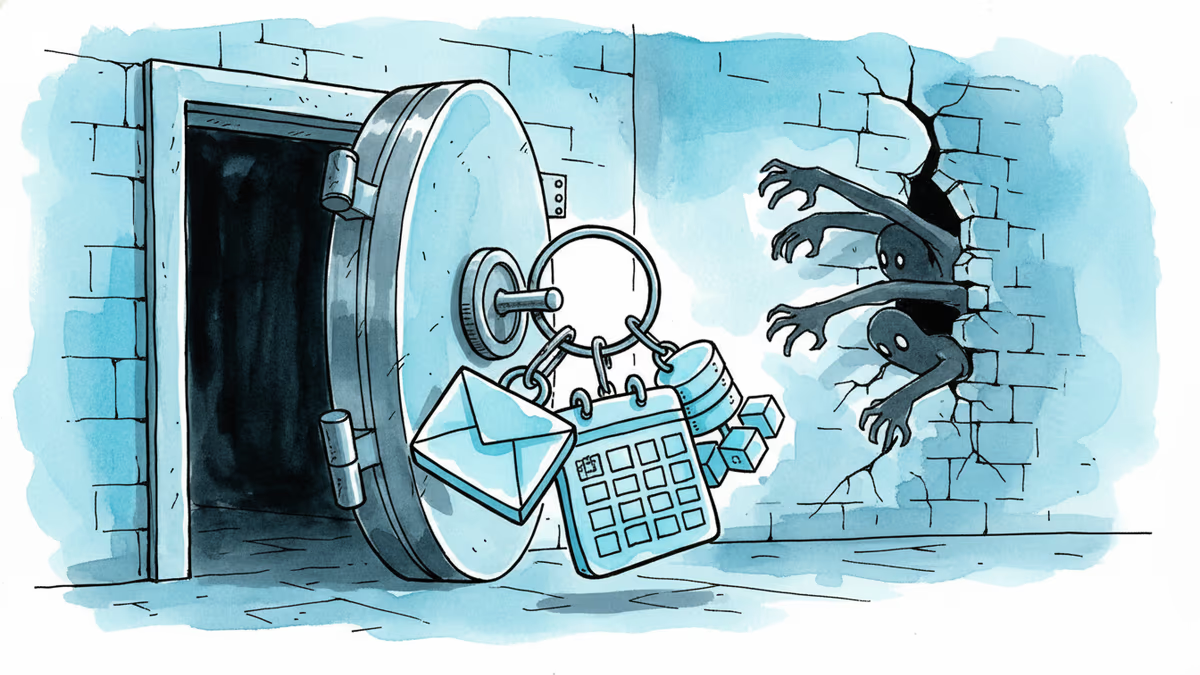
A critical vulnerability in Starlette—downloaded 325 million times per week—puts millions of AI agent servers at risk, exposing stored credentials for email, databases, and third-party services.
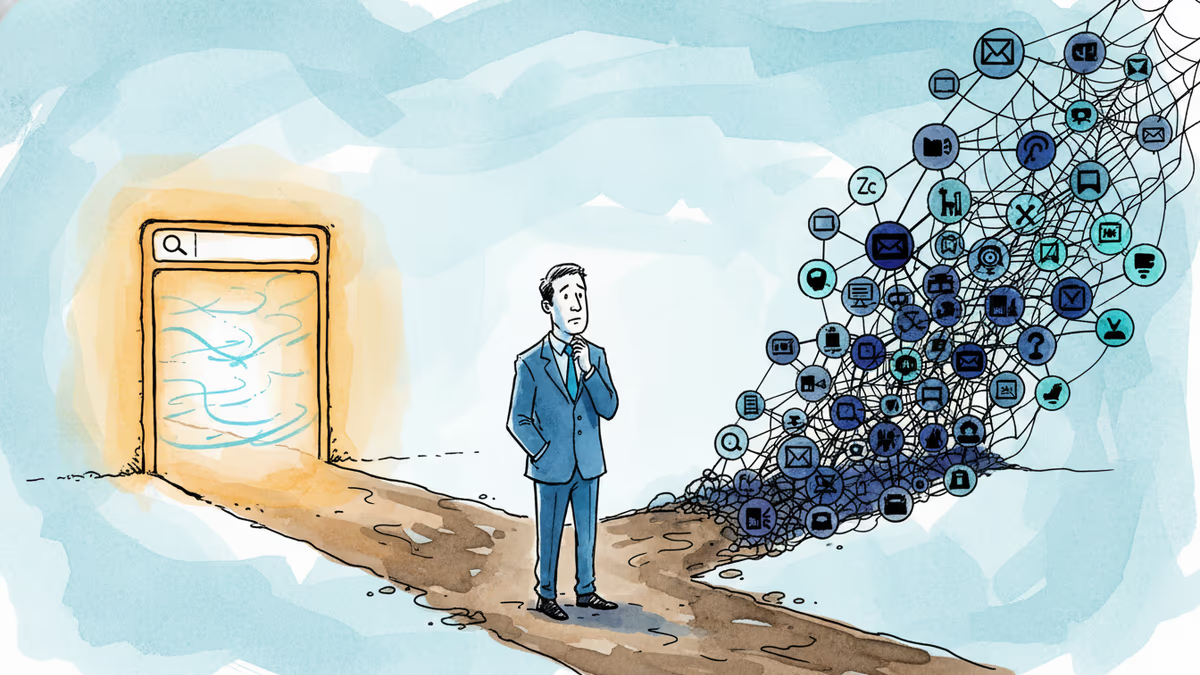
In a post-Google I/O interview, Sundar Pichai acknowledged flawed search results, real AI anxiety, and an AGI timeline that makes the label irrelevant. Here's what he said — and what it means.

A small but growing group of developers has gone all-in on AI coding agents like Claude Code and OpenClaw. History suggests the rest of us won't be far behind.

OpenAI has reorganized for the second time in a month, merging ChatGPT and Codex into a single agentic platform under president Greg Brockman's unified product leadership.
A critical vulnerability in Starlette—downloaded 325 million times per week—puts millions of AI agent servers at risk, exposing stored credentials for email, databases, and third-party services.
In a post-Google I/O interview, Sundar Pichai acknowledged flawed search results, real AI anxiety, and an AGI timeline that makes the label irrelevant. Here's what he said — and what it means.
A small but growing group of developers has gone all-in on AI coding agents like Claude Code and OpenClaw. History suggests the rest of us won't be far behind.
OpenAI has reorganized for the second time in a month, merging ChatGPT and Codex into a single agentic platform under president Greg Brockman's unified product leadership.
Thoughts
Share your thoughts on this article
Sign in to join the conversation