
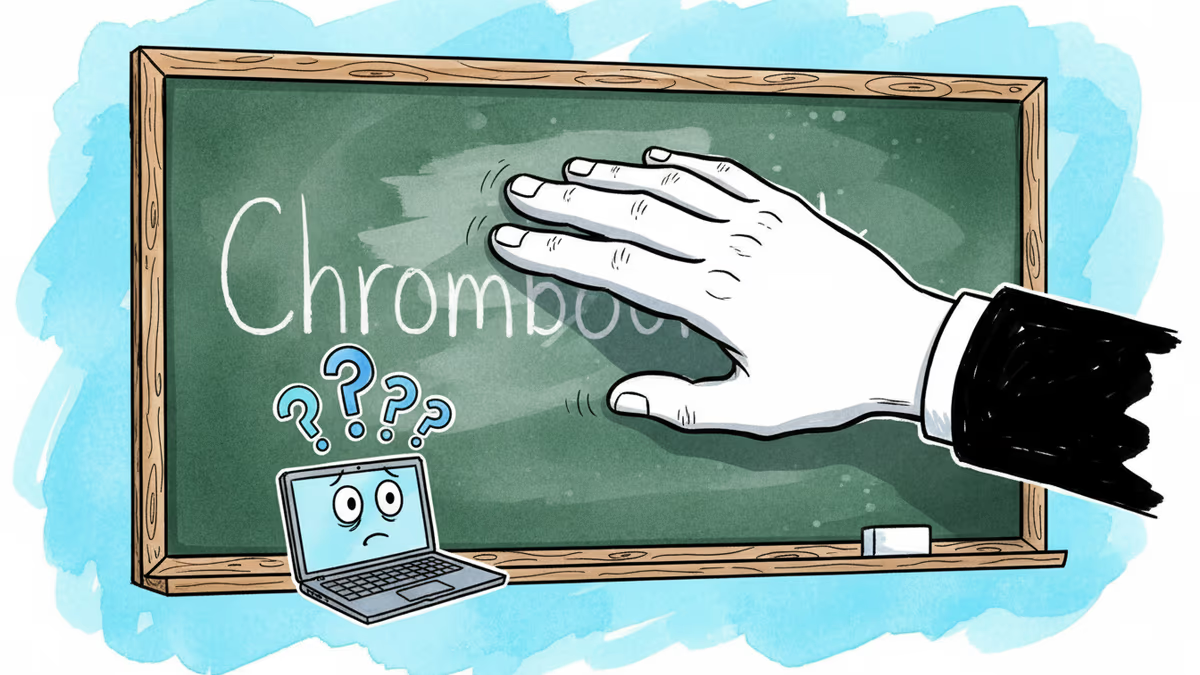
Google Killed Chromebook. Nobody Knows What Comes Next.
Google unveiled the 'Googlebook' platform to replace Chromebook and ChromeOS—but revealed zero hardware specs. What's the strategy, and what does it mean for users, manufacturers, and the education market?
Google just retired one of the most recognizable names in budget computing—and didn't bother telling anyone what replaces it, exactly.
What Google Actually Announced (And Didn't)
The new platform is called Googlebook. That's largely where the concrete information ends. No hardware specs. No pricing. No release timeline. Google announced a brand, not a product.
The timing is jarring because the industry had been anticipating something genuinely interesting: a unified OS, long rumored under the codename Aluminium, that would finally merge Android and ChromeOS into a single coherent platform. The promise was elegant—Android phones doubling as portable desktops when connected to a screen, Android tablets finally getting the software environment they've always lacked, and Chromebook laptops gaining broader app compatibility.
What arrived instead is a name change dressed up as a strategy.
Why Chromebook Mattered—And Why Losing It Stings
Chromebook wasn't just a product line. At its peak, it commanded over 60% of the U.S. K-12 education market. Cheap, fast to boot, easy to manage centrally—schools loved it. Manufacturers like Samsung, Acer, HP, and Lenovo built entire product divisions around ChromeOS. For many students, a Chromebook was their first laptop.

That ecosystem didn't happen by accident. It took years of Google convincing school districts, IT administrators, and budget-conscious consumers that a browser-first OS was enough. Rebranding to Googlebook without explaining what the platform actually is risks undermining that trust in one press release.
Three Groups, Three Very Different Reactions
The announcement lands differently depending on where you sit.
Hardware partners are in the most uncomfortable position. Companies that have built Chromebook lines need to know what Googlebook requires—different chips, different firmware certifications, different software layers? Without specs, investment decisions stall. The silence isn't neutral; it's expensive.
Developers and IT admins are asking a more immediate question: do we keep deploying ChromeOS devices right now, or do we wait? Enterprise and education buyers typically plan 12–18 months ahead. A platform transition with no roadmap is a procurement freeze in slow motion.
Consumers are mostly confused. The Chromebook brand had genuine recognition. Googlebook sounds like something a focus group rejected twice before someone's boss overruled them. Whether the name sticks—or becomes another entry in Google's long list of rebranded-then-abandoned products—depends entirely on what comes next.
The Ghost of Google's Graveyard
This is where context matters. Google+, Stadia, Inbox, Daydream VR—Google has a documented pattern of launching platforms, building user bases, and then walking away. Chromebook survived longer than most because it had institutional adoption: once schools buy in, they don't switch easily.
But Googlebook doesn't yet have that anchor. It's a brand without a body. If the follow-up announcement—actual hardware, actual specs, actual pricing—doesn't arrive within a few months, the vacuum will be filled by competitors. Microsoft has been quietly pushing affordable Windows laptops into the education space. Apple has made inroads with iPad-as-laptop narratives. Neither needs Google to stumble; they just need Google to hesitate.
This content is AI-generated based on source articles. While we strive for accuracy, errors may occur. We recommend verifying with the original source.
Related Articles
In a post-Google I/O interview, Sundar Pichai acknowledged flawed search results, real AI anxiety, and an AGI timeline that makes the label irrelevant. Here's what he said — and what it means.
Google is building AI agents that search the web proactively, without user prompting. That's not just a product update — it's a fundamental shift in who controls the information you receive.
After 15 years of fragmented mobile messaging, Apple and Google are rolling out end-to-end encrypted RCS messaging between iPhones and Android devices. Here's what changed, why it took so long, and what it means for your privacy.

Google is replacing Assistant with Gemini in cars with Google built-in, starting in the U.S. GM's 4 million vehicles are first. But the real story is what happens when your car becomes a Google device.
In a post-Google I/O interview, Sundar Pichai acknowledged flawed search results, real AI anxiety, and an AGI timeline that makes the label irrelevant. Here's what he said — and what it means.
Google is building AI agents that search the web proactively, without user prompting. That's not just a product update — it's a fundamental shift in who controls the information you receive.
After 15 years of fragmented mobile messaging, Apple and Google are rolling out end-to-end encrypted RCS messaging between iPhones and Android devices. Here's what changed, why it took so long, and what it means for your privacy.
Google is replacing Assistant with Gemini in cars with Google built-in, starting in the U.S. GM's 4 million vehicles are first. But the real story is what happens when your car becomes a Google device.
Thoughts
Share your thoughts on this article
Sign in to join the conversation