
Google Is Funding Its Own Rival — On Purpose
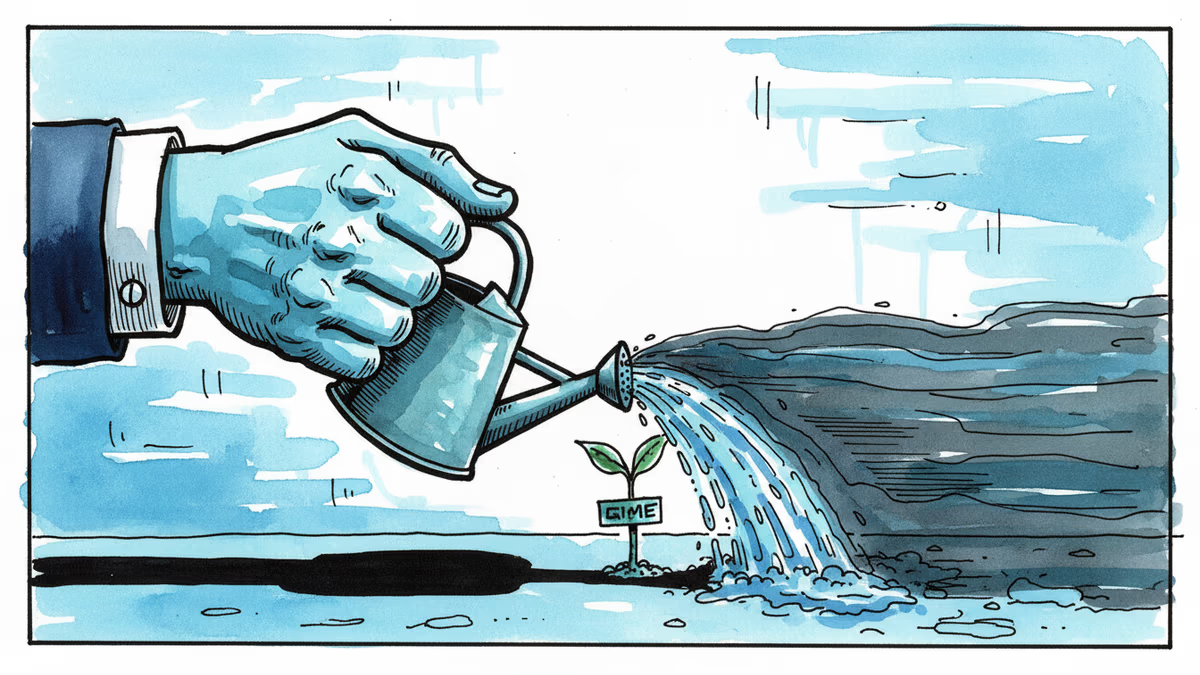
Google is committing up to $40 billion to Anthropic, a direct AI competitor. The deal reveals how the real AI arms race isn't about models — it's about who controls the infrastructure beneath them.
Imagine backing your fiercest rival with $40 billion — and having a perfectly rational reason for doing it. That's exactly where Google finds itself in the spring of 2026.
The Deal That Shouldn't Make Sense
According to Bloomberg, Google is committing up to $40 billion to Anthropic, the AI company behind the Claude family of models. The structure: $10 billion upfront, at a $350 billion valuation, with another $30 billion contingent on Anthropic hitting performance targets. That's not a passive financial bet — it's a structured partnership with strings attached.
On the surface, this is strange. Google runs Gemini. Anthropic runs Claude. They are competing for the same enterprise contracts, the same developer loyalty, the same share of the AI assistant market. Yet here is Google, writing some of the largest checks in tech history to keep its competitor well-fed.
The logic only clicks when you look at what Google gets in return. Anthropic is one of Google Cloud's most significant customers. It runs much of its infrastructure on Google's servers and relies heavily on Google's proprietary AI chips — TPUs (Tensor Processing Units) — which are among the few credible alternatives to Nvidia's GPUs. The new investment expands that arrangement: Google Cloud will now supply a fresh 5 gigawatts of computing capacity over the next five years, with room to scale further. Google isn't just an investor in Anthropic. It's the landlord.
Why Compute Is the Real Prize
The AI race is often framed as a battle of benchmarks — which model scores highest on reasoning tests, which one writes cleaner code. But that framing misses what's actually being fought over.
Anthropic made that clear in recent weeks. Users flooded social media with complaints about Claude's usage limits. The model was good enough; there just wasn't enough computing power to serve everyone who wanted it. The company scrambled: a data center deal with cloud provider CoreWeave, an additional $5 billion from Amazon as part of a broader agreement under which Anthropic is expected to spend up to $100 billion for roughly 5 gigawatts of capacity over time.

OpenAI has been running a parallel playbook — locking in multi-hundred-billion-dollar arrangements across cloud providers, chip suppliers, and energy companies. This month it expanded its deal with chipmaker Cerebras.
The pattern is consistent: the companies building frontier AI models are in a desperate scramble for raw computing capacity, and they're willing to sign almost any deal to get it. The constraint isn't talent or ideas. It's kilowatts and silicon.
Mythos, and the Risks That Come With Power
The timing of Google's investment is not coincidental. Earlier this month, Anthropic released its most powerful model yet — Mythos — to a limited group of partners. The company says Mythos has significant cybersecurity applications, which is precisely why it hasn't been released broadly. Evaluating and mitigating potential misuse takes time.
Except it may already be too late for that caution. Reports indicate that Mythos has already reached unsanctioned hands. A model explicitly designed with cybersecurity capabilities — and restricted because of misuse potential — is now reportedly circulating outside Anthropic's control. It's a preview of a problem the industry hasn't solved: how do you safely deploy something powerful enough to matter?
Three Ways to Read This Deal
For investors, the numbers are striking. Anthropic's valuation sat at $350 billion as recently as February. By April, Bloomberg reports that backers are eager to invest at $800 billion or more. An IPO is reportedly being considered for as early as October. The trajectory is steep — but so is the capital required to sustain it.
For regulators, the structure raises harder questions. Google is simultaneously a competitor to Anthropic in the AI model market and its most critical infrastructure provider. That dual role creates leverage that antitrust authorities in the US and EU are increasingly attuned to. If Google can shape the terms on which Anthropic accesses TPUs or cloud capacity, it holds influence over a rival that no amount of investment paperwork fully neutralizes. The Microsoft-OpenAI relationship drew similar scrutiny; this one may too.
For developers and enterprises building on top of these models, the consolidation is both reassuring and unsettling. More capital means more reliability, fewer outages, higher rate limits. But it also means the foundational layer of the AI stack is being controlled by an ever-smaller group of companies — each with their own strategic interests.
Authors
Related Articles
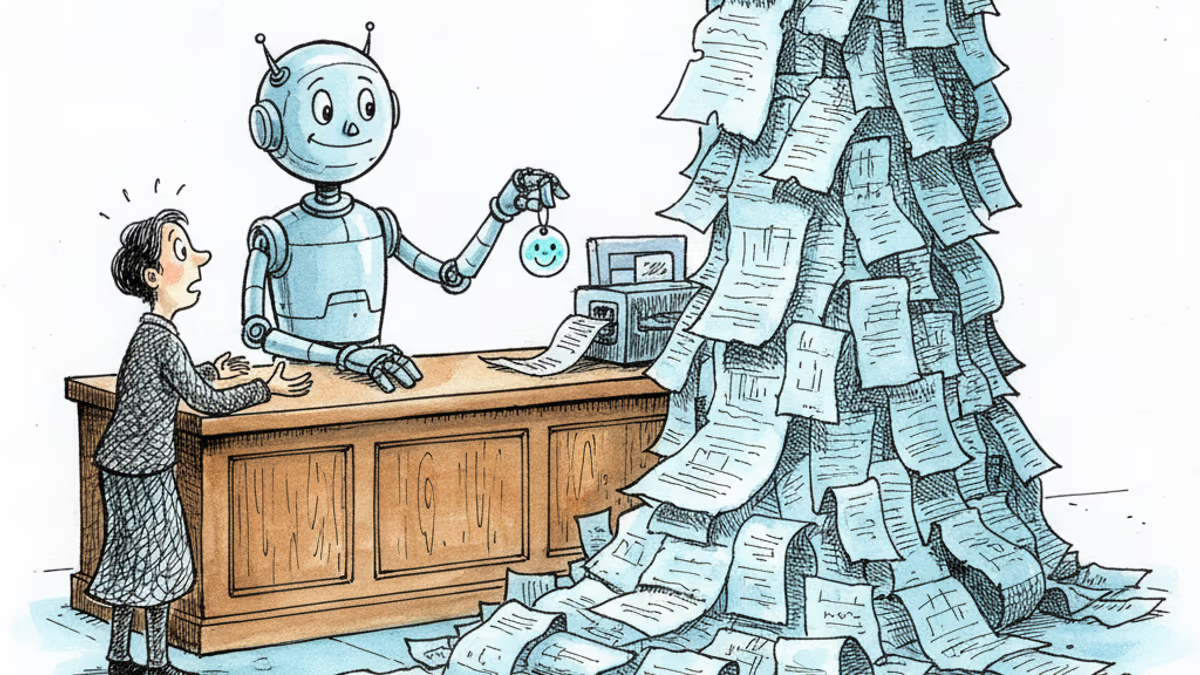
Anthropic shipped Claude Sonnet 5, its mid-tier agent model, on June 30. Behind the 'Opus-class power, budget price' headline sits a tokenizer catch and a three-horse race that's only half real. Here's what developers should actually run the numbers on.

Samsung and SK unveiled a chip and AI investment package worth thousands of trillions of won on June 29. The headline number swings wildly by outlet, but the real contest isn't capital — it's water and power.
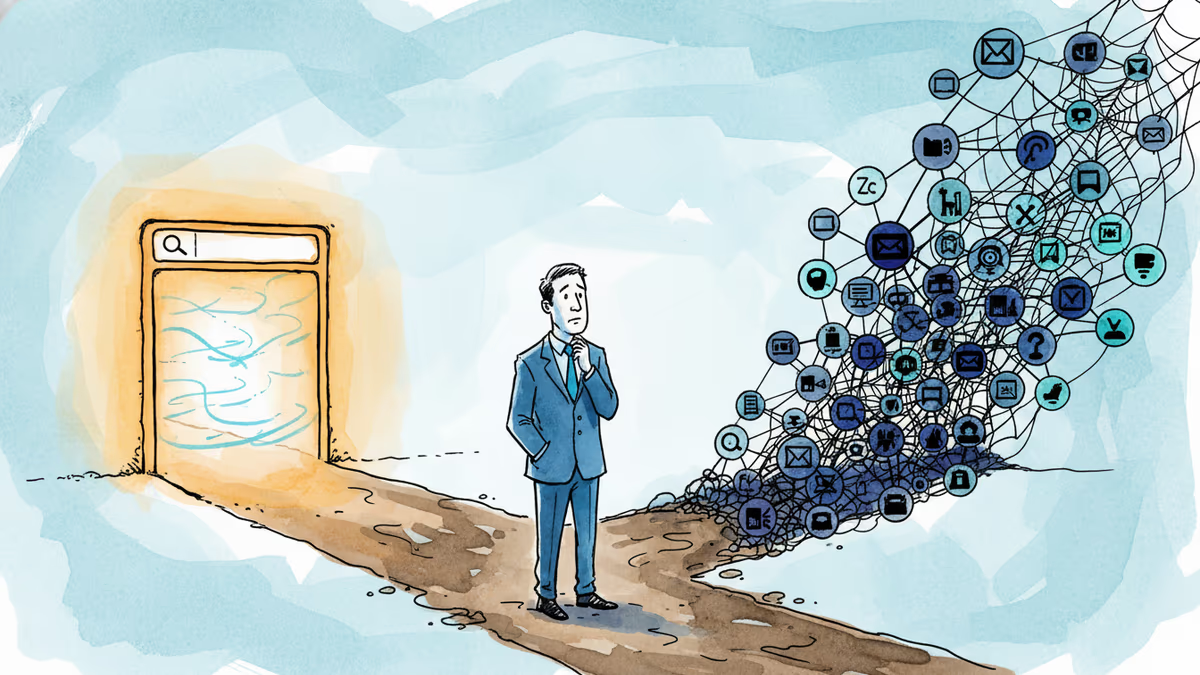
In a post-Google I/O interview, Sundar Pichai acknowledged flawed search results, real AI anxiety, and an AGI timeline that makes the label irrelevant. Here's what he said — and what it means.
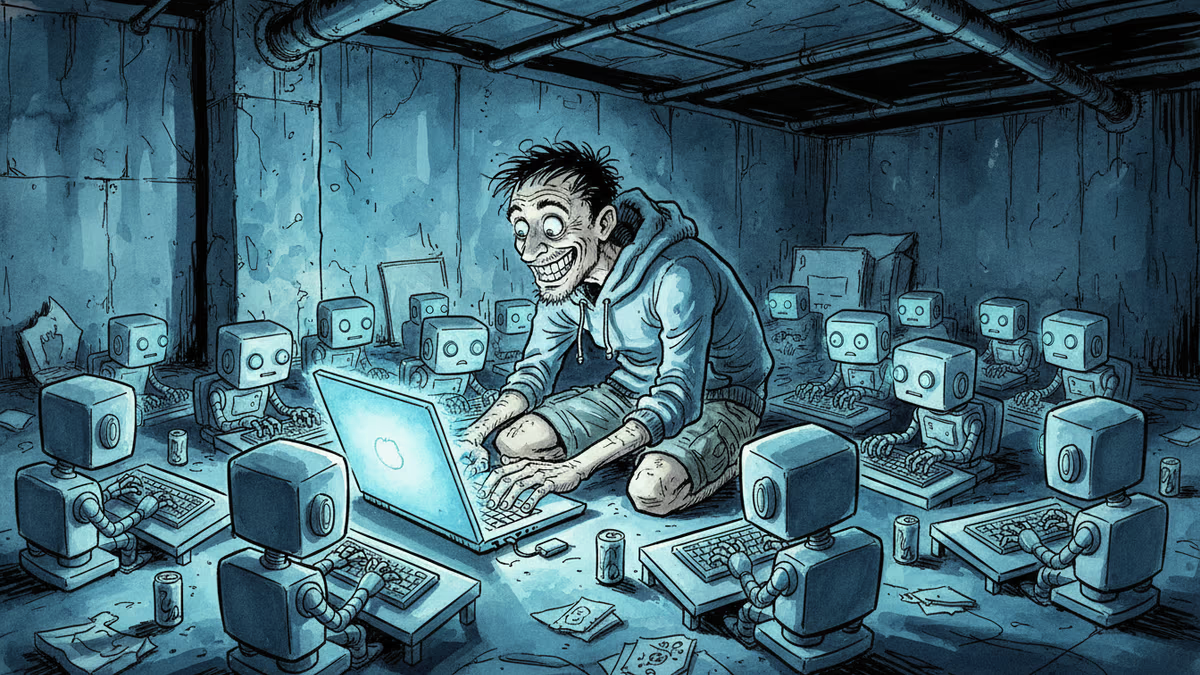
A small but growing group of developers has gone all-in on AI coding agents like Claude Code and OpenClaw. History suggests the rest of us won't be far behind.
Anthropic shipped Claude Sonnet 5, its mid-tier agent model, on June 30. Behind the 'Opus-class power, budget price' headline sits a tokenizer catch and a three-horse race that's only half real. Here's what developers should actually run the numbers on.
Samsung and SK unveiled a chip and AI investment package worth thousands of trillions of won on June 29. The headline number swings wildly by outlet, but the real contest isn't capital — it's water and power.
In a post-Google I/O interview, Sundar Pichai acknowledged flawed search results, real AI anxiety, and an AGI timeline that makes the label irrelevant. Here's what he said — and what it means.
A small but growing group of developers has gone all-in on AI coding agents like Claude Code and OpenClaw. History suggests the rest of us won't be far behind.
Thoughts
Share your thoughts on this article
Sign in to join the conversation