
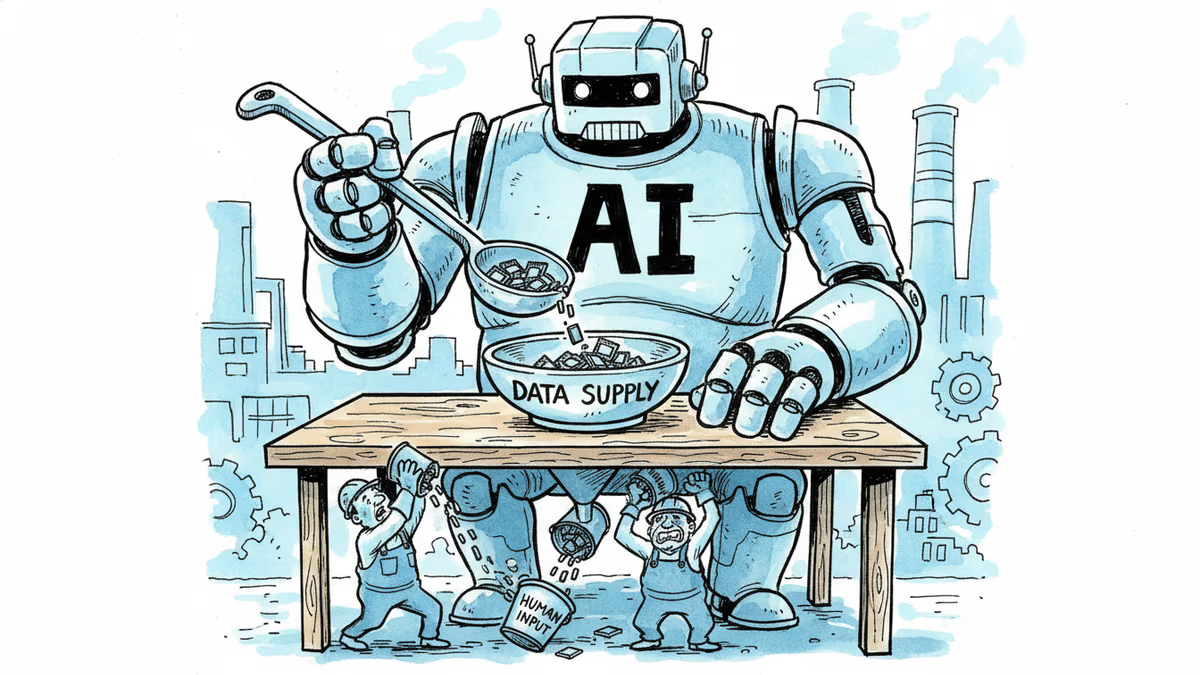
AI Is Eating All the DRAM—And There's No Quick Fix
Memory makers can't build fabs fast enough. By end of 2027, supply will cover just 60% of demand. Here's why the shortage could last until 2030—and what it means for AI, your devices, and the chip industry.
By the end of 2027, the world's memory chip makers will be able to supply just 60% of what the market demands. And according to SK Group's chairman, the shortage might not resolve until 2030.
This isn't a supply chain hiccup. It's a structural mismatch—and AI built it.
The Math Is Unforgiving
Samsung, SK Hynix, and Micron collectively control the overwhelming majority of global DRAM production. All three are racing to add capacity. The problem? Almost none of their new fabs will be operational before 2027, with most coming online in 2028 or later. The sole exception: SK Hynix opened a facility in Cheongju this past February—the only meaningful production increase among the big three for all of 2026.
According to Nikkei Asia, closing the gap would require output to grow by 12% per year in both 2026 and 2027. That's a steep climb, especially when building a leading-edge fab typically takes three to four years from groundbreaking to first wafer. The industry can't sprint its way out of this.
The demand surge traces back, almost entirely, to AI. A single Nvidia AI server rack consumes memory at a scale that would have seemed absurd five years ago. HBM (High Bandwidth Memory)—the specialized DRAM stacked directly onto AI chips—has seen demand outpace forecasts by wide margins. Every time a model scales up, the memory appetite scales with it.
Who Wins, Who Waits, Who Worries

For Samsung and SK Hynix, a prolonged shortage isn't purely bad news. Tight supply means pricing power. Memory has historically been a brutal commodity cycle—boom, bust, repeat. Right now, the boom phase has unusual staying power, which translates into stronger margins for producers who can actually ship.
For the companies buying that memory, it's a different story. Microsoft, Google, Amazon, and every AI startup building infrastructure are staring at a hard constraint on how fast they can expand. This is partly why hyperscalers have been pouring money into designing their own chips—not just for performance, but to reduce dependence on a supply chain they can't control.
For everyday consumers, the effects are more diffuse but real. Laptop and smartphone memory prices have been relatively stable, but if AI infrastructure continues to vacuum up DRAM capacity, the downstream pressure on consumer devices could build. Cloud service costs, which ultimately reflect infrastructure expenses, may be slower to fall than they otherwise would.
Governments have noticed too. The US CHIPS Act, Japan's Rapidus project, and South Korea's planned semiconductor cluster in Yongin all aim to diversify production and reduce geographic concentration. But here's the irony: the timelines on every one of these initiatives point to 2028 and beyond—which means they won't meaningfully address the current crunch.
The Cycle Nobody Talks About
There's a pattern worth watching. Every major chip shortage in recent memory—automotive semiconductors in 2021, NAND flash in the mid-2010s—eventually resolved. And in several cases, it resolved with a whipsaw: too much supply arrived all at once, prices collapsed, and manufacturers who had bet big on sustained demand were left holding the bill.
The current buildout is happening across multiple continents simultaneously. When the new fabs do come online—likely in a compressed window around 2028—the question becomes whether AI demand will have grown enough to absorb all of it. Proponents argue the AI infrastructure buildout is still in its early innings. Skeptics point to historical overinvestment patterns and ask whether the current pace of AI model scaling is sustainable.
Authors
Related Articles
Samsung and SK unveiled a chip and AI investment package worth thousands of trillions of won on June 29. The headline number swings wildly by outlet, but the real contest isn't capital — it's water and power.

The US government invested $2 billion in quantum computing startups, but Congress says the money was never authorized for that purpose. The fate of IBM-backed Anderon hangs in the balance.

Viral videos show 2026 graduates jeering executives who praise AI at commencement ceremonies. It's not just rudeness — it's a signal about who pays for technological optimism.
Beijing added an Nvidia gaming chip to its customs ban list the same week Jensen Huang visited China with Trump. Here's what it means for the chip war—and who actually wins.
Samsung and SK unveiled a chip and AI investment package worth thousands of trillions of won on June 29. The headline number swings wildly by outlet, but the real contest isn't capital — it's water and power.
The US government invested $2 billion in quantum computing startups, but Congress says the money was never authorized for that purpose. The fate of IBM-backed Anderon hangs in the balance.
Viral videos show 2026 graduates jeering executives who praise AI at commencement ceremonies. It's not just rudeness — it's a signal about who pays for technological optimism.
Beijing added an Nvidia gaming chip to its customs ban list the same week Jensen Huang visited China with Trump. Here's what it means for the chip war—and who actually wins.
Thoughts
Share your thoughts on this article
Sign in to join the conversation